
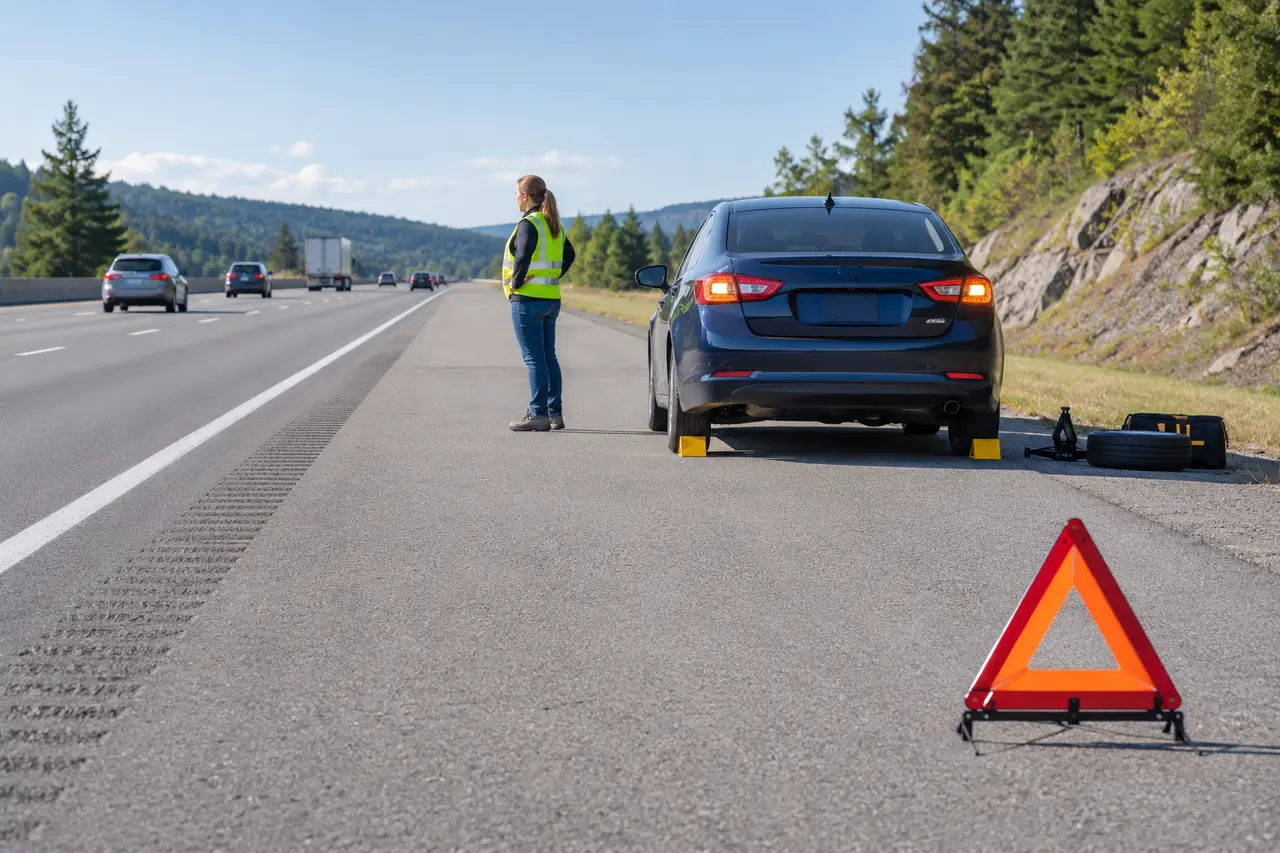
Change a tire roadside only when the vehicle is well away from moving traffic on firm, level ground with clear visibility. Stay in a protected location and call roadside or emergency services when the shoulder is narrow, the surface is unstable, or traffic passes close to the vehicle.
Roadside safety begins before the jack comes out. The immediate objective is to control the vehicle and reach the safest nearby stopping place without abrupt steering or braking. A damaged tire and wheel can often be replaced. A traffic collision or fallen vehicle can cause irreversible harm.
Where Is It Safe to Stop?
A parking lot, rest area, side street, or wide paved turnout is usually preferable to a highway shoulder. The site needs enough distance from traffic for doors, tools, the removed wheel, and the person working. It also needs a firm surface under the jack and every remaining tire.
| Location condition | Risk | Safer response |
|---|---|---|
| Wide, level paved area | Lower traffic and jack risk | Assess vehicle and follow the manual |
| Narrow high-speed shoulder | Traffic can enter the work area | Stay protected and request assistance |
| Curve, hill crest, bridge, or tunnel | Drivers may not see the vehicle in time | Contact emergency services as appropriate |
| Slope, gravel, mud, sand, or ice | Vehicle or jack can slide or sink | Move to firm level ground or arrange a tow |
| Floodwater, fire, smoke, or collision debris | Immediate environmental danger | Move away and call emergency services |
Do not stop just beyond a blind curve or over the crest of a hill. Do not assume that the painted shoulder line protects the work area. If possible, position the damaged side away from traffic, but do not cross active lanes or make another hazardous maneuver to achieve that position.
How Should You Respond When the Tire Fails?
Hold the steering wheel firmly. Ease off the accelerator and avoid abrupt braking or steering. Allow the vehicle to slow in a controlled manner, activate the hazard lights, and move toward the safest available stopping location. Vehicle behavior varies with the type and severity of failure, so remain focused on direction and surrounding traffic.
Driving on a deflated tire can damage the tire, wheel, and nearby components. The need to limit damage does not justify stopping in an immediately dangerous position. Travel only as far as necessary to reach a safer place when the vehicle remains controllable.
How Do You Secure the Vehicle Before Lifting?
Switch on the hazard lights. Place an automatic transmission in Park or use the manual-specified gear for a manual transmission. Apply the parking brake fully. Turn off the engine unless the vehicle instructions require another state for roadside support.
Place purpose-made wheel chocks according to the owner’s manual, commonly at the wheel diagonally opposite the flat. Chock both sides of the tire when the equipment and instructions support it. Never depend on loose rocks, bottles, or cargo that can roll or crush.
Remove the spare and tools before raising the vehicle. This prevents rocking the raised vehicle while opening a hatch, moving seats, or pulling a spare from a carrier. Place equipment on the side away from traffic without creating a trip hazard.
Where Should Passengers and Pets Wait?
Keep everyone away from traffic and away from the raised vehicle. A protected area behind a substantial barrier may be appropriate when it can be reached without crossing traffic. In other settings, remaining belted inside the vehicle may provide more protection than standing on an exposed shoulder. The roadway, barrier, traffic direction, weather, and emergency guidance determine the safer choice.
Children and pets require direct supervision. Do not allow anyone to sit in, lean on, or enter a vehicle while it is supported by a jack. Additional movement can destabilize the setup.
How Should Warning Devices Be Used?
Hazard lights alert other road users but do not establish a work zone. Reflective vests, triangles, flares, and lamps may improve visibility. Their legality and placement requirements vary. Follow local rules and the device instructions.
Do not walk along an exposed traffic lane to place a triangle. Do not use a flame-producing flare near spilled fuel, dry vegetation, or another fire risk. Visibility equipment supports a safe location; it cannot compensate for insufficient separation from traffic.
What Weather Conditions Make a Tire Change Unsafe?
Ice can allow the jack base and tires to slide. Soft ground can let the jack sink. Heavy rain reduces grip and visibility, while flowing water can conceal pavement damage. Strong wind can move loose equipment and affect balance. Lightning creates an outdoor electrical hazard.
Night work requires reliable lighting that illuminates the lift point, fasteners, and walking surface. A headlamp leaves both hands free. Avoid pointing bright lights into traffic. If weather or darkness prevents a stable, visible setup, wait in a protected location for professional help.
How Do You Use a Jack Safely at the Roadside?
Read the vehicle and jack instructions. Position the jack only at the approved reinforced lift point. Keep the base flat and fully supported. Loosen the wheel fasteners slightly before lifting so the required force does not rock the raised vehicle.
Raise the vehicle only enough to remove the flat and fit the spare. Watch the jack and vehicle as they rise. Stop if either shifts, leans, sinks, or makes unexpected contact. Never place hands, feet, a head, or another body part beneath the vehicle. An emergency jack supports a wheel change, not under-vehicle repair.
Keep the removed wheel beside the work area without putting it under the vehicle if doing so requires reaching beneath. Follow the manual’s specific instructions. The priority is to maintain a safe body position outside the fall zone.
How Do You Stay Clear of Traffic?
Work from the side away from moving traffic whenever the vehicle position and wheel location allow it. Do not stand with your back in a traffic lane. Keep tools close so they do not roll toward the roadway. Wear clothing that supports visibility without loose parts that can catch on equipment.
If the flat is on the traffic side and there is not enough separation to work fully outside the lane, do not proceed. A service truck with warning equipment cannot eliminate every traffic risk either, and the provider may arrange a tow to a safer location.
When Should You Call for Help Immediately?
- Traffic exposure: the vehicle or working position is close to an active lane.
- Unstable ground: the surface is sloped, broken, loose, soft, icy, or flooded.
- Limited visibility: the vehicle sits on a curve, hill, bridge, tunnel, or dark unlit area.
- Severe conditions: heavy precipitation, lightning, strong wind, smoke, or extreme temperature creates added risk.
- Vehicle damage: the wheel, suspension, steering, brakes, or body appears damaged.
- Equipment problem: the jack, wrench, wheel-lock key, spare, or chocks are missing or unusable.
- Personal limit: pain, illness, poor balance, fatigue, or uncertainty prevents controlled work.
What Information Should You Give Roadside Assistance?
Provide the road name, travel direction, nearest exit or intersection, mile marker, and GPS location when available. Describe the vehicle color, make, model, and license information requested by the dispatcher. State which tire is damaged and whether a spare and wheel-lock key are present.
Identify immediate hazards first, including a blocked lane, bridge, tunnel, curve, leaking fluid, smoke, injuries, or collision damage. Contact emergency services rather than ordinary roadside service when people are injured or traffic is in immediate danger.
What Safety Checks Follow the Tire Change?
Lower the vehicle according to the manual and tighten fasteners in the specified sequence and torque. Confirm the spare’s pressure. Collect the jack, wrench, chocks, warning devices, damaged wheel, and loose parts before moving the vehicle.
Read the spare tire’s speed, distance, and position restrictions. Enter traffic only when a safe gap is available. Drive smoothly to professional service and have the damaged tire, wheel, and fastener torque checked.
Use the complete tire-change instructions only after the safety conditions are met. Prepare the correct tire-changing tools and decide whether DIY is appropriate before beginning. A delayed professional response is safer than an immediate tire change in a dangerous location.
Quick answers
Frequently Asked Questions
Is it safe to change a tire on the highway shoulder?
Only when the vehicle is completely away from moving traffic on a wide, firm, level area with adequate visibility. A narrow shoulder, curve, bridge, or high-speed traffic exposure is unsafe. Stay protected and request assistance.
Should passengers stay inside during a tire change?
Passengers should move to the safest available protected location away from traffic and the raised vehicle. The correct location depends on the roadway and surroundings. Follow emergency-service instructions when the vehicle is exposed.
Where should wheel chocks be placed?
Follow the owner’s manual. A common instruction is to chock the wheel diagonally opposite the flat tire, using both sides when the chock design permits. Chocks supplement the parking brake; they do not make a slope safe.
Can you change a tire in rain or snow?
Only when the location remains firm, level, visible, and away from traffic. Heavy rain, snow, ice, wind, lightning, flooding, and low visibility can make lifting unstable or expose the driver to additional danger.
What should you do if the jack starts leaning?
Stop immediately and keep everyone away from the vehicle. Do not reach beneath it. Lower the vehicle carefully only when that can be done from a safe position, then reposition on suitable ground or request professional help.