
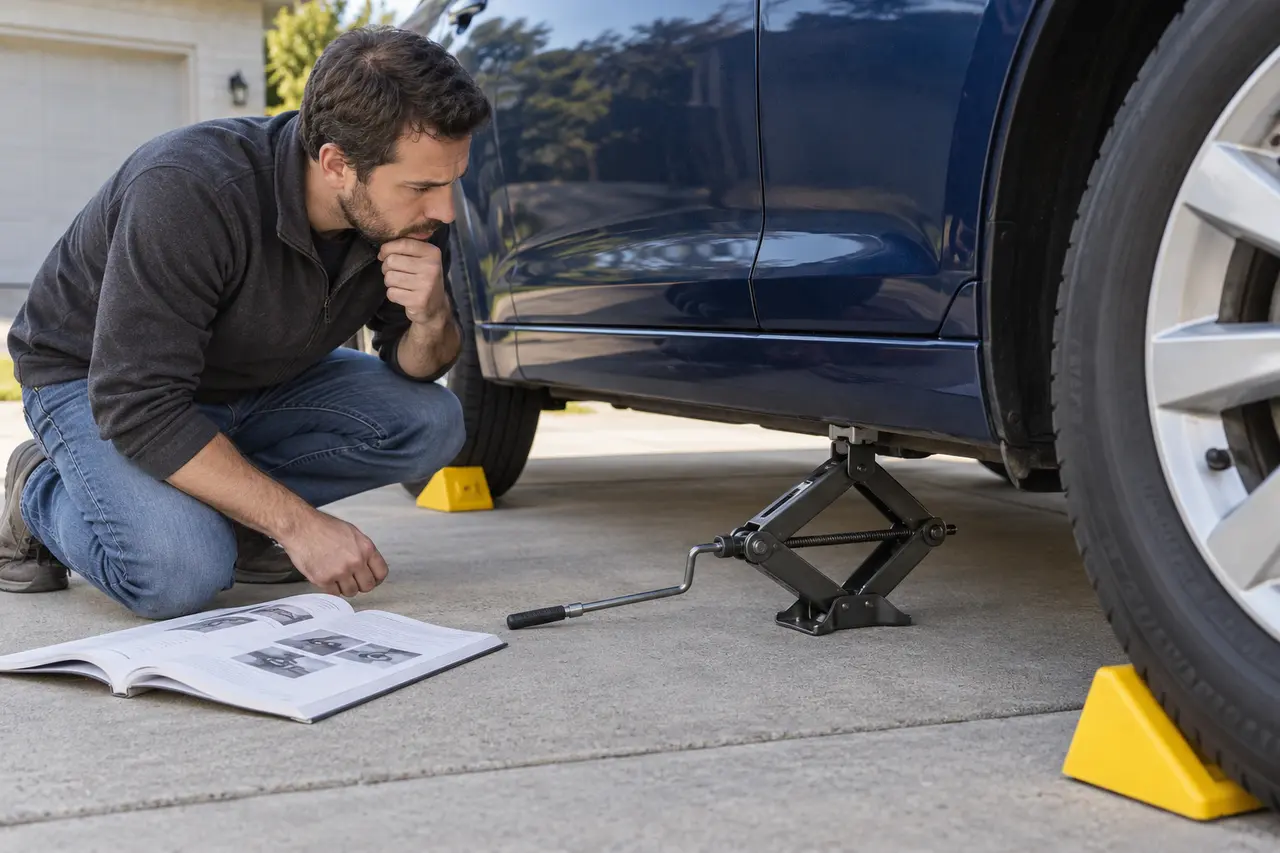
Stop turning or pumping when a jack will not raise the car normally. Secure the vehicle, remove the load from the jack if possible, and check the lift point, handle connection, release valve, capacity, range, base, screw, and hydraulic condition.
A jack may fail because it is not contacting the vehicle, has reached its mechanical range, is incorrectly assembled, is overloaded, or is damaged. More force is not a safe diagnostic method.
What Should You Do First?
Keep everyone away from the vehicle and do not reach underneath. If the saddle has not taken load, lower or retract it and inspect. If the jack is holding partial load, avoid movement and request help when controlled lowering is uncertain.
Keep the vehicle on firm, level ground away from traffic. Apply the parking brake, use the correct transmission position, and place wheel chocks. Do not enter the space beneath a vehicle supported only by an emergency jack. If the car is exposed to moving traffic, stay protected and request roadside assistance.
What Commonly Causes This Problem?
Scissor and hydraulic jacks fail in different ways, so identify the design before testing.
| Possible cause | What you may notice | Safe response |
|---|---|---|
| Wrong lift point | Saddle contacts trim or unsupported metal | Retract and locate the approved point |
| Insufficient range | Jack reaches extension limit before clearance | Use compatible equipment; do not stack blocks |
| Loose handle connection | Handle turns without driving mechanism | Assemble the complete handle correctly |
| Scissor screw damage | Threads bind, skip, or appear bent | Remove the jack from service |
| Open floor-jack valve | Handle pumps but saddle does not rise | Close valve according to instructions |
| Hydraulic leak or air | Jack drifts, leaks, or feels spongy | Remove from service and follow maintenance guidance |
| Insufficient capacity | Tool strains or label rating is too low | Use correctly rated equipment |
How Can You Diagnose It Without Causing More Damage?
Read the jack label and vehicle lifting section. Confirm orientation and minimum height. Inspect the base, saddle, arms, pivots, screw, wheels, handle, release valve, and visible fluid. Test unloaded operation only as the instructions allow. Never put a hand under a partially supported vehicle.
Use adequate lighting and inspect from beside the vehicle. Compare the tool, fastener, jack, spare, or wheel position with the owner’s manual. Stop the test when a component slips, deforms, cracks, leans, binds, leaks, or requires uncontrolled force. A diagnosis is useful only when it does not turn a manageable wheel problem into damaged hardware or an unstable vehicle.
What Is the Safest Resolution?
Correct only simple setup issues while the jack is unloaded. Align the saddle with the approved point, assemble the handle, and close a hydraulic release valve gently. A bent, leaking, cracked, skipping, or overloaded jack should be replaced or professionally serviced.
Work in small, controlled stages and recheck the setup after each change. Use only tools designed for the component. Do not substitute a close socket size, an undersized jack, stacked blocks, improvised extensions, or force applied from an unstable body position. Follow model-specific instructions whenever they differ from this general guidance.
Can You Solve It at the Roadside?
A failed factory jack normally ends the roadside wheel change. Do not borrow an unknown jack or build height with loose materials. Call a provider with compatible lifting equipment.
A parking area or driveway permits more controlled assessment than a shoulder. Road noise, passing vehicles, poor light, rain, snow, wind, soft ground, and limited working space reduce the margin for error. A solution that may be reasonable in a garage can be inappropriate beside traffic. Safety determines whether the task continues.
Which Tools May Be Needed?
Diagnosis needs the manual, adequate lighting, wheel chocks, and the jack instructions. Hydraulic service may require specified fluid and bleeding procedures, but this should be completed without a vehicle load and within manufacturer guidance.
Inspect every tool before loading it. The socket must fit fully, the jack must match the lift point and load, and the spare must be compatible and inflated. Keep the wheel-lock key with the lug wrench. Review the emergency tire change kit before a trip rather than assembling equipment during a breakdown.
What Should You Avoid?
- Do not add pipe leverage: a binding screw or pump can fail suddenly.
- Do not stack blocks: extra height creates an unstable base.
- Do not exceed the rating: overload can deform or collapse the jack.
- Do not crawl underneath: the jack is not a stand.
- Do not keep using a leaking jack: loss of pressure can lower the vehicle.
- Do not bypass the lift point: body and battery damage can result.
Improvised force can damage wheel studs, bolts, nuts, wheels, brakes, lift points, or body structure. It can also move the vehicle off the jack. When an action feels uncontrolled, stop and change the plan rather than increasing force.
When Should You Call Roadside Assistance?
Call when the jack holds any uncertain load, cannot lower safely, leaks, leans, sinks, binds, lacks range, or is not compatible with the vehicle. Keep people clear while waiting.
Tell the provider the exact location, vehicle model, affected wheel, spare status, wheel-lock status, and visible damage. State traffic exposure, collision damage, smoke, leaking fluid, or an unstable vehicle first. A provider may install a usable spare, use specialized removal equipment, or tow the vehicle to a tire or repair facility.
What Happens After the Immediate Problem Is Solved?
Replace or service the jack according to manufacturer instructions. Inspect the lift point for deformation. If the vehicle dropped or shifted, have the wheel, suspension, brake, body, and underbody checked.
Final wheel installation requires clean mating surfaces, sound fasteners, the specified tightening sequence, and the manufacturer’s torque. Check spare pressure and follow every temporary-spare speed, distance, and position limit. Have uncertain damage inspected before returning to normal driving.
How Can You Prevent the Same Problem?
Operate the unloaded jack periodically, inspect its complete handle, store it dry, and confirm capacity and range. Hydraulic jacks require fluid, seal, wheel, and valve maintenance. Practice lift-point alignment on level private property.
Practice the equipment on private, level ground. Confirm wrench fit, wheel-lock-key location, jack operation, spare pressure, and lift points. Regular preparation reduces surprises, but it does not justify roadside work when the location is unsafe.
Which Related Tire Problems Should You Understand?
A wheel change can stop at several connected points. Use these guides to identify the next safe action:
Return to the complete tire-change guide only after this problem is resolved. The normal sequence should not continue with damaged parts, missing equipment, an unstable lift, or a wheel that cannot be secured correctly.
Quick answers
Frequently Asked Questions
Why does my scissor jack turn but not lift?
The screw or handle connection may be damaged, the arms may be at their limit, or the saddle may not be contacting the point correctly..
Why does a floor jack pump but not rise?
The release valve may be open, fluid may be low, air may be present, or hydraulic seals may be failing..
Can you put blocks under a jack for more height?
Do not use improvised blocks. They can split, shift, or make the jack unstable. Use compatible equipment with adequate range.
What if the jack starts lowering by itself?
Keep everyone clear, do not go beneath the vehicle, lower it in a controlled way if safe, and remove the jack from service..
Can roadside assistance lift a car when the factory jack fails?
Yes. Providers carry lifting equipment, although towing may be required when the location or vehicle condition is unsafe.