
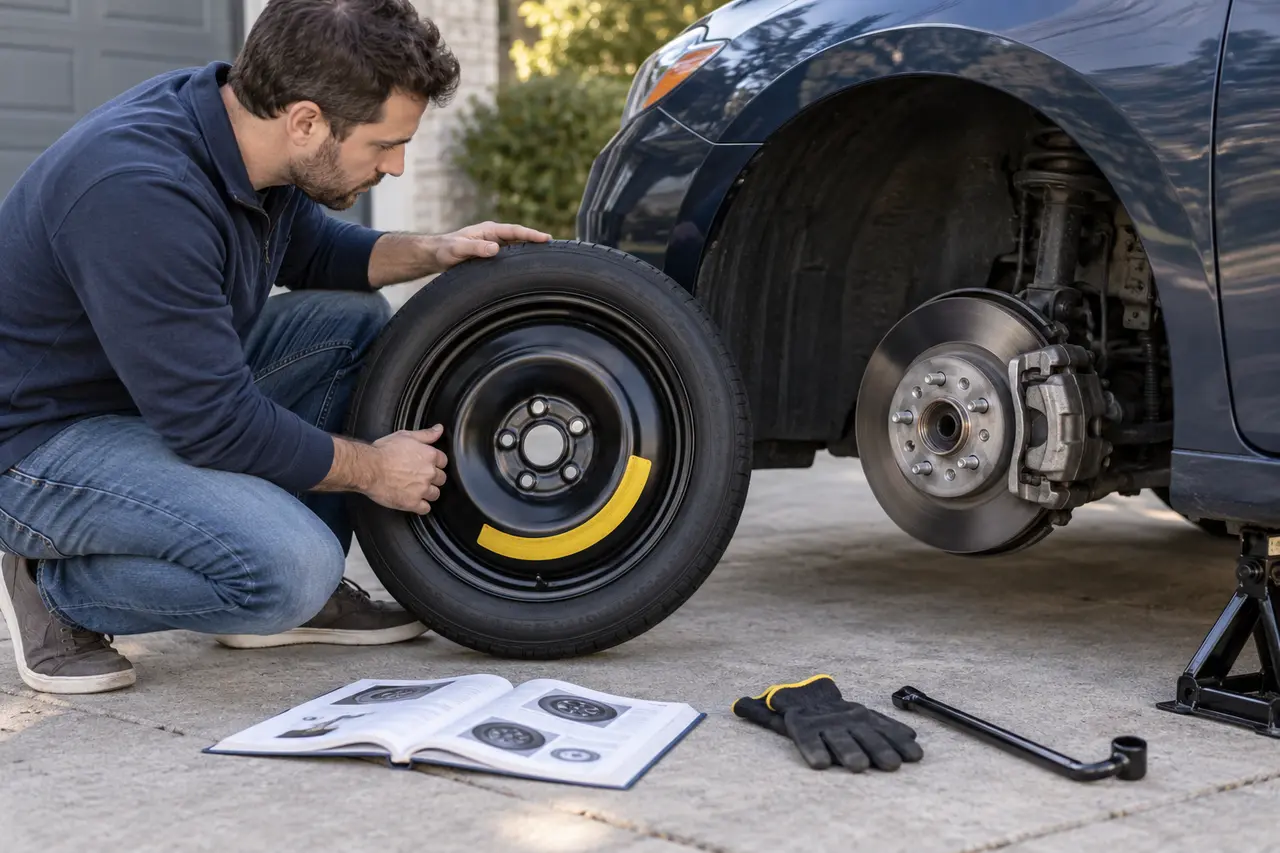
If a spare tire will not fit, lower the vehicle safely and call for correct roadside service or towing. Do not enlarge holes, add unapproved spacers, force the center bore, swap fasteners, or drive on a wheel that does not seat flat against the hub.
Fit depends on more than wheel diameter. Bolt circle, number of fasteners, center bore, wheel offset, mounting-seat shape, brake clearance, hub features, tire size, load rating, axle placement, and drivetrain limits must all work together.
What Is the Most Important Rule?
The wheel must slide into its designed position and seat evenly by hand. Lug nuts or bolts are not tools for pulling an incompatible wheel onto the hub.
A tire-change problem should be solved without turning it into damaged hardware, a damaged vehicle, or an unstable lift. Read the vehicle owner’s manual before lifting or using a temporary repair system. Model-specific instructions control approved lift points, jack capacity, fastener torque, spare placement, tire pressure, and driving limits.
Start by protecting people. Move as far away from traffic as the vehicle can safely travel, turn on the hazard lights, apply the parking brake, and choose firm, level ground. If the car cannot reach a protected place, stay in the safest available location and call emergency or roadside services.
What Should You Check Before Acting?
Use the following checks to decide whether the task can continue. Do not treat a missing item or unsafe condition as a small delay. It may change the correct plan.
| Check | What to confirm | Safe response |
|---|---|---|
| Identity | Spare belongs to the exact vehicle or approved application | Check part number and manual |
| Bolt pattern | Count and circle diameter match exactly | Do not force misaligned holes |
| Center bore | Wheel clears and centers on the hub as designed | Remove only harmless surface debris |
| Brake clearance | Barrel and spokes clear caliper and rotor | Follow axle-placement rules |
| Fasteners | Nut or bolt thread, length, and seat shape match | Do not substitute unknown hardware |
| Tire system | Diameter, load, pressure, AWD, and temporary limits match | Tow when compatibility is uncertain |
Inspect in good light from beside the vehicle. Stop when a fastener slips, a wheel binds, a jack leans, a tire shows structural damage, or a tool does not match. More force does not correct the wrong tool, wrong part, or wrong working area.
How Should You Prepare?
Keep the vehicle stable and the removed wheel beside you, not under the body. Compare the spare label and part number with the manual. Inspect the hub and mounting surface for loose rust flakes or an old wheel spacer.
Keep passengers and pets away from the work area. Put loose cargo where it cannot roll into traffic or block an escape path. Set wheel chocks as directed by the manual. Never rely on hazard lights, cones, or a reflective vest to make a dangerous shoulder safe.
Lay out only the equipment needed for the next step. Check the spare or road tire pressure before raising the vehicle. Confirm that the lug wrench or socket fits fully and that any wheel-lock key is present. If a required part is missing, arrange help before the vehicle is lifted.
What Steps Should You Follow?
- 1Stop forcing
remove pressure from the spare and reassess.
- 2Check identity
compare vehicle details, labels, and part numbers.
- 3Compare holes
verify exact bolt count and circle alignment.
- 4Check the center
look for interference at the hub bore.
- 5Check brakes
confirm the spare is allowed on that axle.
- 6Check fasteners
compare thread, length, washer, and seat type.
- 7Restore safety
reinstall the serviceable road wheel if possible or lower securely.
- 8Call for recovery
request the correct spare, wheel service, or tow.
Pause after every change in load, tool position, or vehicle condition. The setup should remain stable and easy to understand. If the next step depends on a guess, stop and find the exact instruction or request professional help.
Why Does This problem Need Special Care?
A compact spare may be approved only for a rear position because it cannot clear large front brakes. The manual may direct moving a good rear wheel to the front, then placing the compact spare at the rear. Used vehicles sometimes contain a spare from another model.
Wheel and tire systems carry vehicle weight, transmit braking and driving force, and help the driver steer. Small differences in pressure, diameter, fastener clamping, or lift-point placement can affect several systems at once. A part that appears close enough may still be unsafe.
Modern vehicles can add tire-pressure sensors, large brakes, all-wheel drive, air suspension, underbody battery packs, staggered tires, wheel locks, and model-specific spare rules. These features are manageable when the correct procedure is known, but they make guessing more costly.
Which Tools and Information Are Needed?
Use the owner manual, spare label, wheel part number, bright light, brush for loose debris, correct wrench, wheel-lock key, jack and chocks, gauge, phone, and vehicle identification information. Measuring fit requires accurate wheel data and trained service.
Common equipment includes the owner’s manual, a charged phone, work light, gloves, wheel chocks, pressure gauge, approved jack, correct wrench, wheel-lock key, and compatible spare or factory mobility kit. Not every page requires every tool, and not every vehicle supplies them.
Use a torque wrench only for final tightening within its rated range. Do not use it as a breaker bar. Use impact tools only with suitable sockets, controlled settings, and the training needed to protect wheel fasteners. Store heavy equipment securely after use.
What Limits Apply?
Do not use universal claims based only on bolt pattern. An adapter or spacer changes clamping and geometry and should never be improvised roadside. AWD systems may restrict tire diameter and axle placement even when the wheel physically fits.
A temporary spare or repair restores limited mobility. It does not return the tire system to normal service. Follow the lowest stated speed, distance, load, axle, weather, towing, and road-surface limit. Drive smoothly and go directly to a tire or repair facility.
Stop driving for vibration, pulling, rubbing, new warning lights, rapid pressure loss, smoke, odor, or unusual noise. These signs can point to poor fit, hidden damage, incorrect pressure, loose fasteners, or a problem beyond the original flat.
What Mistakes Should You Avoid?
- Do not pull the wheel on with lug nuts: it must seat correctly first.
- Do not hammer the center bore: the spare may be wrong.
- Do not grind the wheel or brake: use an approved wheel.
- Do not add a loose spacer: clamping and stud engagement can fail.
- Do not mix lug seats: cone, ball, and flat seats are not interchangeable.
- Do not test-fit by driving: rubbing or loose seating can cause loss of control.
Do not crawl under a vehicle supported only by an emergency jack. Do not work with your back to nearby traffic. Do not place hands or feet beneath a wheel, suspension, or body area that could drop. A safe wheel change is completed from beside the vehicle.
Do not improvise with stacked blocks, a near-size socket, unapproved spacers, substitute fasteners, or a spare from another vehicle. These shortcuts can cause a fall, damage threads, reduce wheel clamping, or create brake and drivetrain interference.
When Should You Call Roadside Assistance?
Call roadside assistance or towing when the spare is wrong, does not clear the brakes, uses different hardware, cannot seat fully, is prohibited on that axle, or leaves any doubt about drivetrain compatibility.
Give the provider your exact location, vehicle year and model, affected wheel, spare or mobility-kit status, and any wheel-lock problem. Mention traffic exposure, collision damage, leaking fluid, smoke, fire risk, or an unstable vehicle first. A tow may be safer than roadside work.
Professional help is also the right choice when the driver cannot kneel, turn the tools, handle the wheel, or maintain balance without pain or strain. The goal is safe recovery, not proving that the repair can be completed alone.
What Should Happen Afterward?
Have the spare, carrier, fasteners, hub, and vehicle records checked. Obtain the correct replacement spare or approved mobility plan and inspect any surface that was contacted during the failed attempt.
Have the tire removed from the wheel for an internal inspection when repair may be possible. Ask the technician to check the wheel, valve, TPMS sensor, fasteners, hub surface, and any parts affected by the event. Restore the normal wheel and tire as soon as practical.
After a spare or kit is used, inspect it, restore the correct pressure, replace consumed sealant, and return every tool to its fixed storage location. Record any replacement part or service need before the next trip.
How Can You Be Ready Next Time?
Verify a used vehicle's spare before travel, including part number, pressure, age, fit, lock key, jack, and axle instructions. Test only in a controlled shop or supervised setting.
Check all tire pressures, including the spare, at least monthly when cold and before a long trip. Inspect tread, sidewalls, valve stems, wheel condition, spare age, tool operation, and sealant expiration. Save roadside numbers and vehicle instructions for offline access.
Practice finding the equipment and lift points on private, firm, level ground in daylight. Preparation reduces searching and confusion. It does not make a dangerous highway shoulder, slope, storm, or damaged vehicle suitable for a DIY change.
Which Related Guides Can Help?
Use these pages to complete the next part of the decision:
Return to the complete 12-step tire-change guide for the normal wheel-swap sequence. Also review the tool checklist and roadside safety guide before starting.
Quick answers
Frequently Asked Questions
Why do the bolt holes line up but the spare still not fit?
The center bore, offset, brake clearance, wheel shape, or fastener seat may differ..
Can lug nuts pull a tight spare onto the hub?
No. The wheel should seat correctly without using the fasteners as a press.
Can a donut spare be front-only or rear-only?
Yes. Brake and drivetrain rules can limit its position.
Can a spare from another car be used?
Only when the full vehicle and wheel specifications approve it, not because it looks similar..
What should you do with the car already jacked up?
Keep clear, reinstall a serviceable wheel if possible, or lower safely and call for qualified help..