
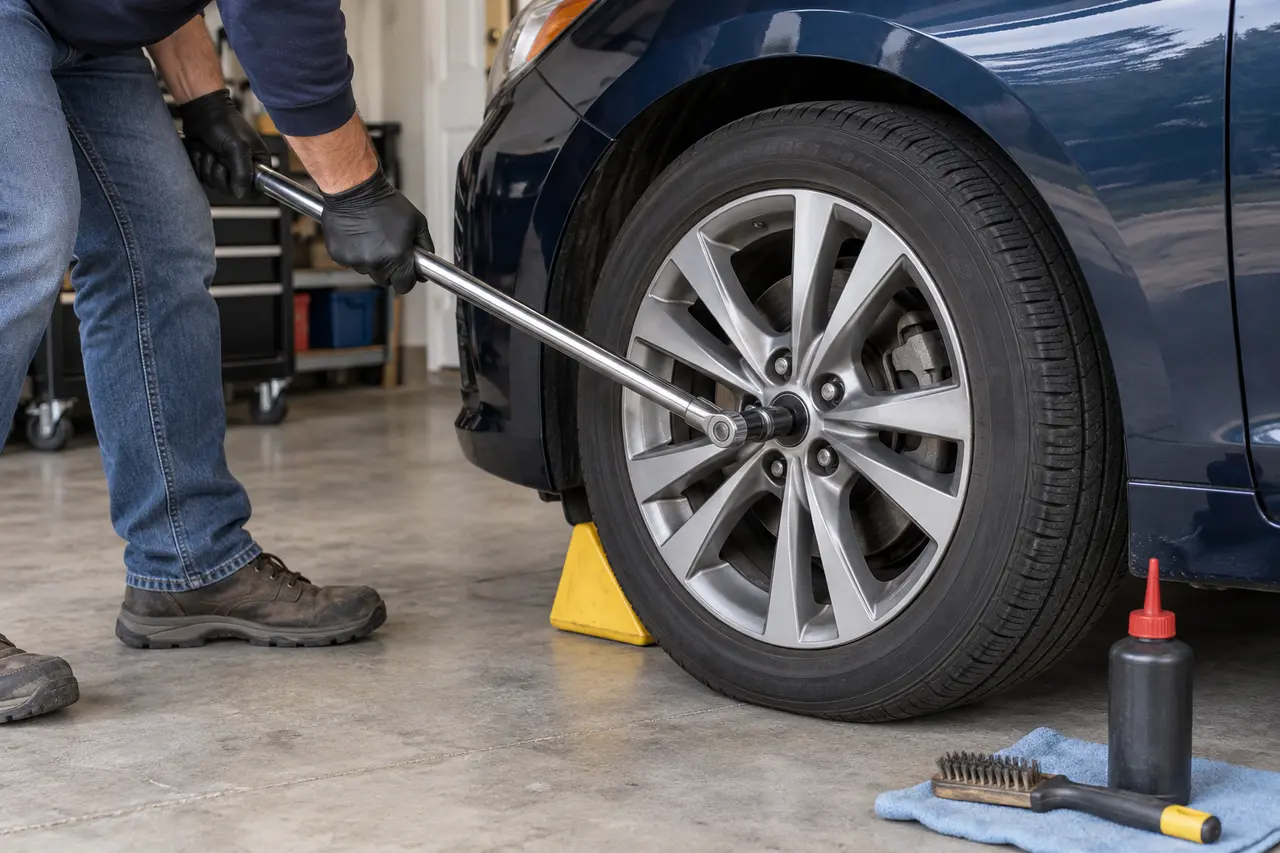
Keep the tire on the ground, confirm the correct loosening direction and socket size, seat the tool fully, and apply steady controlled force. Do not jump on the wrench or use an unstable pipe extension. Stop if the socket slips, the nut rounds, or the vehicle can move.
A lug nut may resist removal because it was overtightened, corroded, cross-threaded, damaged, covered by a distorted cap, or secured by a wheel lock. Identifying the cause protects the stud and makes the next action safer.
What Should You Do First?
Verify that most passenger-car fasteners loosen counterclockwise when viewed from the nut. Check the manual if markings or design are unusual. Remove decorative caps, identify any locking nut, and test an exact six-point socket. Keep all fasteners installed while diagnosing.
Keep the vehicle on firm, level ground away from traffic. Apply the parking brake, use the correct transmission position, and place wheel chocks. Do not enter the space beneath a vehicle supported only by an emergency jack. If the car is exposed to moving traffic, stay protected and request roadside assistance.
What Commonly Causes This Problem?
Resistance does not always mean the same failure. The fit, appearance, and movement provide useful clues.
| Possible cause | What you may notice | Safe response |
|---|---|---|
| Previous overtorque | Correct socket fits but high force is needed | Use controlled breaker-bar leverage or professional help |
| Corrosion | Rust is visible around nut or stud | Use manufacturer-approved methods and allow service time |
| Wrong socket | Tool rocks or will not seat fully | Select the exact metric or inch size |
| Swollen cap | Socket that once fit no longer seats | Use the correct service socket or replace capped nut |
| Cross-threading | Fastener turns unevenly or binds | Stop and have the stud or bolt assessed |
| Wheel lock | One nut has a patterned face | Use the matching key or follow the missing-key process |
| Damaged corners | Socket slips across rounded edges | Stop before creating a stripped lug nut |
How Can You Diagnose It Without Causing More Damage?
Clean the visible face and compare every nut. Check whether only one fastener is affected. Push the socket to full depth and test for rocking before applying load. Inspect the wrench and extension for cracks or flex. Do not use an impact tool without the correct socket, settings, and training.
Use adequate lighting and inspect from beside the vehicle. Compare the tool, fastener, jack, spare, or wheel position with the owner’s manual. Stop the test when a component slips, deforms, cracks, leans, binds, leaks, or requires uncontrolled force. A diagnosis is useful only when it does not turn a manageable wheel problem into damaged hardware or an unstable vehicle.
What Is the Safest Resolution?
A correctly sized six-point socket on a sound breaker bar provides controlled leverage. Position the handle for a steady pull or push while maintaining balance. If approved for the specific situation, a penetrant may be applied to exposed corrosion without contaminating braking surfaces. Follow its instructions and allow time.
Work in small, controlled stages and recheck the setup after each change. Use only tools designed for the component. Do not substitute a close socket size, an undersized jack, stacked blocks, improvised extensions, or force applied from an unstable body position. Follow model-specific instructions whenever they differ from this general guidance.
Can You Solve It at the Roadside?
Only a simple fit or leverage correction should be attempted in a protected, stable location. Seized, rounded, or cross-threaded fasteners often require workshop extraction. Do not spend extended time applying force beside traffic.
A parking area or driveway permits more controlled assessment than a shoulder. Road noise, passing vehicles, poor light, rain, snow, wind, soft ground, and limited working space reduce the margin for error. A solution that may be reasonable in a garage can be inappropriate beside traffic. Safety determines whether the task continues.
Which Tools May Be Needed?
Useful equipment can include an exact six-point socket, factory lug wrench, rated breaker bar, wheel-lock key, gloves, light, and a torque wrench for later installation. An impact wrench requires suitable impact sockets and controlled use.
Inspect every tool before loading it. The socket must fit fully, the jack must match the lift point and load, and the spare must be compatible and inflated. Keep the wheel-lock key with the lug wrench. Review the emergency tire change kit before a trip rather than assembling equipment during a breakdown.
What Should You Avoid?
- Do not jump on the wrench: a sudden release can cause a fall or tool slip.
- Do not use a loose socket: near-size tools round fastener corners.
- Do not heat the wheel area: heat can damage the tire, wheel finish, brake parts, and nearby components.
- Do not add an improvised pipe: uncontrolled leverage can break tools or studs.
- Do not loosen while raised: high side force can move the vehicle off the jack.
- Do not lubricate threads for installation: unless the vehicle manufacturer specifies it.
Improvised force can damage wheel studs, bolts, nuts, wheels, brakes, lift points, or body structure. It can also move the vehicle off the jack. When an action feels uncontrolled, stop and change the plan rather than increasing force.
When Should You Call Roadside Assistance?
Call when controlled force does not move the fastener, the wheel is exposed to traffic, the nut is rounded, the lock key is missing, a stud turns with the nut, or the available tool bends or slips.
Tell the provider the exact location, vehicle model, affected wheel, spare status, wheel-lock status, and visible damage. State traffic exposure, collision damage, smoke, leaking fluid, or an unstable vehicle first. A provider may install a usable spare, use specialized removal equipment, or tow the vehicle to a tire or repair facility.
What Happens After the Immediate Problem Is Solved?
Replace damaged wheel hardware. Inspect the remaining fasteners for distortion or corrosion. Install the wheel using clean specified thread conditions and a calibrated torque wrench. Investigate prior overtorque so the problem does not repeat.
Final wheel installation requires clean mating surfaces, sound fasteners, the specified tightening sequence, and the manufacturer’s torque. Check spare pressure and follow every temporary-spare speed, distance, and position limit. Have uncertain damage inspected before returning to normal driving.
How Can You Prevent the Same Problem?
Have wheel fasteners tightened to the vehicle specification in a crossing pattern. Avoid uncontrolled impact-wrench installation. Test the roadside wrench and wheel-lock key at home, and have capped nuts replaced when swelling begins.
Practice the equipment on private, level ground. Confirm wrench fit, wheel-lock-key location, jack operation, spare pressure, and lift points. Regular preparation reduces surprises, but it does not justify roadside work when the location is unsafe.
Which Related Tire Problems Should You Understand?
A wheel change can stop at several connected points. Use these guides to identify the next safe action:
Return to the complete tire-change guide only after this problem is resolved. The normal sequence should not continue with damaged parts, missing equipment, an unstable lift, or a wheel that cannot be secured correctly.
Quick answers
Frequently Asked Questions
Why are my lug nuts so hard to loosen?
Common causes include excessive installation torque, corrosion, cross-threading, a distorted decorative cap, a wheel lock, or an incorrect socket..
Should the car be jacked up before loosening lug nuts?
No. Break each fastener loose slightly while the tire remains on the ground, then lift the vehicle.
Can penetrating oil be used on lug nuts?
It may help exposed corrosion when applied according to product and vehicle guidance, but keep it off braking surfaces and do not assume lubricated installation torque..
Can an impact wrench remove stuck lug nuts?
A suitable impact wrench may help when used with the correct impact socket and controlled settings, but it can also damage hardware..
When should a stuck lug nut be handled professionally?
Use professional service when the nut rounds, stud turns, key is missing, tool slips, or controlled leverage fails..