
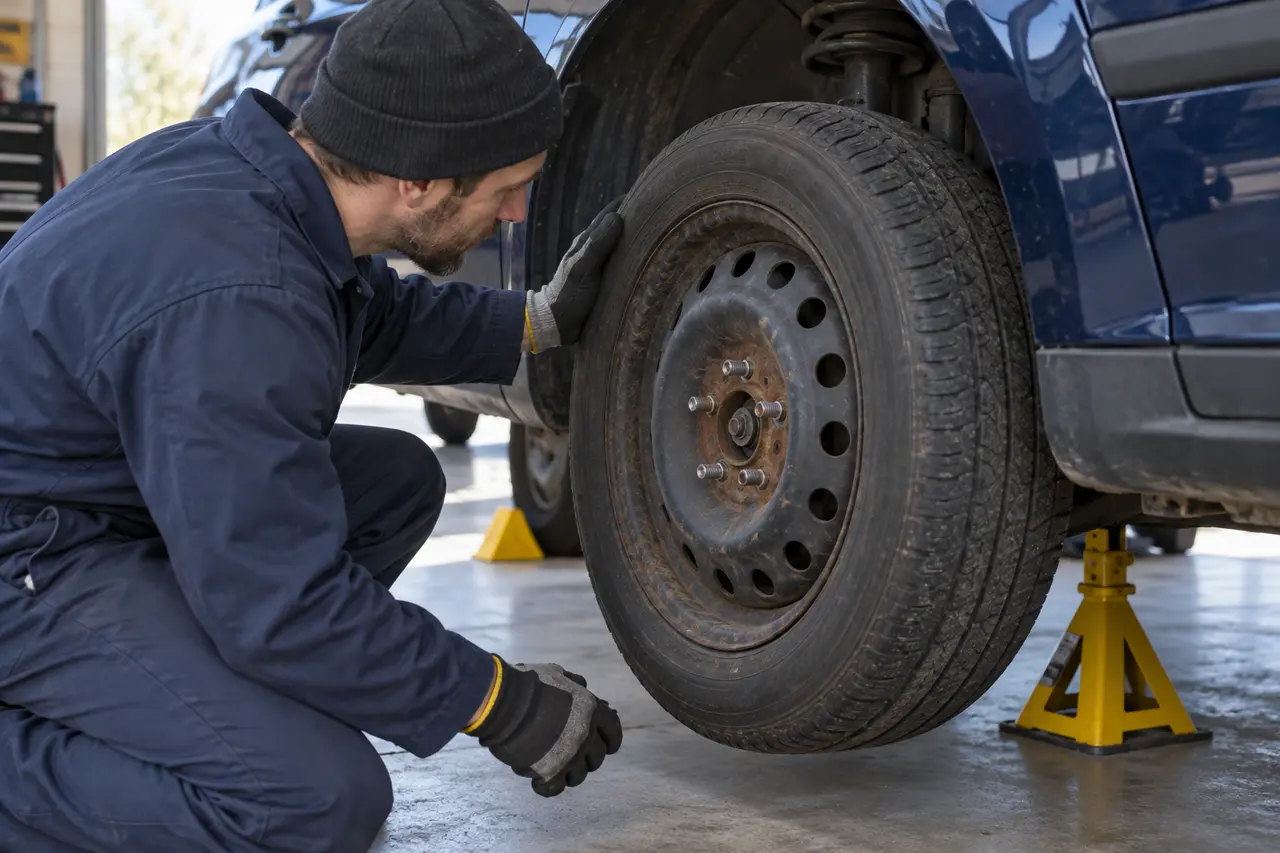
If the wheel will not come off, confirm every lug nut or wheel bolt is removed, keep the vehicle stable, and follow the manufacturer’s approved corrosion-release method. Never crawl beneath the raised vehicle or strike the wheel in a way that can knock it off the jack.
Moisture and road salt can create corrosion between a steel hub and aluminum or steel wheel. Dirt, an overlooked fastener, wheel covers, or mechanical damage can also prevent removal.
What Should You Do First?
Count the fasteners and compare the wheel with the manual. Check for a hidden lock or decorative center attachment. Support the vehicle according to the task and keep all body parts outside the fall zone. Thread fasteners back loosely if the manufacturer’s release method requires retention.
Keep the vehicle on firm, level ground away from traffic. Apply the parking brake, use the correct transmission position, and place wheel chocks. Do not enter the space beneath a vehicle supported only by an emergency jack. If the car is exposed to moving traffic, stay protected and request roadside assistance.
What Commonly Causes This Problem?
The location of the resistance helps separate corrosion from an overlooked attachment or damaged part.
| Possible cause | What you may notice | Safe response |
|---|---|---|
| Hub-face corrosion | Wheel does not move evenly | Use approved penetrant and controlled side force |
| Center-bore corrosion | Wheel rocks little at any edge | Professional hub cleaning may be needed |
| Hidden fastener | One area stays firmly attached | Recheck cover, lock, bolt count, and manual |
| Wheel cover attachment | Trim remains connected to nuts | Remove the cover by its correct procedure |
| Bent wheel or hub | Uneven gap or impact history | Stop and arrange inspection |
| Vehicle load remains | Tire still presses heavily on ground | Confirm adequate but minimal lift clearance |
| Aftermarket fit issue | Wheel has incorrect center-ring or offset | Use specialist removal and compatibility check |
How Can You Diagnose It Without Causing More Damage?
Use a light to inspect the center bore and back of visible wheel openings without reaching beneath the car. Try only gentle hand movement from the sides. A wheel that pivots at one point may still have a fastener. Rust powder around the center often indicates a corrosion bond.
Use adequate lighting and inspect from beside the vehicle. Compare the tool, fastener, jack, spare, or wheel position with the owner’s manual. Stop the test when a component slips, deforms, cracks, leans, binds, leaks, or requires uncontrolled force. A diagnosis is useful only when it does not turn a manageable wheel problem into damaged hardware or an unstable vehicle.
What Is the Safest Resolution?
Manufacturer-approved methods may include penetrant at the center interface, time for it to work, controlled force on the tire sidewall, or a non-marring mallet used from a stable side position. Retaining fasteners loosely can prevent sudden release when specified. Professional hub tools provide a more controlled pull.
Work in small, controlled stages and recheck the setup after each change. Use only tools designed for the component. Do not substitute a close socket size, an undersized jack, stacked blocks, improvised extensions, or force applied from an unstable body position. Follow model-specific instructions whenever they differ from this general guidance.
Can You Solve It at the Roadside?
Roadside striking is risky because the vehicle normally rests on an emergency jack. If gentle side movement does not release the wheel, lower the vehicle safely and request assistance. A shop lift and supports provide more controlled access.
A parking area or driveway permits more controlled assessment than a shoulder. Road noise, passing vehicles, poor light, rain, snow, wind, soft ground, and limited working space reduce the margin for error. A solution that may be reasonable in a garage can be inappropriate beside traffic. Safety determines whether the task continues.
Which Tools May Be Needed?
Useful equipment can include a light, gloves, approved penetrant, non-marring mallet, wheel-retaining hardware, hub-cleaning brush, and professional wheel puller. Do not use tools that require entering beneath the vehicle.
Inspect every tool before loading it. The socket must fit fully, the jack must match the lift point and load, and the spare must be compatible and inflated. Keep the wheel-lock key with the lug wrench. Review the emergency tire change kit before a trip rather than assembling equipment during a breakdown.
What Should You Avoid?
- Do not crawl under the car: an emergency jack is not a support stand.
- Do not kick from an unstable position: force can move the vehicle sideways.
- Do not strike the rim face: impacts can bend or crack the wheel.
- Do not drive with loose lug nuts: hub and stud damage can occur.
- Do not pry against brakes or suspension: these parts can be damaged.
- Do not leave corrosion untreated: the next removal may be more difficult.
Improvised force can damage wheel studs, bolts, nuts, wheels, brakes, lift points, or body structure. It can also move the vehicle off the jack. When an action feels uncontrolled, stop and change the plan rather than increasing force.
When Should You Call Roadside Assistance?
Call when gentle approved methods fail, the car is supported only by a roadside jack, the wheel is bent, the hub or brake appears damaged, or safe tool access is unavailable.
Tell the provider the exact location, vehicle model, affected wheel, spare status, wheel-lock status, and visible damage. State traffic exposure, collision damage, smoke, leaking fluid, or an unstable vehicle first. A provider may install a usable spare, use specialized removal equipment, or tow the vehicle to a tire or repair facility.
What Happens After the Immediate Problem Is Solved?
Clean the hub and wheel mating surfaces by the approved method. Inspect the center bore, mounting face, studs, bolts, and wheel. Do not apply compound unless the vehicle or wheel manufacturer permits it. Torque fasteners correctly.
Final wheel installation requires clean mating surfaces, sound fasteners, the specified tightening sequence, and the manufacturer’s torque. Check spare pressure and follow every temporary-spare speed, distance, and position limit. Have uncertain damage inspected before returning to normal driving.
How Can You Prevent the Same Problem?
During tire service, have mating surfaces inspected and cleaned. Use compatible wheels and center rings. Correct torque helps future removal, while uncontrolled overtightening does not prevent corrosion.
Practice the equipment on private, level ground. Confirm wrench fit, wheel-lock-key location, jack operation, spare pressure, and lift points. Regular preparation reduces surprises, but it does not justify roadside work when the location is unsafe.
Which Related Tire Problems Should You Understand?
A wheel change can stop at several connected points. Use these guides to identify the next safe action:
Return to the complete tire-change guide only after this problem is resolved. The normal sequence should not continue with damaged parts, missing equipment, an unstable lift, or a wheel that cannot be secured correctly.
Quick answers
Frequently Asked Questions
Why is my wheel stuck after removing all lug nuts?
Corrosion between the wheel center and hub is the most common reason, but an overlooked lock, cover, or damaged fit can also hold it..
Can you kick a stuck wheel off?
Kicking can destabilize a raised vehicle and injure the driver. Use a controlled approved method or professional service.
Can penetrating oil be used between the wheel and hub?
A suitable product may help at the center interface when kept off brakes and tires and used according to instructions..
Should anti-seize be put on the hub?
Only when the vehicle or wheel manufacturer approves the exact location and product. Keep compounds off seating surfaces and fasteners unless specified.
Can you drive with loose lug nuts to free a wheel?
No. Driving loose can damage studs, bolts, the hub, and wheel and can allow wheel separation.