
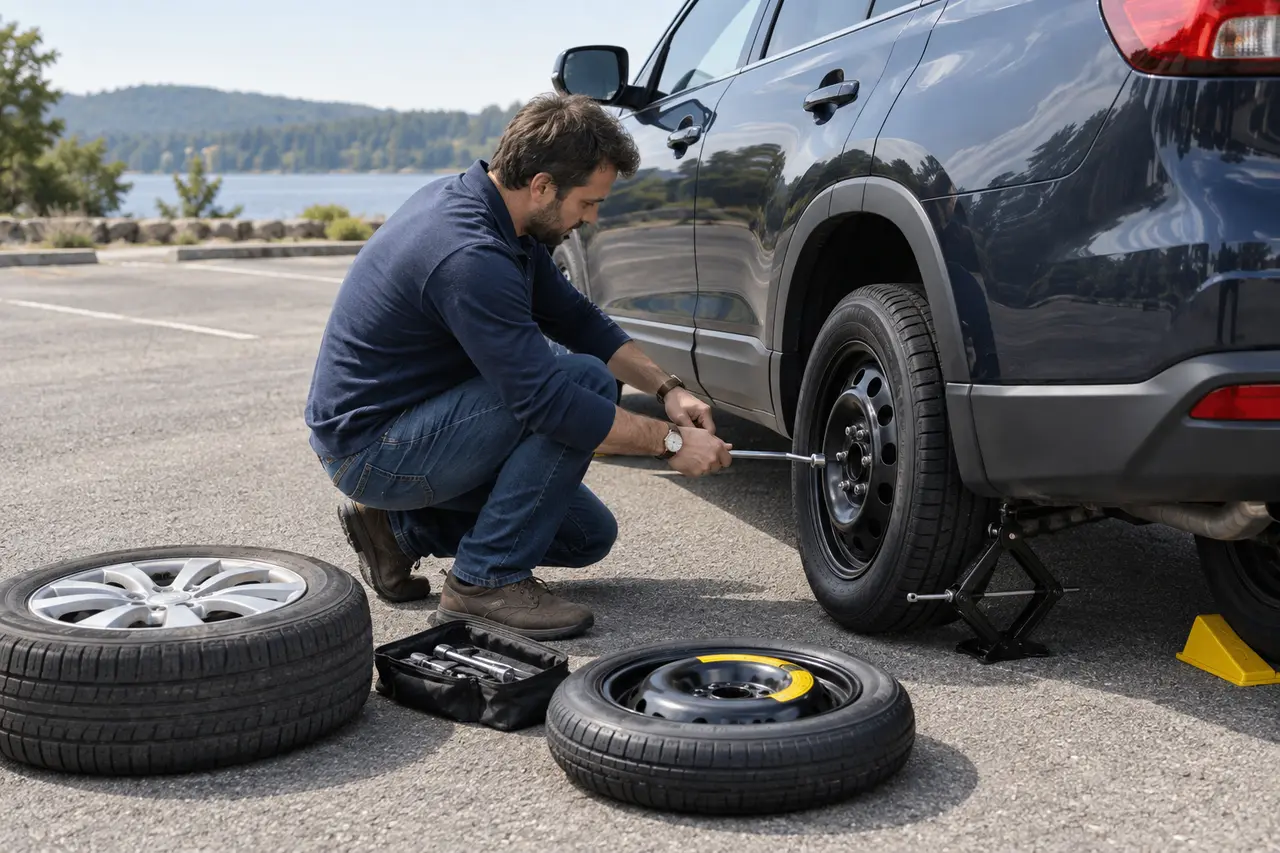
Changing one flat tire usually takes 15 to 30 minutes for a prepared driver on firm, level ground. A beginner may need 30 to 60 minutes. Roadside assistance may complete the wheel swap in about 10 to 20 minutes after arrival, but dispatch and travel time can be much longer.
Typical Tire-Change Times
| Situation | Typical working time | What the estimate assumes |
|---|---|---|
| Prepared driver | 15 to 30 minutes | Safe location, usable spare, correct tools, and no stuck parts |
| First-time driver | 30 to 60 minutes | Time to read the manual and identify equipment and lift points |
| Roadside technician after arrival | About 10 to 20 minutes | Standard wheel change with access and no complications |
| Complicated roadside change | 60 minutes or more | Wheel lock, corrosion, unsafe ground, damaged wheel, or missing equipment |
| Tire replacement at a shop | Varies by workload and service | Demounting, inspection, mounting, balancing, installation, and checks |
These are planning ranges, not deadlines. The safe location and correct procedure control the pace. Waiting for roadside assistance is separate from the time required to perform the wheel change.
Where Does the Time Go?
- 1Reach a safe place
Slow smoothly, leave active traffic, and find firm, level ground.
- 2Secure the vehicle
Use hazards, the parking brake, the correct gear or Park, and wheel chocks as directed.
- 3Find the equipment
Remove the spare, jack, wrench, wheel-lock key, and any trim or carrier tools.
- 4Loosen and lift
Use the approved lift point and loosen fasteners before the tire leaves the ground.
- 5Swap the wheel
Remove the flat, seat the spare, and start every fastener by hand.
- 6Lower and tighten
Use the specified pattern and final torque procedure.
- 7Check before driving
Confirm spare pressure, storage, and speed and distance restrictions.
Why Does a First Tire Change Take Longer?
A first-time driver must locate the jack, identify the lift point, understand the spare carrier, and read vehicle-specific instructions. Trim covers, locking fasteners, unfamiliar jack handles, and a compact spare pressure requirement can add several minutes.
That extra time is useful when it prevents a wrong lift point, slipping wrench, cross-threaded fastener, or underinflated spare. Practicing the equipment location and manual procedure in daylight on private property makes an emergency change easier.
Which Problems Add the Most Time?
- Unsafe location: moving the vehicle or waiting for traffic protection can take longer than the wheel change.
- Flat or inaccessible spare: a low spare or seized underbody carrier may make the change impossible.
- Missing wheel-lock key: the correct key or professional removal equipment must be found.
- Overtightened or corroded lug nuts: the vehicle wrench may not safely loosen them.
- Wheel stuck to the hub: corrosion can hold the wheel after the fasteners are removed.
- Wrong or unstable jack: lifting must stop until suitable equipment and ground are available.
- Large or heavy wheel: truck, SUV, EV, and full-size spare assemblies may require more control or assistance.
- Collision or suspension damage: a normal spare installation may not restore safe mobility.
How Long Does Roadside Assistance Take?
The provider's arrival time depends on distance, traffic, weather, call volume, access, and location accuracy. Once present, a routine wheel change may take about 10 to 20 minutes. A tow is needed when the vehicle has no usable spare, the wheel is damaged, the tire will not come off safely, or the site is too dangerous for roadside work.
Give dispatch the exact road, direction of travel, nearby marker, vehicle description, affected wheel, spare status, and wheel-lock information. Mention a live lane, narrow shoulder, collision, smoke, or leaking fluid first.
Is a Tire-Shop Change Faster?
A shop service is a different job from installing a spare. The technician may inspect the puncture, remove the tire from the wheel, repair or replace it, service the valve or TPMS sensor, mount and inflate the tire, balance the assembly, reinstall the wheel, and verify torque and pressure.
Actual turnaround includes the shop queue, parts availability, number of tires, wheel condition, alignment needs, and any manufacturer procedure. Ask for working time and estimated completion time separately.
How Can You Reduce the Time Safely?
Check spare pressure and tire condition monthly, keep tools in their assigned locations, store the wheel-lock key with the kit, and know the lift points before a trip. Carry a pressure gauge, light, gloves, and charged phone. Review the owner manual instead of relying on memory from another vehicle.
NHTSA TireWise recommends monthly cold-pressure checks for all tires, including the spare. A maintained spare and complete tool kit remove two of the most common delays.
What Should Happen After the Spare Is Installed?
Follow the spare's speed, distance, load, axle, and towing restrictions. Drive directly to a tire service facility. Have the flat tire and wheel inspected, and have wheel-fastener torque checked according to the vehicle and service instructions.
After the normal wheel returns, restore the spare pressure, replace used sealant or missing parts, and secure the jack and tools. The emergency is not fully closed until the spare system is ready again.
Related Tire-Change Guides
Quick answers
Frequently Asked Questions
How long does it take to change one tire yourself?
A prepared driver on safe, level ground may need about 15 to 30 minutes. A first attempt often takes 30 to 60 minutes.
How long does roadside assistance take to change a tire?
The wheel change may take about 10 to 20 minutes after the provider arrives, but travel, traffic, weather, and dispatch time are separate.
Why can a tire change take longer than one hour?
Unsafe location, missing tools, a flat spare, wheel locks, stuck lug nuts, a seized wheel, vehicle damage, or an unsuitable jack can stop or delay the job.
Is changing all four tires the same as changing a flat?
No. A tire shop must lift the vehicle, remove wheels, demount tires, inspect components, mount, inflate, balance, reinstall, and verify the work.
Should you try to change a tire faster?
No. Stable lifting, correct fastener handling, and roadside safety matter more than speed.