
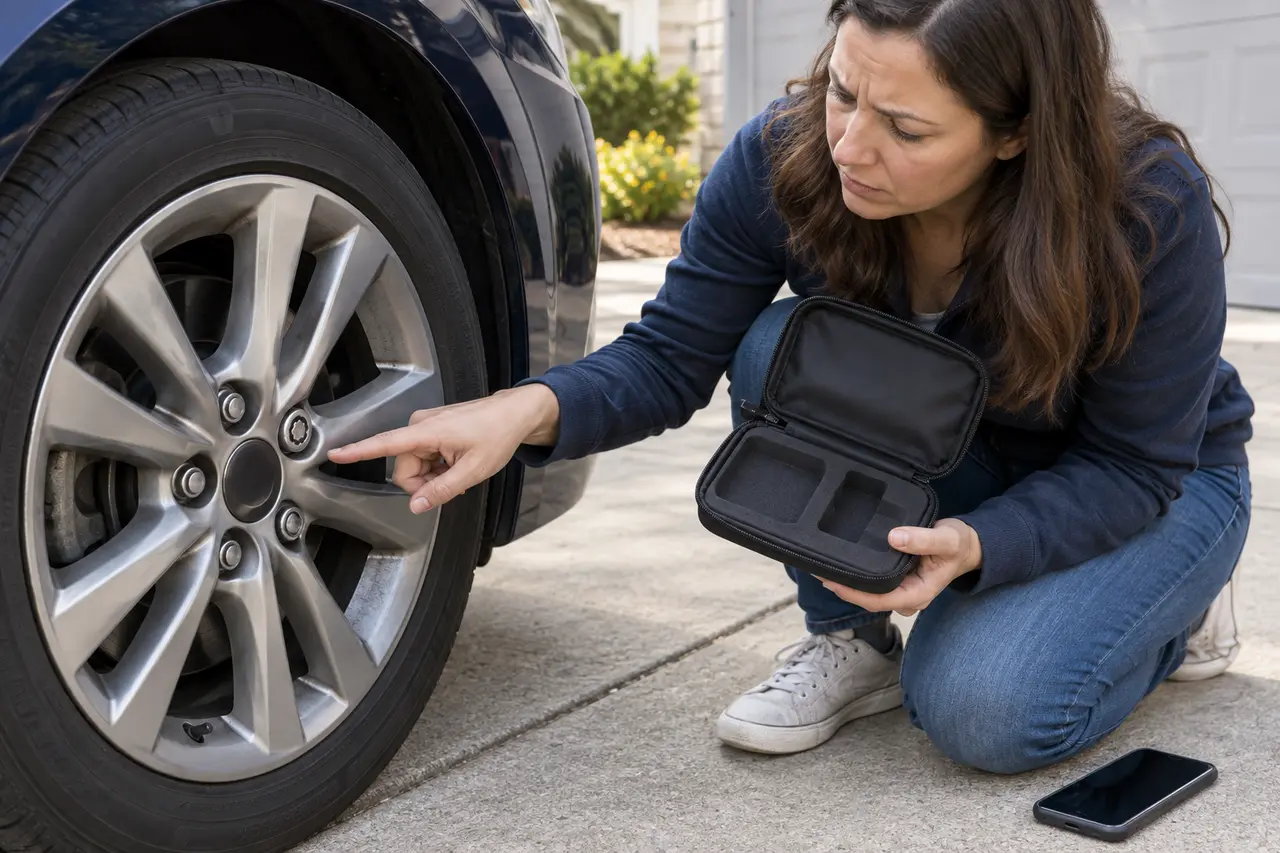
Do not force a locking lug nut with a standard socket when the key is missing. Search the vehicle’s tool storage, glove box, console, spare well, and service paperwork, then contact a dealer, lock supplier, tire shop, or roadside provider for a match or controlled removal.
Wheel locks replace one standard fastener on each wheel. The key pattern transfers turning force. A poor fit can damage both the lock and wheel, making later removal more difficult.
What Should You Do First?
Keep the vehicle grounded. Inspect every wheel to confirm the number and style of locks. Search only while safely parked. Check the pouch with the jack, the spare well, center console, door pockets, glove box, tool roll, and any small container returned after tire service.
Keep the vehicle on firm, level ground away from traffic. Apply the parking brake, use the correct transmission position, and place wheel chocks. Do not enter the space beneath a vehicle supported only by an emergency jack. If the car is exposed to moving traffic, stay protected and request roadside assistance.
What Commonly Causes This Problem?
The key may be misplaced, broken, left at a shop, or never supplied with a used vehicle.
| Possible cause | What you may notice | Safe response |
|---|---|---|
| Key stored elsewhere | Empty fitted slot in tool pouch | Search fixed storage points and service records |
| Key left after service | Recent tire or brake work | Contact the facility immediately |
| Used vehicle missing key | No key or code was transferred | Ask seller or dealer and identify lock brand |
| Broken key | Cracked or rounded pattern | Order replacement or professional extraction |
| Wrong key | Pattern partly engages but rocks | Do not apply force; find exact match |
| Aftermarket wheel lock | Unique pattern and packaging absent | Use supplier identification process |
| Factory lock set | Dealer system may have master references | Provide VIN and ownership proof if requested |
How Can You Diagnose It Without Causing More Damage?
Photograph the lock face straight on without relying on the photo alone for final matching. Note the vehicle, wheel type, lock location, and any brand information. Search for a key code card or purchase receipt. Do not test random keys under heavy load.
Use adequate lighting and inspect from beside the vehicle. Compare the tool, fastener, jack, spare, or wheel position with the owner’s manual. Stop the test when a component slips, deforms, cracks, leans, binds, leaks, or requires uncontrolled force. A diagnosis is useful only when it does not turn a manageable wheel problem into damaged hardware or an unstable vehicle.
What Is the Safest Resolution?
A dealer or lock supplier may identify and order the exact key. A tire shop can use master sets or extraction tools. If extraction damages the lock, install a complete compatible replacement set or standard fasteners approved for the wheel.
Work in small, controlled stages and recheck the setup after each change. Use only tools designed for the component. Do not substitute a close socket size, an undersized jack, stacked blocks, improvised extensions, or force applied from an unstable body position. Follow model-specific instructions whenever they differ from this general guidance.
Can You Solve It at the Roadside?
This is usually a service-call problem. Professional removal beside the road may be possible in a safe area, but the provider may tow when access, security pattern, or wheel design prevents controlled extraction.
A parking area or driveway permits more controlled assessment than a shoulder. Road noise, passing vehicles, poor light, rain, snow, wind, soft ground, and limited working space reduce the margin for error. A solution that may be reasonable in a garage can be inappropriate beside traffic. Safety determines whether the task continues.
Which Tools May Be Needed?
Legitimate removal may use a matching key, master identification set, spiral extractor, protective guide, breaker bar, and replacement fastener. Drilling or welding belongs in a controlled professional setting.
Inspect every tool before loading it. The socket must fit fully, the jack must match the lift point and load, and the spare must be compatible and inflated. Keep the wheel-lock key with the lug wrench. Review the emergency tire change kit before a trip rather than assembling equipment during a breakdown.
What Should You Avoid?
- Do not hammer on a random socket: it can crack the wheel finish or worsen the lock.
- Do not use a chisel: slips can damage the rim, tire, and brake.
- Do not apply open flame: heat creates tire and component hazards.
- Do not use a partial key fit: it can strip the patterned face.
- Do not publish the key code: retain security information privately.
- Do not reinstall a damaged lock: replace the set or use approved hardware.
Improvised force can damage wheel studs, bolts, nuts, wheels, brakes, lift points, or body structure. It can also move the vehicle off the jack. When an action feels uncontrolled, stop and change the plan rather than increasing force.
When Should You Call Roadside Assistance?
Call when a flat wheel has a lock and no matching key, the key is damaged, the lock face has started to strip, or the vehicle is in an unsafe location. Mention the lock before dispatch.
Tell the provider the exact location, vehicle model, affected wheel, spare status, wheel-lock status, and visible damage. State traffic exposure, collision damage, smoke, leaking fluid, or an unstable vehicle first. A provider may install a usable spare, use specialized removal equipment, or tow the vehicle to a tire or repair facility.
What Happens After the Immediate Problem Is Solved?
Inspect the stud or bolt and wheel seat after extraction. Replace damaged hardware. Store the new key in one consistent labeled location and record its code securely outside the vehicle.
Final wheel installation requires clean mating surfaces, sound fasteners, the specified tightening sequence, and the manufacturer’s torque. Check spare pressure and follow every temporary-spare speed, distance, and position limit. Have uncertain damage inspected before returning to normal driving.
How Can You Prevent the Same Problem?
Check the key before tire, brake, or alignment service. Ask the shop to return it to the designated pouch. When buying a used vehicle, confirm every wheel lock and test the key fit before purchase completion.
Practice the equipment on private, level ground. Confirm wrench fit, wheel-lock-key location, jack operation, spare pressure, and lift points. Regular preparation reduces surprises, but it does not justify roadside work when the location is unsafe.
Which Related Tire Problems Should You Understand?
A wheel change can stop at several connected points. Use these guides to identify the next safe action:
Return to the complete tire-change guide only after this problem is resolved. The normal sequence should not continue with damaged parts, missing equipment, an unstable lift, or a wheel that cannot be secured correctly.
Quick answers
Frequently Asked Questions
Where is the wheel-lock key usually stored?
Common locations include the spare-tire well, jack pouch, glove box, center console, tool roll, door pocket, or a small case in the trunk..
Can a dealer replace a missing wheel-lock key?
Often yes, especially for factory systems, but identification and proof of ownership may be required..
Can a tire shop remove a locking lug without the key?
Many shops have master sets or extraction tools, although some locks require drilling or other controlled methods..
Can you use a regular socket on a wheel lock?
A standard socket normally will not engage the pattern and can damage the lock and wheel..
Should wheel locks be replaced after extraction?
Replace any damaged lock and consider a complete matched set so one reliable key serves all wheels..