
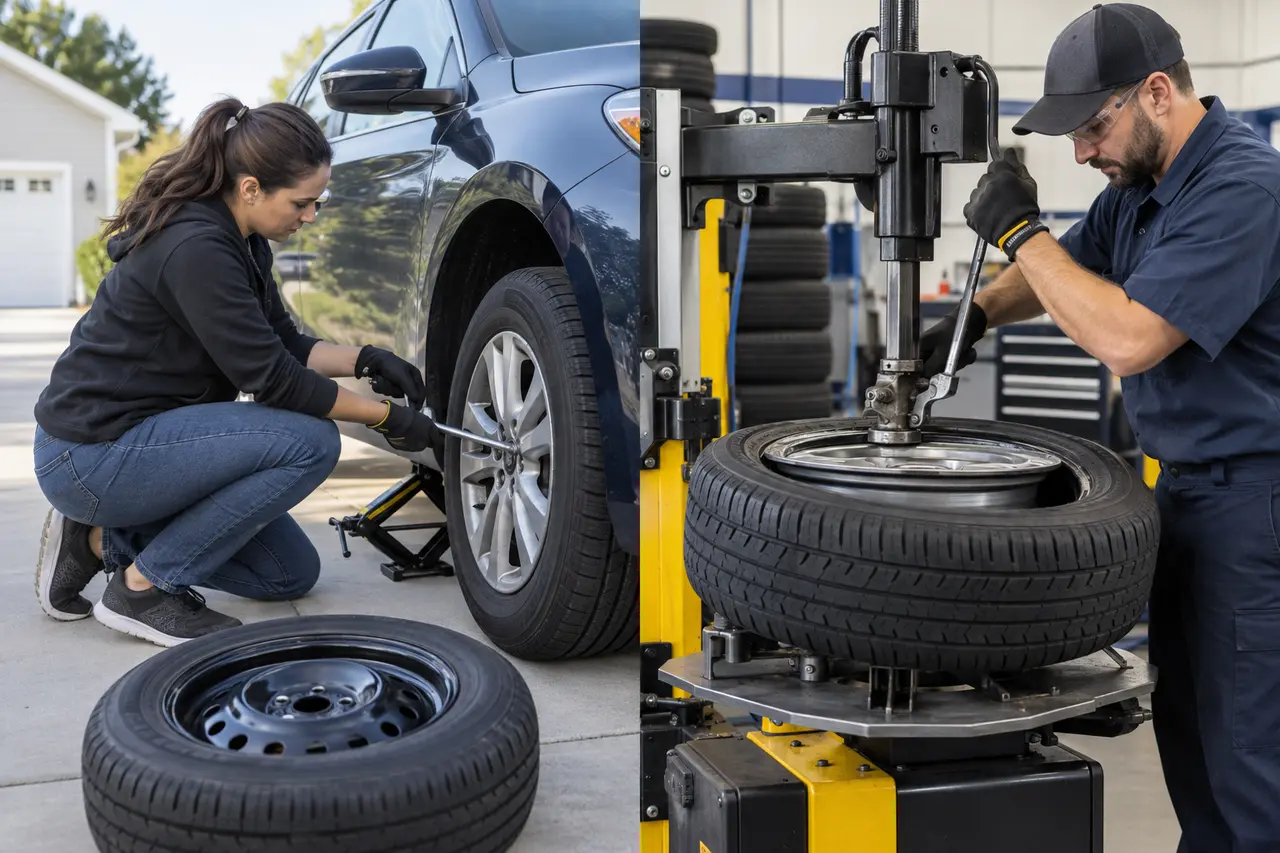
Changing a tire usually means removing the complete wheel and tire assembly from the vehicle and installing a spare. Replacing a tire means removing the rubber tire from the wheel, installing another tire, inflating it safely, and balancing the assembly with specialized shop equipment.
The terms are often used interchangeably in everyday conversation, but they describe different work. The distinction helps a driver choose the correct service, tools, time estimate, and safety procedure.
What Is Changed During a Roadside Tire Change?
A roadside tire change disconnects the wheel from the vehicle hub. The tire normally remains mounted on the wheel. The driver secures the vehicle, loosens the lug nuts or wheel bolts, raises the vehicle at the approved point, removes the damaged wheel assembly, and installs a spare wheel assembly.
The job uses a vehicle jack, lug wrench, wheel chocks, wheel-lock key when fitted, and a serviceable spare. It can often be completed in 15 to 30 minutes under safe and straightforward conditions. The spare may be full size, temporary compact, or absent if the vehicle uses another mobility system.
A roadside change restores limited mobility. It does not determine whether the damaged tire can be repaired, and it does not correct a bent wheel, damaged valve, brake problem, or suspension damage.
What Happens During Tire Replacement?
Tire replacement begins after the wheel assembly is removed from the vehicle. A technician deflates the tire, releases both beads from the wheel, and uses a tire-changing machine to demount it. The wheel, valve, and tire-pressure monitoring system (TPMS) sensor are inspected as applicable.
The replacement tire must have an approved size, load capacity, speed capability, construction, and application for the vehicle. The technician lubricates the bead with an approved product, mounts the tire without damaging the bead or sensor, and inflates it using controlled procedures and equipment.
The mounted assembly is balanced to reduce vibration. The wheel is then installed on a clean mating surface and its fasteners are tightened in the specified sequence and torque. The final tire pressure is set to the vehicle specification.
How Do the Two Services Compare?
| Factor | Change to a spare | Replace the tire |
|---|---|---|
| Part removed | Complete wheel and tire assembly | Rubber tire is removed from the wheel |
| Typical location | Safe roadside area, driveway, or workshop | Equipped tire service facility |
| Main equipment | Jack, wrench, chocks, spare, manual | Tire changer, controlled inflation, balancer, service tools |
| Main purpose | Restore temporary or normal mobility | Install a serviceable road tire |
| Typical result | Vehicle runs on a spare assembly | Normal wheel returns with repaired or new tire |
| Balancing | Spare should already be balanced | Mounted assembly is balanced after service |
When Is a Wheel Swap the Correct Response?
Use a spare when the road tire loses air and the vehicle is in a safe place for a wheel change. A puncture, cut, bead leak, damaged valve, or bent wheel may all cause pressure loss, but the roadside response can be the same: install an approved spare and drive within its limits to inspection.
Confirm that the spare is compatible, inflated, and permitted in the required wheel position. Some vehicles restrict temporary spares by axle or require another wheel to be moved first. Follow the owner’s manual.
Do not perform a wheel change when traffic exposure, unstable ground, weather, missing tools, personal limits, or additional vehicle damage creates unacceptable risk. Use the roadside safety checklist before unloading equipment.
When Does the Rubber Tire Need Replacement?
A tire may require replacement because of sidewall damage, a large or irregular puncture, exposed reinforcement, tread or belt separation, impact damage, weather cracking, excessive wear, or deterioration. Driving with very low pressure can damage the internal structure even when the exterior appears normal.
A technician needs to remove the tire for a complete internal inspection when repair is being considered. External appearance alone cannot confirm that a driven-flat tire is structurally safe. Tires that do not meet the repair criteria for their construction and damage location should be replaced.
Age is another factor. Inspect the tire identification information and follow the vehicle and tire manufacturer’s replacement guidance. Spare tires age even when they have little or no tread wear.
Can a Punctured Tire Be Repaired Instead?
Some small punctures in the repairable tread area may qualify for a proper internal repair. The tire must be removed from the wheel so its inner surface and structure can be inspected. Damage in the sidewall or shoulder, a puncture outside repair limits, overlapping damage, and structural deterioration can make repair inappropriate.
An external string plug or aerosol sealant is not equivalent to a complete internal inspection and repair. Mobility sealant can be useful only for the damage types permitted by its manufacturer. Tell the tire technician when sealant has been used because it affects inspection and cleanup.
Repair policies can differ by tire type, manufacturer, speed rating, previous service, and damage history. Let a qualified provider apply the criteria for the exact tire.
Why Does Tire Replacement Need Specialized Equipment?
Tire beads fit tightly against the wheel. Removing and installing them without suitable equipment can damage the bead, wheel finish, valve, or TPMS sensor. Inflation is also a controlled procedure. A damaged, mismatched, or incorrectly seated assembly can fail violently.
Balancing requires a machine that measures the assembly’s mass variation and identifies correction locations. An unbalanced wheel can create vibration, reduce ride quality, and contribute to irregular wear. Visual alignment is not a substitute for measurement.
Professional equipment does not replace judgment. The technician must verify component compatibility, inspect the wheel, follow mounting directions, and use the correct pressure and torque information.
What Are the Wheel, Rim, Bead, and Hub?
The tire is the rubber and reinforced structure that contacts the road. The wheel is the metal assembly attached to the vehicle. The rim is technically the outer wheel area that supports the tire beads, although the word is commonly used for the whole wheel.
The bead is the reinforced tire edge that seals against the rim. The hub is the vehicle component that locates and supports the wheel. Lug nuts on studs or wheel bolts secure the wheel to the hub. A valve allows inflation, and many modern vehicles place a TPMS sensor at or near the valve.
Using precise names makes service requests clearer. “I need the right rear wheel changed to the spare” describes roadside work. “I need the punctured tire inspected for repair or replacement” describes tire-shop work.
Do Run-Flat Tires Change the Answer?
Run-flat tires can support limited travel after pressure loss under specified conditions. They do not permit unrestricted driving, and they can still suffer nonrepairable damage. Follow the vehicle and tire instructions for speed, distance, load, and service.
A run-flat vehicle may not carry a spare or jack. If the tire cannot continue within its limits, roadside service may need to tow the vehicle. Replacement should match the vehicle’s approved system and the requirements for the other tires.
Should One Tire or Multiple Tires Be Replaced?
The answer depends on remaining tread, axle pairing, tire construction, vehicle manufacturer guidance, and drivetrain requirements. All-wheel-drive systems can have limits on tire circumference differences. Mixing unsuitable sizes, constructions, or wear levels can affect handling and system operation.
A tire professional should measure the other tires and apply vehicle-specific requirements. Do not assume that every puncture requires four new tires, but do not assume that one mismatched tire is acceptable either.
What Should You Ask the Tire Shop?
- Damage finding: ask where the air loss occurred and what the internal inspection showed.
- Repair decision: ask why the tire qualifies or does not qualify for repair.
- Replacement match: confirm size, load, speed, construction, and vehicle compatibility.
- Wheel condition: ask whether the rim, valve, TPMS sensor, and mounting surface are sound.
- Balance and torque: confirm balancing, installation torque, and any recheck guidance.
- Spare restoration: ask for the repaired or replaced normal wheel to be installed and the spare to be inspected and returned to storage.
Which Task Can You Do Yourself?
A capable driver may change a complete wheel assembly when the location, tools, spare, physical demands, and manual instructions support it. Review whether you can change a tire yourself and gather the required tire-change tools.
Removing rubber from a wheel, inspecting internal damage, seating beads, controlling inflation, and balancing are normally shop tasks. The distinction is simple: change the wheel assembly to restore mobility, then have the tire evaluated and repaired or replaced with the correct equipment.
Quick answers
Frequently Asked Questions
What is the difference between changing and replacing a tire?
Changing a tire commonly means removing the complete wheel and tire assembly from the vehicle and installing a spare. Replacing a tire means removing the rubber tire from the wheel, mounting another tire, inflating it safely, and balancing the assembly.
Can you replace a tire yourself at home?
Professional replacement is recommended because safe demounting, bead seating, inflation, inspection, and balancing require specialized equipment and training. A home mechanic may swap complete wheel assemblies when the location, tools, and vehicle instructions permit.
Does a punctured tire always need replacement?
No. Some small tread-area punctures may qualify for an internal repair after the tire is removed and inspected. Sidewall damage, large punctures, structural separation, and some run-flat or driven-flat conditions generally prevent repair.
Do you need to balance a tire after changing to a spare?
The spare wheel assembly should already be balanced. Mounting a new tire on a wheel normally requires balancing because tire and wheel mass varies. Vibration after a wheel change should be inspected promptly.
Is a wheel the same as a rim?
The wheel is the complete metal structure that attaches to the hub. Rim technically describes the outer part that holds the tire bead, although everyday use often treats rim and wheel as the same term.