
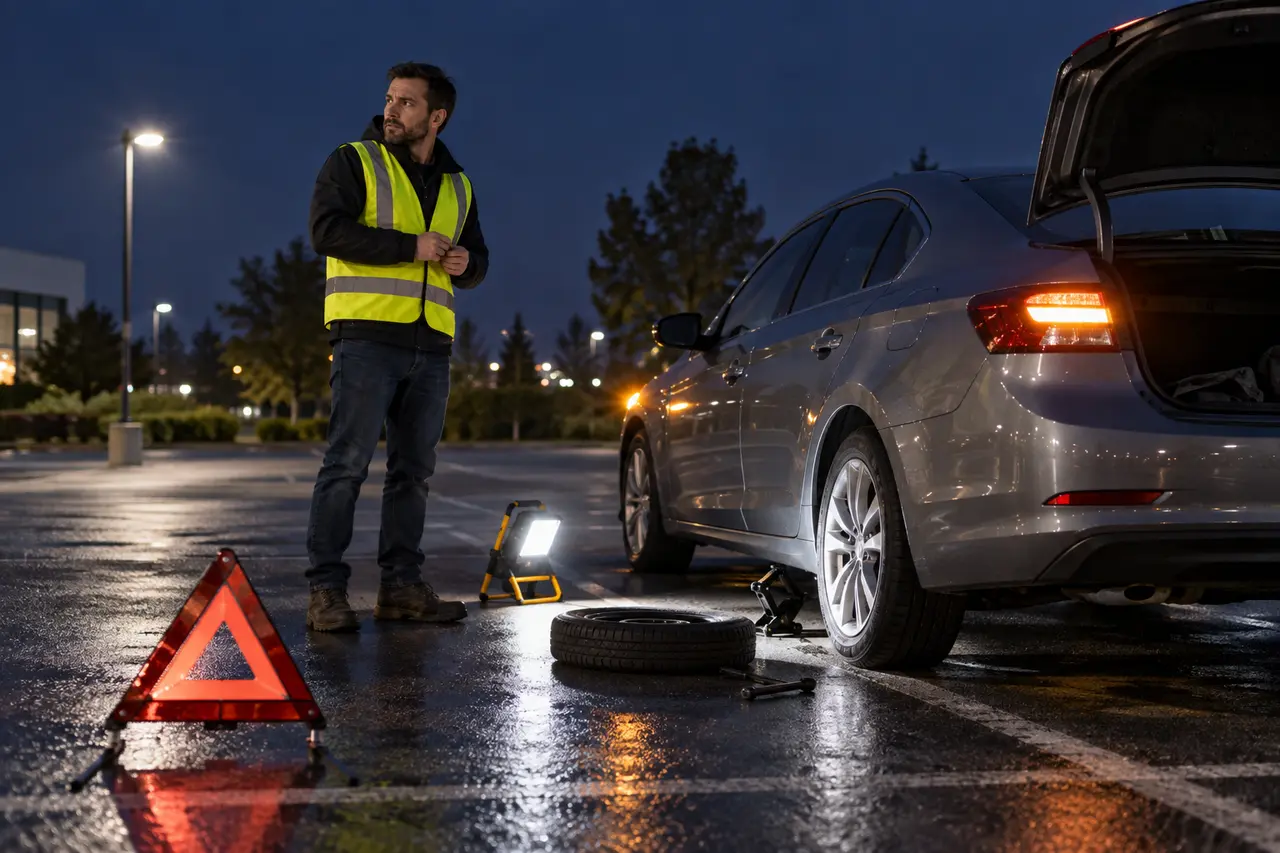
At night, change a tire only in a visible, protected location on firm level ground. If the vehicle cannot clear traffic, the shoulder is narrow, or lighting is too poor to confirm the lift point and jack base, stay in the safest available place and call for assistance.
Move to Light and Separation
An exit ramp destination, service area, parking lot, or wide turnout is usually safer than a dark shoulder. Move only as far as the vehicle can be controlled without causing more damage or risk. Avoid stopping just beyond a curve, hill crest, bridge, or construction barrier.
What Lighting Do You Need?
| Light | Use |
|---|---|
| Hazard lights | Warn other drivers that the vehicle is stopped |
| Hands-free headlamp | Lights the lift point and fasteners while both hands remain available |
| Portable work light | Illuminates the jack base, spare, and surrounding ground |
| Phone light | Backup only; preserve battery for calls and location sharing |
Nighttime Tire-Change Sequence
- 1Stop in the safest visible place
Get fully outside traffic and avoid dark curves, ramps, and soft shoulders.
- 2Secure occupants
Choose the safest protected location based on barriers, traffic, weather, and official advice.
- 3Inspect with light
Confirm the tire, wheel, ground, lift point, jack, wrench, lock key, and spare pressure.
- 4Prepare on the ground
Set chocks and loosen fasteners slightly before lifting.
- 5Keep lighting stable
Do not hold a light in the same hand as a tool or place it where it can roll into traffic.
- 6Install and verify
Use the manual procedure, store every item, and check the area before leaving.
Visibility Equipment Has Limits
A reflective vest and warning devices can make a person easier to see, but they do not stop vehicles. Do not walk into or along a live lane to place triangles or flares. Avoid flares near fuel, dry grass, or leaking fluids.
When Roadside Service Is the Better Choice
- You cannot see the approved lift point clearly.
- The shoulder edge, slope, or surface cannot be confirmed.
- The flat tire is on the traffic side with little clearance.
- You are alone in an unsafe area or cannot maintain situational awareness.
- The wheel, tire, fasteners, jack, or spare has a problem.
Related Guides
Quick answers
Frequently Asked Questions
Is it safe to change a tire at night?
Only in a well-separated, visible, firm, level location where the full task can be completed away from traffic.
Should you use hazard lights while changing a tire?
Yes, when appropriate, but hazards improve visibility and do not create physical protection.
Is a phone flashlight enough?
It is a backup, not ideal primary lighting. A hands-free light keeps both hands available and preserves phone battery.
Where should a light be placed?
Illuminate the lift point, wheel, tools, and ground without shining into traffic or creating deep shadows.
When should you call for help at night?
Call when the shoulder is narrow, lighting poor, traffic fast, weather bad, ground uncertain, or equipment incomplete.