
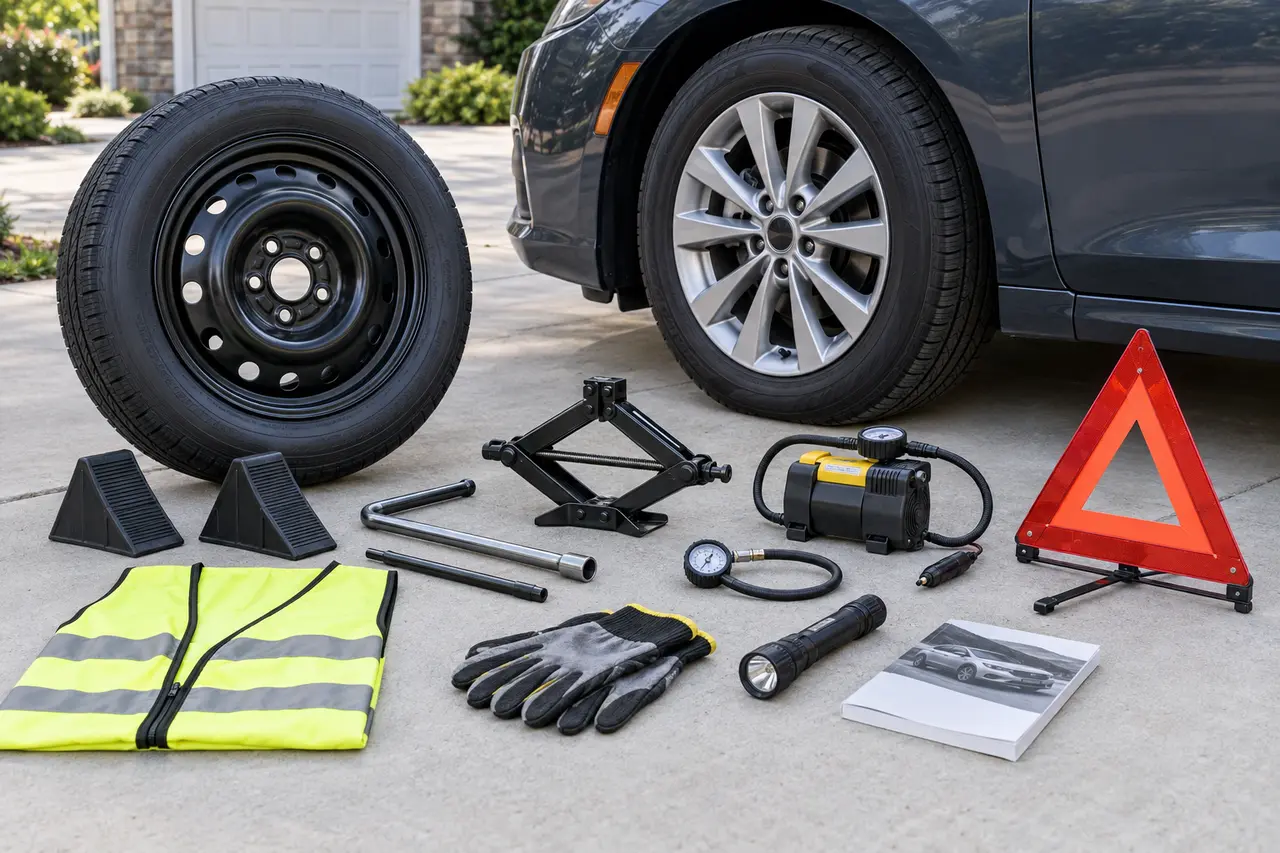
The tools needed to change a tire are a usable spare wheel and tire, the correct jack, a properly sized lug wrench, the vehicle owner’s manual, and a wheel-lock key when the vehicle has locking fasteners. Wheel chocks, gloves, a flashlight, a pressure gauge, and warning equipment make the task safer and more reliable.
A complete kit must match the vehicle. The jack must fit the approved lift point. The wrench or socket must fit the lug nuts or wheel bolts. The spare must be approved for the vehicle and inflated to its specified pressure. A tool that is present but incompatible does not solve the roadside problem.
What Tools Are Essential for a Tire Change?
Five items determine whether the wheel can be removed and replaced. Inspect them together because one missing component can stop the entire process. Store the equipment where cargo cannot bury it and where moisture will not cause corrosion.
| Essential item | Purpose | What to verify |
|---|---|---|
| Spare wheel and tire | Replaces the flat wheel assembly | Correct fit, safe condition, and specified pressure |
| Vehicle jack | Raises one corner of the vehicle | Load rating, lift-point fit, and operating condition |
| Lug wrench | Removes and installs wheel fasteners | Correct socket size and enough leverage |
| Owner’s manual | Identifies lift points, sequence, and limits | Accessible printed or offline copy |
| Wheel-lock key | Releases a locking nut or bolt | Correct pattern and undamaged engagement |
Which Spare Tire Does the Vehicle Have?
A full-size spare may match the road wheels, but its age, tread, pressure, and construction still require inspection. A compact temporary spare is smaller and usually carries strict speed, distance, and position limits. Read the tire sidewall and owner’s manual after installation. Do not treat a compact spare as a normal long-term tire.
Some vehicles have no spare. They may use run-flat tires, a tire mobility kit, or manufacturer roadside support. A sealant kit is intended only for certain tread-area punctures. It will not make a sidewall cut, separated tire, damaged wheel, or large puncture safe. Sealant also expires, so check its date during routine maintenance.
Verify spare pressure when checking the four road tires. Temporary spares often require a different, higher pressure than regular tires. Use the pressure stated by the vehicle or tire manufacturer, not the pressure printed as a guess from another car.
How Do You Choose the Correct Jack?
Use the jack supplied for the vehicle or another jack that has adequate rated capacity and is compatible with the approved lift point. Emergency scissor jacks are compact and vehicle-specific. Hydraulic floor jacks can be easier to operate on a suitable hard surface, but they require correct saddle placement, sufficient capacity, and enough space.
The load rating is not the only requirement. The jack must reach the lift point without unstable extensions, and its base must remain fully supported. Soft soil, sand, slopes, ice, and broken pavement can allow a jack to shift or sink. Move to a safer location or request assistance when the surface is unsuitable.
Never put any part of your body beneath a vehicle held only by an emergency jack. A roadside wheel change requires access beside the vehicle, not underneath it. Jack stands are required for many repair tasks, but a roadside shoulder is not an appropriate place to expand the job into under-vehicle service.
What Lug Wrench and Socket Size Are Required?
The wrench must fully engage the wheel fastener. A loose or incorrect socket can round the fastener and make removal impossible. Many factory kits use an L-shaped wrench. A cross wrench or breaker bar can provide better leverage, provided its socket fits correctly and the tool can be stored securely.
Vehicles may use lug nuts on studs or wheel bolts that thread into the hub. Both systems require the correct tool and installation method. Some lug nuts have decorative caps that swell or deform, which can change how the socket fits. Test the wrench at home without loosening fasteners.
A torque wrench applies the final specified tightening torque. It should not be used as a breaker bar for stuck fasteners because overloading can affect calibration. Keep the manufacturer’s torque specification with the kit. If final torque cannot be applied roadside, arrange a prompt torque check after reaching service.
Why Are Wheel Chocks Important?
Wheel chocks reduce vehicle movement while one corner is raised. Place them according to the owner’s manual, commonly at the wheel diagonally opposite the flat. Apply the parking brake and select Park for an automatic transmission or the manual-specified gear for a manual transmission before positioning the jack.
Purpose-made rubber or molded chocks grip better than loose objects. Do not depend on a stone, bottle, or piece of cargo that can roll, crush, or slide. Chocks do not make a slope safe. The vehicle still needs firm, level ground away from traffic.
Which Safety and Visibility Items Should You Carry?
- Reflective vest: makes the driver easier to see when leaving the vehicle is safe.
- Flashlight or headlamp: keeps both hands available and reveals lift points at night.
- Work gloves: improve grip and protect against dirt and sharp wheel damage.
- Warning triangle or approved roadside device: increases advance warning where local rules and placement conditions permit.
- Kneeling pad: keeps the working position stable and reduces contact with hot, wet, or rough pavement.
- Phone and charged power bank: support emergency calls, location sharing, and access to vehicle instructions.
Place visibility devices only when doing so does not expose you to traffic. Requirements vary by location, and a warning triangle does not create a protected work zone. The safer response on a narrow shoulder, curve, bridge, or high-speed road is to remain protected and call roadside assistance.
Which Pressure and Inflation Tools Help?
A reliable pressure gauge confirms whether the spare is usable. A portable 12-volt inflator can restore pressure to an undamaged spare and can help manage a slow leak long enough to reach a safer location when the manufacturer permits it. Neither device repairs structural damage.
Check pressure before lifting the vehicle. Discovering a flat spare after removing the road wheel creates a more difficult situation. If the spare cannot hold the required pressure, lower the vehicle safely and request help.
Do Electric Vehicles, SUVs, and Trucks Need Different Tools?
They may. Electric vehicles can be heavy and may have restricted lift areas near battery structures. Sport utility vehicles and trucks can require higher-capacity jacks and greater lift range. Dual-wheel vehicles, air suspension, aftermarket wheels, and oversized tires introduce additional instructions or equipment.
Do not select tools by vehicle appearance. Read the gross vehicle and axle information, lift-point instructions, wheel-fastener details, and spare procedure supplied by the manufacturer. Request professional service when the required capacity or procedure is uncertain.
How Should You Inspect and Store the Kit?
Inspect the kit at least when seasons change and before a long trip. Confirm spare pressure, sealant expiration, flashlight batteries, inflator operation, jack movement, wrench fit, and wheel-lock-key location. Look for rust, cracks, bent parts, missing handles, and damaged threads.
Secure every heavy tool. An unsecured jack or wrench can become dangerous during sudden braking or a collision. Keep small parts in a labeled pouch, and place a printed checklist with the kit. Save an offline copy of the vehicle instructions because mobile coverage may be unavailable.
What Should You Do When a Tool Is Missing?
Do not improvise with an undersized jack, mismatched socket, unstable base, or damaged spare. Call roadside assistance or arrange a tow. Forced removal can damage fasteners, and unstable lifting can cause the vehicle to fall.
Prepare before an emergency by following the complete 12-step tire-change guide. Review roadside tire-change safety, decide whether you can change the tire yourself, and understand the difference between changing a wheel and replacing a tire.
Quick answers
Frequently Asked Questions
What are the five essential tools for changing a tire?
The essential items are a serviceable spare wheel and tire, the vehicle-approved jack, a correctly sized lug wrench, the owner’s manual, and the wheel-lock key when locking fasteners are installed. Wheel chocks are also an important safety addition.
Does every car come with tire-changing tools?
No. Some vehicles have a compact spare and tools, while others use run-flat tires or an inflator and sealant kit. Check the cargo area and owner’s manual before assuming that a jack, wrench, or spare is present.
Can any jack be used to change a tire?
No. The jack must support the vehicle’s weight, fit the approved lift point, and be used on a firm, level surface. Follow the jack and vehicle instructions. Never rely on an emergency jack for work beneath a vehicle.
Why does the wheel-lock key belong in the vehicle?
A locking lug nut or wheel bolt cannot normally be removed with the standard wrench. Keeping the matching key with the spare prevents a roadside tire change from stopping before the wheel can be removed.
Should a torque wrench be carried in the car?
A torque wrench is useful for final tightening when it covers the specified torque range and is stored correctly. If one is unavailable roadside, tighten according to the manual and have the wheel torque checked promptly with a calibrated wrench.