
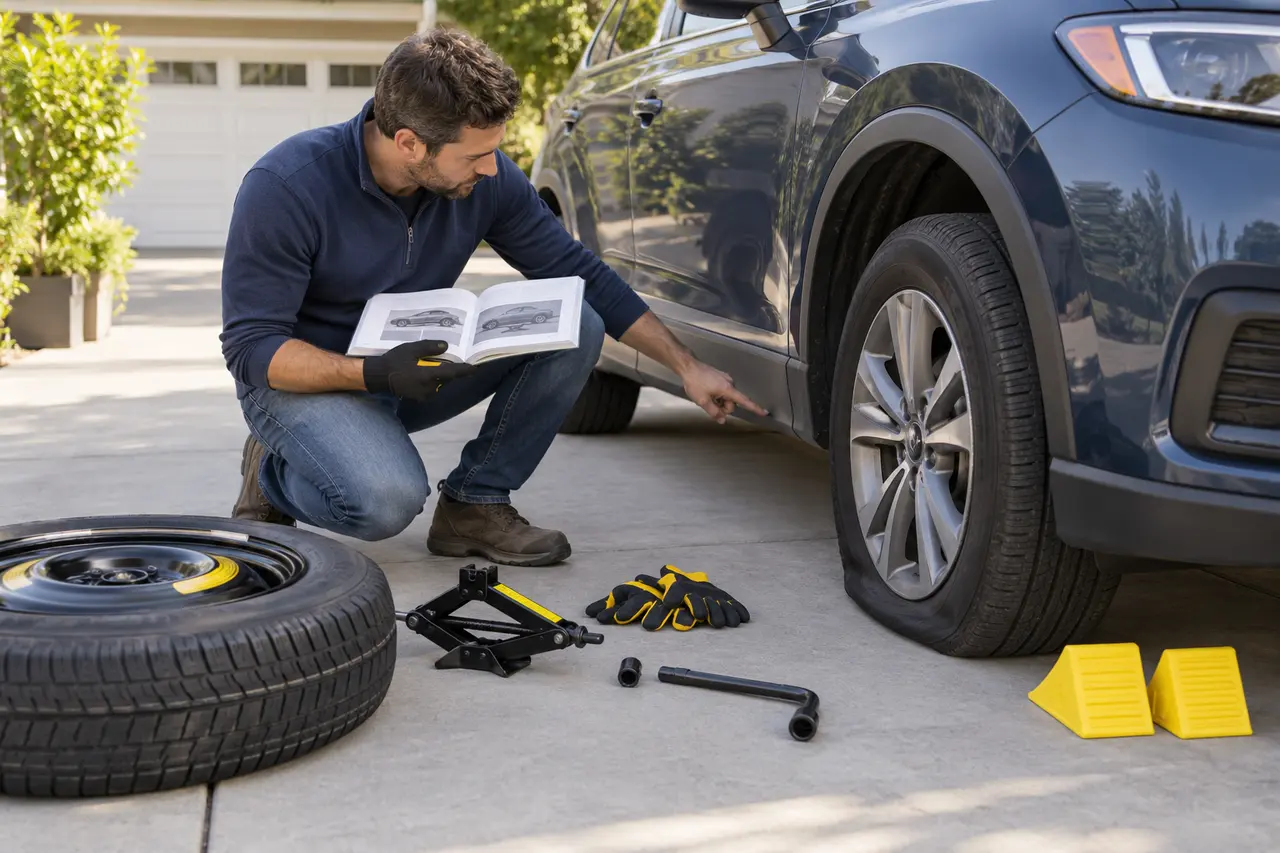
Yes, many drivers can change a tire themselves when the vehicle is in a safe location, the correct tools and usable spare are available, and they can follow the owner’s manual without unsafe physical strain. Call roadside assistance when any one of those conditions is missing.
DIY ability is not only a mechanical question. Traffic exposure, unstable ground, weather, vehicle design, tool condition, and personal mobility determine whether the task is reasonable. A driver who has changed several tires should still stop when the setting is unsafe.
What Must Be True Before You Start?
Use a go-or-stop decision before unloading tools. Every “go” condition must be present. One serious “stop” condition is enough to request help.
| Check | Go condition | Stop condition |
|---|---|---|
| Location | Firm, level, well away from traffic | Narrow shoulder, curve, bridge, slope, soft soil, or ice |
| Visibility | Clear sight lines and adequate light | Fog, darkness without lighting, or severe weather |
| Equipment | Compatible spare, jack, wrench, chocks, and key | Missing, damaged, or incompatible equipment |
| Vehicle | Stable and limited to one flat tire | Collision, wheel, suspension, or multiple-tire damage |
| Driver | Can work beside the vehicle with control | Pain, poor balance, illness, fatigue, or uncertainty |
Hazard lights and warning devices improve visibility, but they do not convert a dangerous shoulder into a safe work area. If the vehicle is exposed to moving traffic, stay in a protected location and call emergency or roadside services as appropriate.
What Skills Does a DIY Tire Change Require?
The driver must identify the correct wheel, lift point, fastener tool, and spare procedure. The mechanical sequence includes securing the vehicle, loosening fasteners while the tire remains grounded, raising at the approved point, swapping the wheel, lowering the vehicle, and tightening in the specified pattern and torque.
Careful observation is more important than speed. The jack should remain vertical and stable according to its design. The spare should sit flush against the mounting surface. Each fastener should start by hand where the design permits, reducing the risk of cross-threading. The driver must recognize when a tool slips, a thread binds, or the vehicle shifts.
Read the 12-step guide to changing a tire before attempting the work. Vehicle instructions override general guidance because lift points, spare placement, fastener type, torque, and suspension requirements differ.
How Much Strength and Mobility Are Needed?
Changing a tire can require kneeling, bending, turning a jack handle, applying controlled force to a wrench, and lifting or rolling a wheel. A small passenger-car wheel may still be awkward. Large sport utility vehicle and truck wheels can be substantially heavier.
Do not use body weight in a way that causes a fall into traffic or against the vehicle. Do not jump on the wrench. Keep your back in a stable position, move the wheel by its sides, and roll it when appropriate instead of carrying it farther than necessary. Work gloves can improve grip but do not increase safe lifting capacity.
Stop if the task causes dizziness, chest pain, sharp pain, loss of balance, or uncontrolled strain. Personal health conditions, pregnancy, recent surgery, and mobility limitations can make professional assistance the safer choice. This decision does not reflect driving competence; it reflects the physical requirements of the specific task.
How Can a Beginner Practice Safely?
Practice in daylight on firm, level private property with another capable adult present. Begin by locating the owner’s manual, spare, jack, wrench, wheel-lock key, and chocks. Identify the approved lift points without placing yourself under the vehicle.
Test that the wrench fits the fasteners and the wheel-lock key engages fully, but do not disturb final wheel torque unless you are completing the full procedure correctly. Learn how the spare carrier releases and how the jack handle assembles. Check spare pressure and sidewall restrictions.
If completing a supervised wheel change, follow the manual from start to finish. Use a torque wrench suitable for the specification. Repack the kit in a repeatable order and confirm that every item is secured. The purpose of practice is to remove uncertainty, not to achieve a fast time.
When Should an Experienced Driver Stop?
Experience does not overcome unstable ground or traffic exposure. Stop if the jack leans, sinks, slips, or contacts the wrong area. Lower the vehicle carefully if conditions permit. Never reach beneath a raised vehicle to reposition equipment or recover an object.
Stop when a lug nut or bolt is rounded, seized, cross-threaded, or turning abnormally. Stop when the wheel appears cracked, bent, or attached to damaged suspension or brake components. Stop when the spare is flat, cracked, separated, the wrong size, or not permitted in the needed position.
Unexpected vehicle movement, leaking fluid, smoke, fuel odor, electrical damage, or collision damage requires a wider emergency response. Move away when safe and contact appropriate services.
Can You Change a Tire on an Electric Vehicle, SUV, or Truck?
Possibly, but do not assume the passenger-car procedure applies. Electric vehicles can have protected battery areas and model-specific lift points. Their weight may exceed the capacity of a generic jack. Some models do not include a spare.
Sport utility vehicles and trucks may require higher lift range and load capacity. Trucks with dual rear wheels, commercial-style wheel hardware, or heavy assemblies can require procedures outside a typical roadside kit. Air suspension may require a service or jack mode.
Check the manual before lifting any unfamiliar vehicle. If the supplied tools are missing or the instructions specify professional service, follow that direction.
What Mistakes Make a DIY Change Unsafe?
- Working too close to traffic: the greatest hazard may be outside the vehicle rather than at the wheel.
- Using soft or sloped ground: the jack can shift or sink as the vehicle rises.
- Skipping wheel chocks: the vehicle can move even when the parking brake is applied.
- Using the wrong lift point: unsupported body areas can deform and the vehicle can become unstable.
- Going beneath the vehicle: an emergency jack is not a safe support for under-vehicle work.
- Guessing fastener torque: improper tightening can damage parts or allow movement.
- Ignoring spare limits: a temporary spare may restrict speed, distance, and wheel position.
What Does Roadside Assistance Provide?
A roadside provider brings trained personnel, larger equipment, visibility measures, and towing access. The provider can install a usable spare when site conditions allow. If the vehicle lacks a spare or has additional damage, towing to a tire or repair facility is usually the next step.
Share the exact location, direction of travel, vehicle color and model, damaged wheel position, spare status, and immediate hazards. Remain in the safest available place while waiting and follow the dispatcher’s instructions.
How Do You Make the Final Decision?
Proceed only when you can state that the location is safe, the vehicle is stable, the tools fit, the spare is usable, the manual is available, and the physical work is within your ability. If one answer is uncertain, request assistance.
Prepare with the complete tool checklist, review roadside safety, and allow the realistic time required to change a tire. A successful DIY change is defined by controlled decisions and a correctly installed spare, not by avoiding a service call.
Quick answers
Frequently Asked Questions
Can a beginner change a tire?
Yes, a beginner can change a tire when the vehicle is on firm, level ground away from traffic, the correct equipment is available, and the owner’s manual is followed. A supervised practice session is safer than learning on a roadside.
How strong do you need to be to change a tire?
You need enough controlled strength and balance to loosen fasteners, operate the jack, and move the wheel without entering the space beneath the vehicle. Use roadside assistance when these actions cause pain, instability, or unsafe strain.
When should you not change a tire yourself?
Do not proceed beside close traffic, on a curve or slope, on soft or icy ground, in severe weather, with missing or damaged tools, with an unusable spare, or when the vehicle or wheel has additional damage..
Can you change a tire without a jack?
No. A wheel cannot be removed safely while it supports the vehicle. Use an approved, correctly rated jack at the manufacturer’s lift point, or request professional help. Improvised lifting methods can fail without warning.
Is changing a tire the same as replacing the tire?
No. A roadside tire change usually swaps the complete wheel and tire assembly for a spare. Replacing the rubber tire on the rim requires specialized mounting, inflation, inspection, and balancing equipment.