
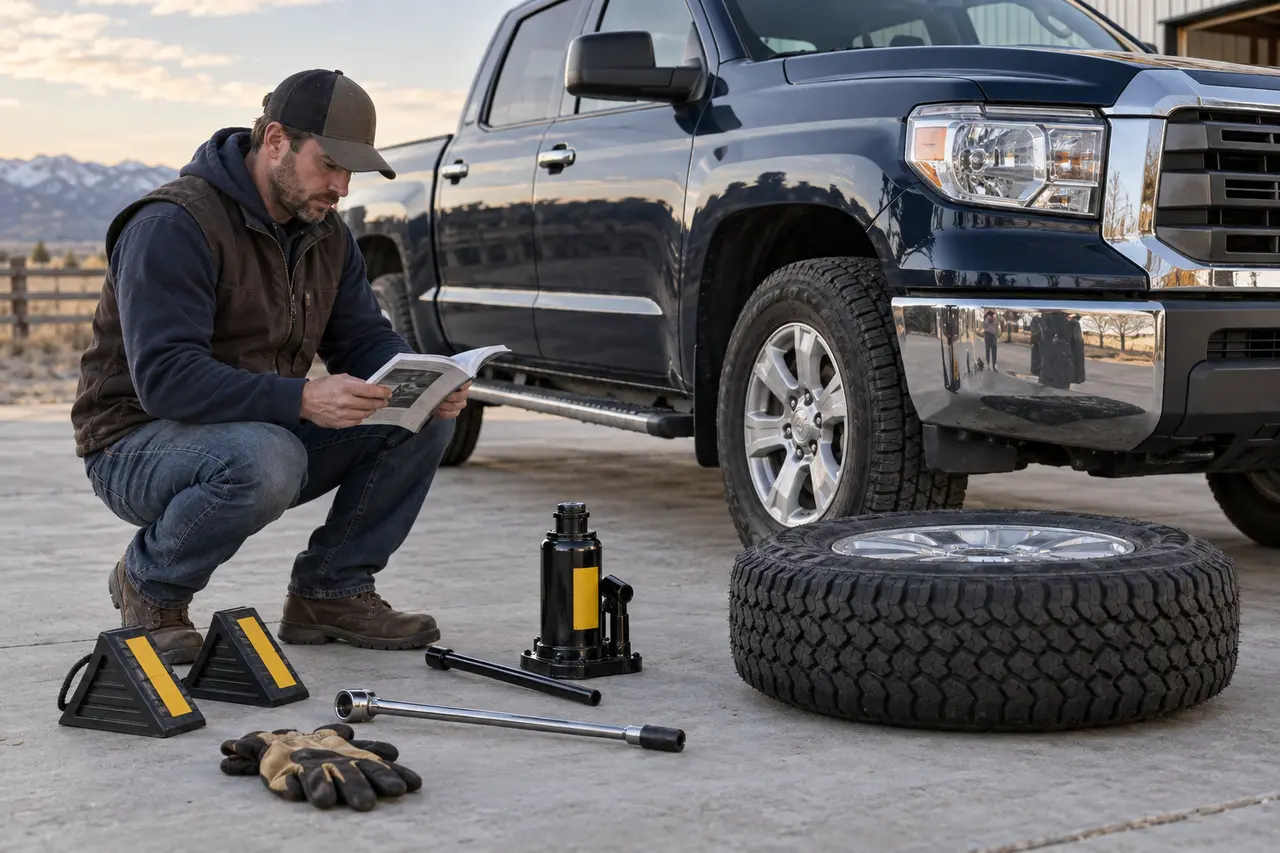
To change a pickup truck tire, stop on firm level ground, secure the truck and its load, retrieve the spare, and use a jack rated for the vehicle at the exact front or rear lift point in the owner manual. Loosen fasteners before lifting, install the spare, lower the truck, and complete the specified tightening procedure.
Pickup Truck Risks to Check First
A pickup may be carrying cargo, a slide-in camper, tools, or tongue weight from a trailer. These loads affect jack capacity and stability. Large light-truck tires are also heavier than passenger-car tires. Do not begin until the truck can be stabilized and the wheel can be handled without strain.
| Condition | Action |
|---|---|
| Heavy or shifting cargo | Secure or reduce the load before lifting when safe and permitted |
| Trailer attached | Follow truck and trailer manuals; call for help if the combination is unstable |
| Dually rear wheel | Use professional service unless the exact equipment and procedure are available |
| Underbody spare carrier | Release it with the factory tool and inspect the cable or latch |
| Lifted or modified truck | Confirm rated jack reach and approved lift points for the modification |
How to Change a Truck Tire
- 1Move out of traffic
Choose firm, level ground. Use hazards, Park or gear, parking brake, and wheel chocks as directed.
- 2Control the load
Secure cargo and keep people outside the work area. Do not lift beneath loose or shifting material.
- 3Lower the spare
Use the factory carrier tool. Pull the spare clear, check pressure, and inspect the wheel and tire.
- 4Prepare the wheel
Remove the cover if fitted and loosen each nut slightly while the tire remains on the ground.
- 5Position the jack
Use the exact frame, axle, or body point shown for that model. Do not guess based on another truck.
- 6Raise and replace
Lift only enough for the inflated spare. Remove the wheel, fit the spare, and hand-start every nut.
- 7Lower and tighten
Use the manual's sequence and torque specification. Store the flat tire and tools securely.
Ford's tire-change guidance is one example of why model-specific instructions matter: jack points and spare-removal procedures are identified through the vehicle manual and factory equipment.
Four-Wheel Drive and Spare Placement
A temporary spare may differ in diameter, load capacity, or tread depth from the road tires. On four-wheel-drive trucks, that difference can affect transfer-case and differential operation. Use only a compatible spare in the permitted position and drive within the stated limit.
What About Lifted Trucks and Oversize Tires?
A suspension lift or larger tire can make the factory jack too short and can change the load at its saddle. The replacement wheel must still clear the brakes and match required load, size, and fastener specifications. Do not stack lumber, rocks, or loose blocks to gain height.
When to Stop and Call for Help
- The truck cannot be positioned away from traffic.
- The jack sinks, leans, or cannot reach safely.
- The spare carrier, wheel lock, or lug nuts will not release.
- The wheel is damaged, the tire is shredded, or suspension parts appear bent.
- A dually, camper, heavy load, or trailer makes the setup uncertain.
After the Change
Follow the spare's speed, distance, load, towing, and axle restrictions. Have the damaged tire and wheel inspected and the wheel-fastener torque verified according to the manual or service instructions. Check all cold pressures monthly and before towing or carrying heavy loads.
Compare the procedure with SUV tire changes, trailer tire changes, and RV tire service when the truck carries or tows extra weight.
Related Guides
Quick answers
Frequently Asked Questions
Can you change a pickup truck tire with the factory jack?
Yes, when the factory jack is present, undamaged, correctly positioned, and approved for the truck's current configuration and load.
Where should a pickup truck be jacked?
Use only the front or rear lift point specified in the owner manual for the affected wheel.
Should cargo or a trailer be removed first?
Reduce or secure loads and follow the manual. A connected trailer or heavy cargo can change stability and may require professional recovery.
Can a pickup spare be mounted on the front axle?
Not always. Spare size, brake clearance, four-wheel-drive rules, and manufacturer instructions may restrict placement.
Can you change an inner tire on a dually yourself?
Dual-rear-wheel service involves heavy parts and special fastener or valve access. Roadside or tire-service help is usually the safer choice.