
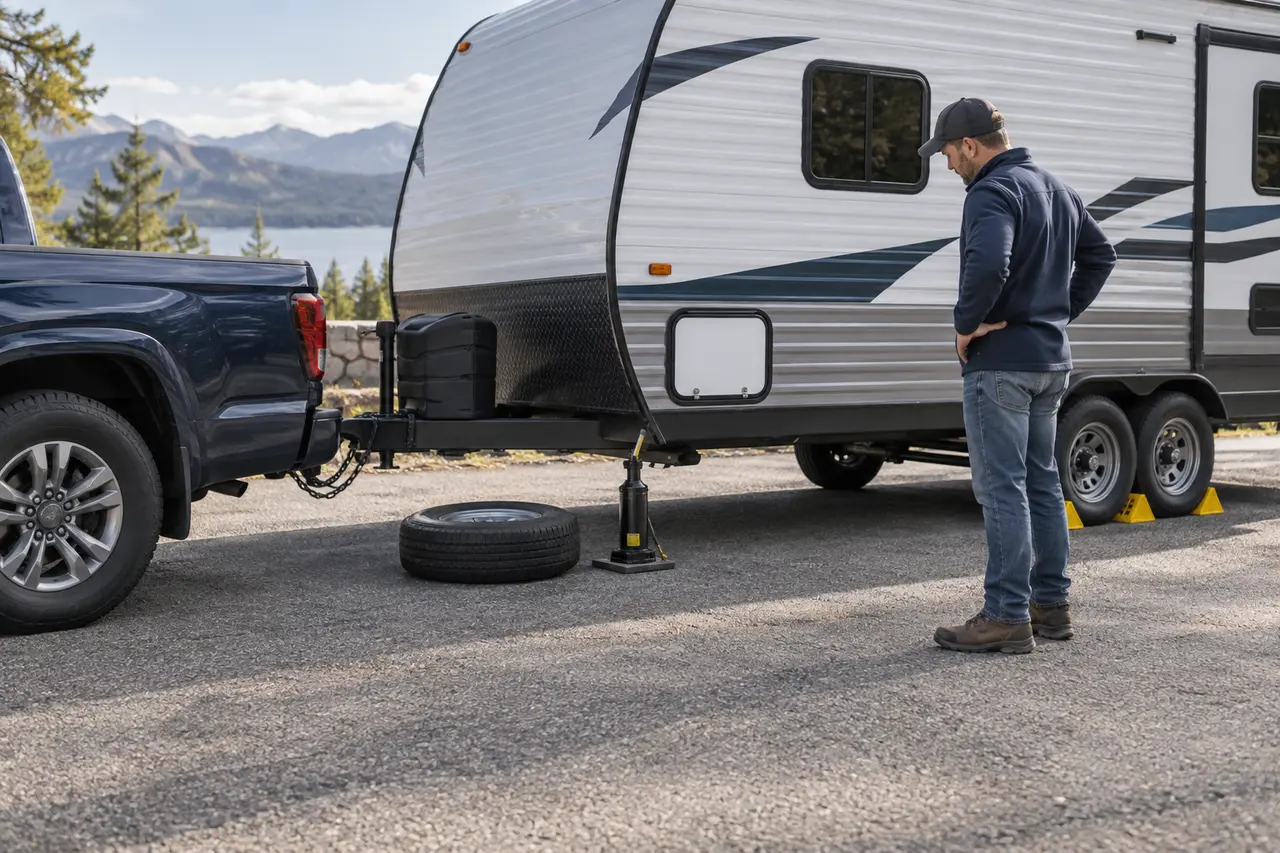
To change a trailer tire, move the tow vehicle and trailer to firm level ground, secure the entire combination, and use only the trailer maker's approved lift point and equipment. Never assume the axle tube, suspension, stabilizer, landing gear, or leveling jack can lift the trailer.
Secure the Trailer Before Touching the Wheel
A trailer can roll, pivot at the hitch, shift its cargo, or settle as one side rises. Keep people away from the traffic side and between the tow vehicle and trailer. Apply the tow vehicle's parking brake, select Park or gear, and chock the wheels exactly as the manuals direct.
| Item | Requirement |
|---|---|
| Jack | Rated for the load at the lift point with enough stable travel |
| Support | Rated stands when the manufacturer procedure calls for them |
| Spare | Correct ST or specified tire, load range, wheel, pressure, and bolt pattern |
| Chocks | Suitable for trailer weight and ground surface |
| Torque tool | Correct socket and torque wrench for final tightening |
How to Change the Trailer Tire
- 1Reach a protected location
Reduce speed smoothly and stop the combination on the firmest level area available.
- 2Secure vehicle and trailer
Use brakes, gear, chocks, hazard lighting, and coupling instructions from both manuals.
- 3Control cargo and systems
Stop shifting loads. Turn off equipment and propane when the manufacturer or damage condition requires it.
- 4Prepare the spare
Verify pressure, size, load rating, wheel fit, valve, and condition before lifting.
- 5Loosen fasteners
Break them loose slightly while the tire still supports weight.
- 6Lift at the approved point
Raise only enough for the inflated spare and add rated support where the manual requires it.
- 7Install and torque
Hand-start the nuts, lower as directed, and tighten in sequence to the trailer specification.
Do Not Guess the Jack Point
Trailer frames, torsion axles, leaf-spring suspensions, enclosed underbellies, tanks, wiring, and slide mechanisms vary widely. Some manufacturer documents specifically warn against lifting with landing gear or rear leveling jacks. Others prohibit jacking on axle tubes or suspension components. Use the exact model procedure.
Single-Axle and Multi-Axle Differences
A single-axle trailer has no neighboring tire to share load, so rated lifting equipment is normally essential. Some multi-axle trailers permit a rated tire-aid ramp to raise the good tire and unload the flat, but only when the trailer maker approves it. A ramp can overload a tire, axle, or suspension on an incompatible trailer.
Trailer Tire and Wheel Matching
Match the specified tire type, size, load range, pressure, wheel capacity, bolt pattern, offset, and fastener seat. The tire load rating must support the axle requirement. Inspect the other tires because overload, age, heat, or low pressure may affect more than one position.
When to Call Roadside Assistance
- The trailer is on a narrow shoulder, slope, soft ground, or curve.
- Cargo is heavy, hazardous, living, or able to shift.
- The hitch, axle, suspension, brake wiring, wheel, or frame is damaged.
- No verified lift point or rated equipment is available.
- The trailer uses heavy commercial wheels or the assembly cannot be handled safely.
After the Change
Follow the trailer maker's lug-torque recheck schedule, often involving checks after initial travel. Monitor the spare pressure and hub temperature, drive conservatively, and arrange inspection of the flat tire, wheel, bearings, brake, suspension, and neighboring tires.
Related heavy-vehicle procedures include RV tire service and pickup truck tire changes. For traffic-exposed stops, use the highway safety guide.
Related Guides
Quick answers
Frequently Asked Questions
Should a trailer stay hitched while changing a tire?
Follow the trailer manual. Many procedures use the tow vehicle for stability, but trailer design and damage can require a different recovery plan.
Can you jack a trailer under the axle?
Not unless the trailer or axle manufacturer identifies that exact point. Some manufacturers warn that axle or suspension jacking can cause damage.
Can leveling jacks lift a trailer for a tire change?
Do not use stabilizers, landing gear, or leveling jacks as lifting devices unless the manufacturer explicitly approves that use.
Can a trailer aid ramp change a tire?
Only on compatible multi-axle trailers when the manufacturer permits it and the ramp is correctly rated and positioned.
When should a trailer tire be replaced after a flat?
Replace it when the sidewall, shoulder, bead, cords, or casing is damaged, or when it was run underinflated beyond safe inspection limits.