
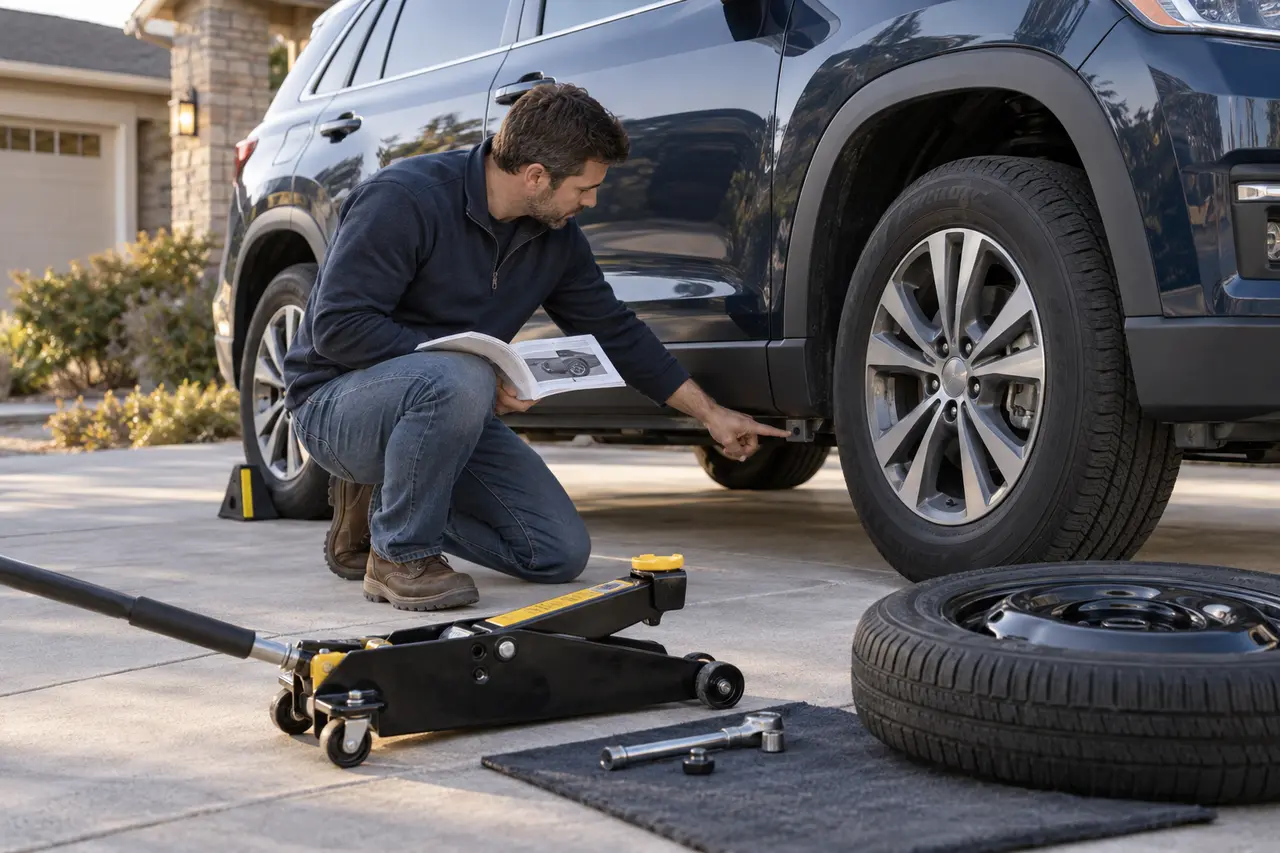
To change an SUV tire, park on firm level ground, secure the vehicle, confirm the jack and spare are rated for the SUV, loosen the wheel nuts slightly, and lift only at the model's approved jack point. Install the spare, hand-start every nut, lower the SUV, and tighten in the specified pattern and torque.
Why Is an SUV Tire Change Different?
An SUV may weigh more and sit higher than a passenger car. Its wheel can be larger and harder to control, while the factory jack may need more travel. Some SUVs use air suspension, running boards, underbody protection, staggered tires, large brakes, or all-wheel drive. Each feature can change the safe lift point or spare placement.
Do not choose a lifting location because it looks strong. A body seam, suspension arm, differential, battery enclosure, or step may be unsuitable. The owner manual and factory jack label control the procedure.
What Should You Check Before Lifting?
| Check | Confirm | Stop if |
|---|---|---|
| Location | Firm, level, protected ground | Traffic, slope, soft soil, or unstable shoulder |
| Jack | Correct type, capacity, reach, and saddle | Damage, leaning, sinking, or poor contact |
| Spare | Correct fit, pressure, and permitted position | Flat, cracked, wrong size, or restricted |
| Suspension | Required jack or service mode is active | Vehicle can self-level while raised |
| Wheel tools | Full-fitting socket and wheel-lock key | Tool slips or fastener is damaged |
How to Change the SUV Tire
- 1Stop and secure the SUV
Turn on hazards, select Park or a low gear, apply the parking brake, and keep passengers away from traffic.
- 2Chock the opposite wheel
Follow the manual. A common position is the wheel diagonally opposite the flat.
- 3Prepare the spare and tools
Check spare pressure before lifting. Remove the lock key, wrench, jack, handle, and any wheel-cover tool.
- 4Loosen the wheel nuts
With the tire on the ground, loosen each fastener about a partial turn without removing it.
- 5Lift at the approved point
Place the jack squarely, raise only enough for an inflated spare to clear, and never go under the SUV.
- 6Swap the wheel
Remove the nuts and wheel. Keep hands and feet out from under the vehicle. Fit the spare and start each nut by hand.
- 7Lower and tighten
Snug in the specified crossing pattern, lower fully, then apply the manufacturer's final torque procedure.
Air Suspension and High Ground Clearance
An air-suspension SUV may try to level itself while raised. Activate the exact jack, tire-change, or service mode stated in the manual before lifting, and cancel it afterward. A tall SUV also needs a jack with enough rated reach. Stacking loose blocks under a short jack is unstable and unsafe.
Temporary Spare and AWD Limits
Read the spare label before driving. A compact spare can change braking, steering, ground clearance, and driver-assistance operation. On an AWD SUV, the spare's diameter and permitted axle position are especially important. Follow the lowest speed, distance, load, towing, and position limit.
When Should You Call Roadside Assistance?
- The shoulder is narrow, sloped, soft, or exposed to traffic.
- The SUV is towing, heavily loaded, damaged, or cannot be made stable.
- The spare, lock key, jack, or correct wrench is missing.
- A wheel nut is stripped, swollen, seized, or previously overtightened.
- The wheel is too heavy to control safely.
After Installing the Spare
Check the spare pressure and TPMS warning, store the damaged wheel securely, and drive directly to service within all temporary limits. Ask the technician to inspect the tire, wheel, valve, sensor, hub, and fasteners. NHTSA TireWise recommends monthly cold-pressure checks for all tires, including the spare.
Related Guides
Quick answers
Frequently Asked Questions
Can you use a car jack on an SUV?
Only if the jack is approved for the SUV's weight, reaches the specified lift point, and is used exactly as the vehicle manual directs.
Where do you jack up an SUV?
Use only the lift point identified for that exact model and wheel position in the owner manual or on the factory jack label.
Why is an SUV wheel harder to change?
SUVs often have greater weight, higher lift points, heavier wheels, larger tires, and sometimes air suspension or special spare placement.
Can an SUV temporary spare go on any wheel?
Not always. Brake clearance, drivetrain design, tire size, and manufacturer instructions may restrict its position.
Should you retighten SUV lug nuts after changing a tire?
Follow the owner manual and service instructions for final torque and any required recheck after driving.