
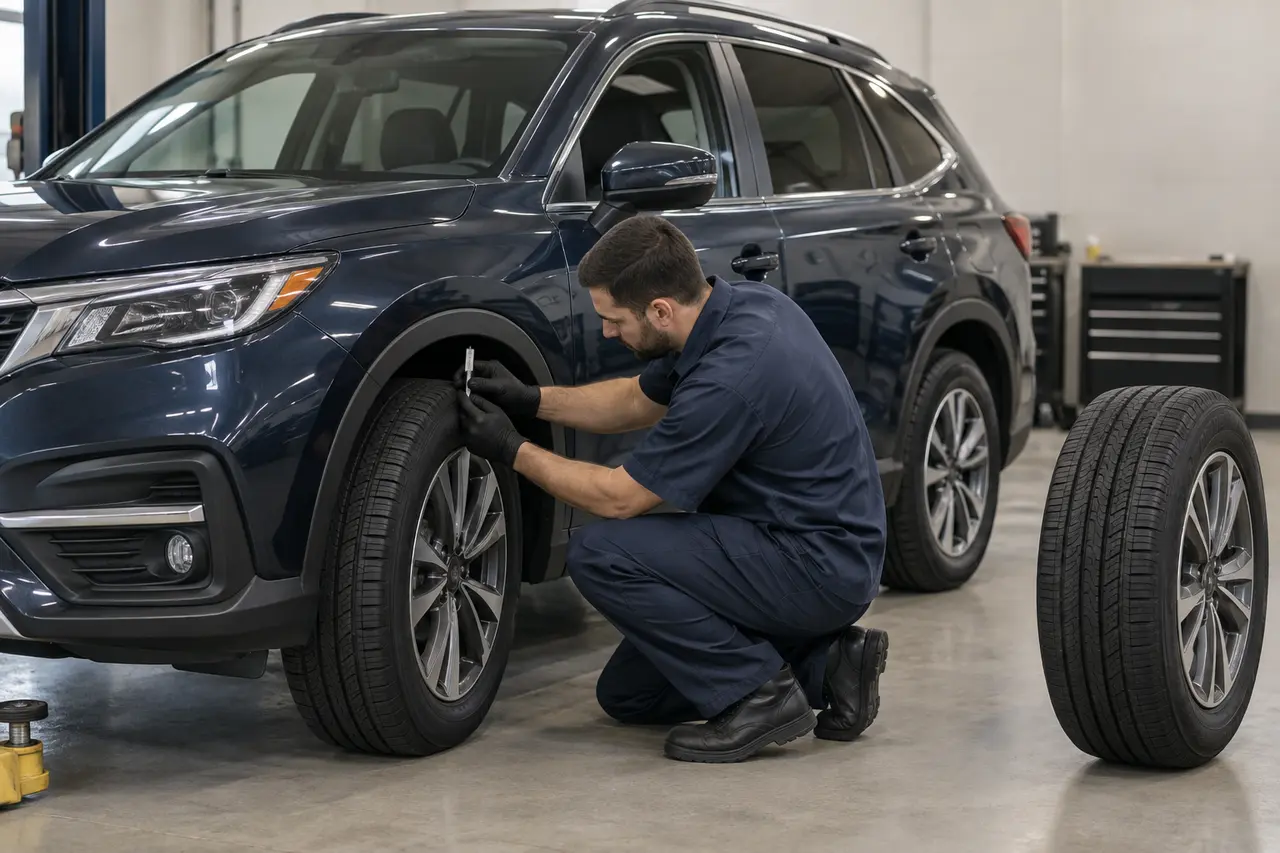
Changing a tire on an AWD car uses the normal safe wheel-swap sequence, but the replacement tire's rolling diameter and permitted wheel position matter more. Use only the spare approved in the owner manual, follow its axle, speed, and distance limits, and restore a correctly matched road tire as soon as possible.
Why AWD Tire Matching Matters
An all-wheel-drive system distributes power through several differentials or couplings. If one tire travels a different distance per rotation, the system may keep correcting for a difference that is caused by tire size or wear rather than a turn. Excessive mismatch can create heat, binding, warning messages, or driveline wear.
Matching is not based on the size label alone. Actual circumference changes with tread depth, pressure, construction, and load. Use the vehicle maker's allowable difference, not a universal rule copied from another AWD model.
Check These Items Before Installing the Spare
| Item | What to confirm |
|---|---|
| Spare type | It is the factory-specified temporary or full-size spare |
| Wheel position | The manual permits it on the affected axle |
| Pressure | It matches the spare-specific cold requirement |
| Driving limit | Speed, distance, load, weather, and towing restrictions are understood |
| Tow method | The method will not rotate a connected drivetrain contrary to the manual |
How to Change the AWD Tire
- 1Stop on protected level ground
Use hazards, Park or gear, parking brake, and wheel chocks as instructed.
- 2Read the spare-placement rule
Some vehicles restrict a compact spare to the rear and may require moving a good rear wheel to the front.
- 3Check the spare and tools
Confirm pressure, condition, jack, wrench, lock key, and approved lift point.
- 4Loosen and lift
Loosen fasteners while the tire is grounded, then lift only at the named point.
- 5Install the permitted wheel
Seat it fully, start all fasteners by hand, lower, and tighten to the specified torque.
- 6Use temporary mobility carefully
Drive directly to service within every limit and avoid hard acceleration or sharp turns.
Replacing One Tire on an AWD Car
A technician should measure tread depth and identify the exact make, model, size, load index, speed rating, and construction of all four tires. Depending on manufacturer limits, the solution may be one closely matched tire, a shaved new tire, an axle pair, or a full set. Do not assume all four must always be replaced, but do not ignore a meaningful mismatch.
TPMS and Driver-Assistance Warnings
A temporary spare, different tire diameter, or incorrect pressure may trigger TPMS, stability-control, ABS, or AWD warnings. These systems do not prove the wheel is mechanically secure. Check pressure and installation first, then follow the model's relearn or reset instructions.
When to Use a Flatbed
Call for a flatbed when no approved spare is available, the spare position is restricted, the vehicle cannot be lifted safely, or the towing method is unclear. Do not allow two driven wheels to roll on the road unless the manufacturer expressly permits that method.
Related Guides
Quick answers
Frequently Asked Questions
Can you use a temporary spare on an AWD car?
Only if the owner manual permits that exact spare and wheel position, and only within its stated speed and distance limits.
Does tread depth matter on an AWD vehicle?
Yes. Different rolling circumferences can make the AWD system compensate continuously, so manufacturers may limit tread-depth differences.
Should all four AWD tires be replaced together?
Not always. Measure all tires and follow the vehicle and tire makers' limits for size, type, and circumference.
Where should a compact spare go on an AWD car?
The permitted axle and position vary by model. Follow the owner manual, which may require moving a good wheel first.
Can an AWD car be towed with two wheels on the road?
Only when the manufacturer permits it. Flatbed transport is often the safest default when towing instructions are uncertain.