
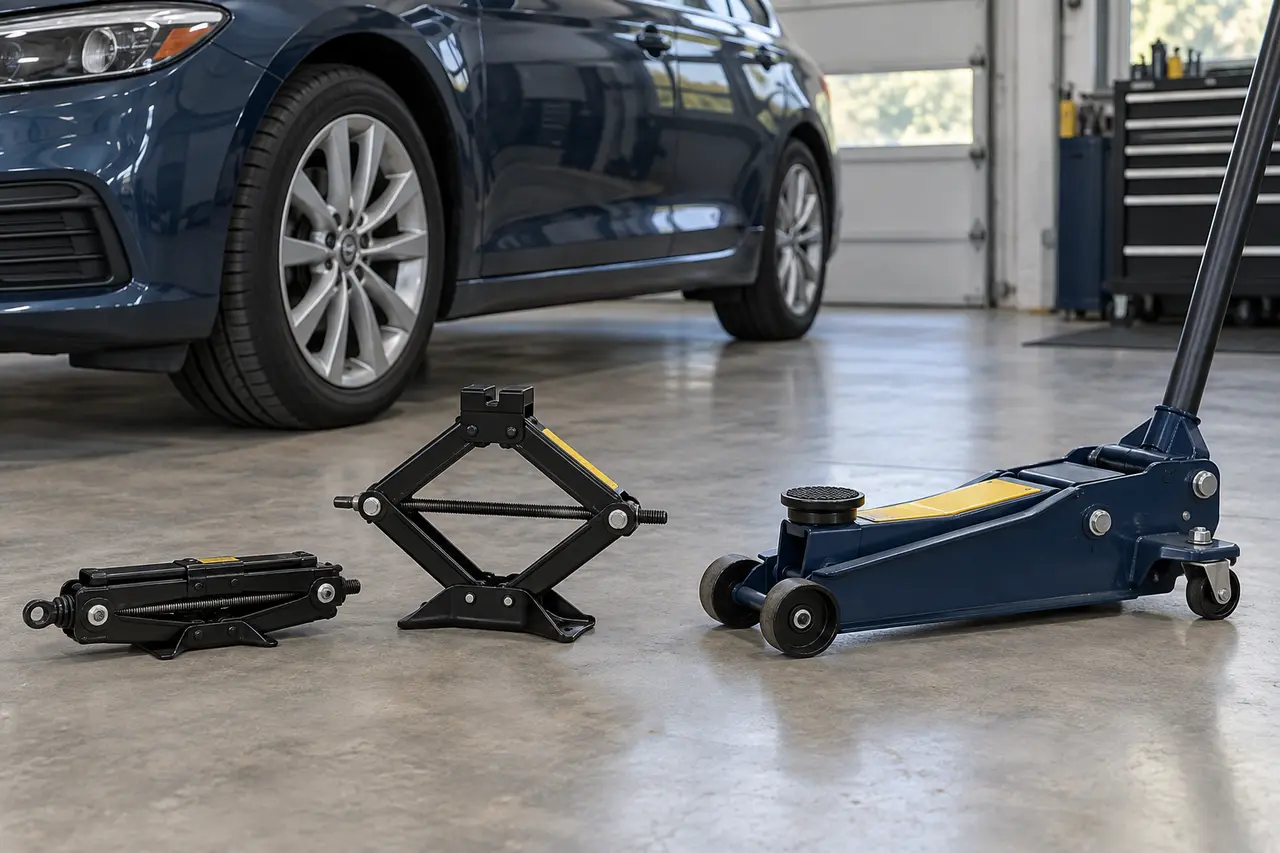
A scissor jack is best for compact emergency storage and a model-specific roadside wheel change, while a hydraulic floor jack is usually better for controlled lifting on a smooth, level garage floor. Neither is automatically safe; rating, fit, surface, placement, and condition determine safe use.
The correct choice depends on the task. A jack raises the vehicle. It does not provide safe support for work beneath it. Use properly rated jack stands at approved support points whenever service requires under-vehicle access.
What Is the Main Difference?
A scissor jack uses a mechanical screw to pull linked arms together and raise a small saddle. It is light and folds nearly flat. Most factory scissor jacks are intended for changing one wheel during an emergency.
A floor jack uses a hydraulic mechanism and a long handle. Its wheeled chassis stays under the vehicle while the lifting arm raises a saddle. It is larger and heavier but can provide faster, smoother lifting on a suitable surface.
| Factor | Scissor jack | Floor jack |
|---|---|---|
| Primary use | Emergency wheel change | Garage lifting and repeated service |
| Operation | Mechanical screw and handle | Hydraulic pump and release valve |
| Storage | Compact and light | Large and heavy |
| Base | Small fixed footprint | Broader wheeled chassis |
| Surface need | Firm and level | Smooth, firm, level surface for wheels |
| Lift speed | Slower screw turns | Faster handle strokes |
| Maintenance | Inspect screw, arms, base, and saddle | Inspect hydraulics, wheels, valve, handle, and saddle |
Which Jack Is Better for a Roadside Emergency?
The factory scissor jack is generally more practical because it is stored in the vehicle and shaped for the specified emergency lift point. Its handle and spare tools form one system. It does not require a large, heavy tool to be carried on every trip.
A compact floor jack may be useful for a service vehicle or for drivers who can secure the weight safely. Roadside surfaces can prevent its small wheels from moving as the lift arm arcs. Gravel, dirt, broken pavement, and soft asphalt can make either jack unsuitable.
Traffic exposure remains the controlling factor. A more stable-looking jack does not make a narrow shoulder safe. Call roadside assistance when the work area is close to moving traffic.
Which Jack Is Better in a Home Garage?
A properly rated floor jack is usually easier for repeated lifting on smooth, level concrete. The long handle provides leverage, and the hydraulic mechanism raises the saddle with controlled strokes. Low-profile models can reach some low cars, while long-reach models may access deeper lift points.
The jack must have enough capacity and lift range for the vehicle. Its saddle must contact the approved point or an approved adapter. Check that the jack can roll slightly as the lifting arm rises. Blocking its wheels can introduce lateral force unless the instructions state otherwise.
Lower the vehicle onto correctly rated jack stands when the work extends beyond a wheel change or involves under-vehicle access. Never use a floor jack as permanent support.
How Does Stability Compare?
A floor jack normally has a wider chassis, but its stability relies on level ground, free-moving wheels, correct saddle contact, and sound hydraulics. A scissor jack has a smaller base and is more sensitive to tilt, ground compression, and side loading.
Neither design should lift on a slope. Neither should be used with random blocks or stacked materials. The vehicle must be secured with the parking brake, correct transmission position, and wheel chocks before lifting.
Side force can occur when fasteners are loosened after the tire leaves the ground. Loosen them slightly first. Avoid pushing the vehicle, opening doors repeatedly, or allowing occupants to remain inside.
How Do Capacity and Lift Range Differ?
Floor jacks are sold in several rated capacities and lift ranges. A higher advertised rating does not make every model suitable. The jack must fit under the vehicle when lowered and reach the approved point while retaining safe engagement.
Factory scissor jacks are selected for a particular vehicle or platform. Do not assume that one from another car is compatible. Differences in curb weight, lift-point shape, minimum height, and required clearance matter.
Vehicle gross weight is not the only number involved because a jack normally raises part of the vehicle. Follow manufacturer selection guidance rather than calculating an improvised minimum.
Which Jack Is Easier to Operate?
A floor jack usually requires less repeated hand turning. Pumping the handle raises the saddle, and a controlled release lowers it. The release valve must be operated gradually. Rapid lowering can damage the vehicle or trap hands and tools.
A scissor jack requires more turns and can become harder to operate as load increases. A clean, lightly maintained screw operates better, but apply only manufacturer-approved lubrication. Keep fingers away from folding arms and pinch points.
Which Jack Requires More Maintenance?
A scissor jack needs inspection for a straight screw, sound threads, undamaged pivot points, aligned arms, a flat base, and a correct saddle. Corrosion or bending is a reason to replace it.
A floor jack adds hydraulic fluid, seals, pump action, release control, wheels, casters, handle attachment, and lifting-arm pivots. A jack that drifts down, leaks, binds, or fails to raise smoothly should be removed from service and assessed according to its instructions.
Do not repair a structural or hydraulic fault without qualified instructions and correct parts. Test equipment without placing a person beneath a load.
Can Either Jack Be Used on Gravel or Asphalt?
Loose gravel allows a base or wheel to move. Soft ground can let the load sink. Warm asphalt may deform under concentrated pressure, especially beneath small floor-jack wheels. These surfaces can make lifting unsafe.
Use only manufacturer-approved ground support methods. A random board may split, tilt, or prevent a floor jack from moving correctly. Moving the vehicle to firm, level concrete or requesting help is safer than improvising.
What About SUVs, Trucks, and Electric Vehicles?
These vehicles may require greater capacity, height, reach, or special contact pads. Electric vehicle battery enclosures create restricted contact areas. Body-on-frame trucks may specify frame or axle points. Air suspension may require a jack mode.
Read the lifting section for the exact model. A jack that fits a passenger car may be too short, too lightly rated, or incorrectly shaped. Heavy wheels also affect the practicality of a roadside change.
What Are the Main Pros and Cons?
- Scissor-jack advantage: compact storage and model-specific emergency fit.
- Scissor-jack limit: small base, slower operation, and greater sensitivity to side loading.
- Floor-jack advantage: broader chassis, smooth lift, and easier repeated garage use.
- Floor-jack limit: weight, storage space, hydraulic maintenance, and need for a smooth surface.
- Shared limit: neither replaces jack stands for under-vehicle service.
- Shared requirement: both need an approved lift point and a secured vehicle.
Which Jack Should You Choose?
Keep the approved scissor jack for a roadside wheel change when the vehicle supplies one. Select a suitable floor jack for controlled home service when you have firm, level workspace, correct capacity, compatible contact equipment, and jack stands.
Learn how to use a scissor jack safely and how to identify jack points. Inspect any jack before use. The safer choice is the correctly rated, compatible, maintained tool used in the environment for which it was designed.
Quick answers
Frequently Asked Questions
Is a floor jack safer than a scissor jack?
A suitable floor jack often has a broader base and easier controlled lifting on smooth, level concrete, but safety still depends on rating, saddle placement, surface, maintenance, and jack stands. A correctly used scissor jack can be suitable for its intended roadside wheel change.
Can a floor jack be used to change a tire?
Yes, when it has adequate capacity, the correct lift range and saddle, and it is used on firm level ground at an approved lift point. Never work beneath a vehicle supported by the floor jack alone.
Why do cars come with scissor jacks?
Scissor jacks are compact, light, inexpensive to package, and designed around vehicle-specific emergency lift points. They fit a cargo compartment more easily than a hydraulic floor jack.
Can you use a floor jack on asphalt?
Use caution and follow the jack instructions. Warm or weak asphalt can deform under small wheels and concentrated loads. A suitable load-distributing surface may be required, but improvised boards can create instability.
Do you need jack stands for a tire change?
A roadside wheel swap is performed without entering beneath the vehicle. Any task that requires under-vehicle access needs properly rated jack stands placed at approved support points in a suitable work area. A jack alone is not a stand.