
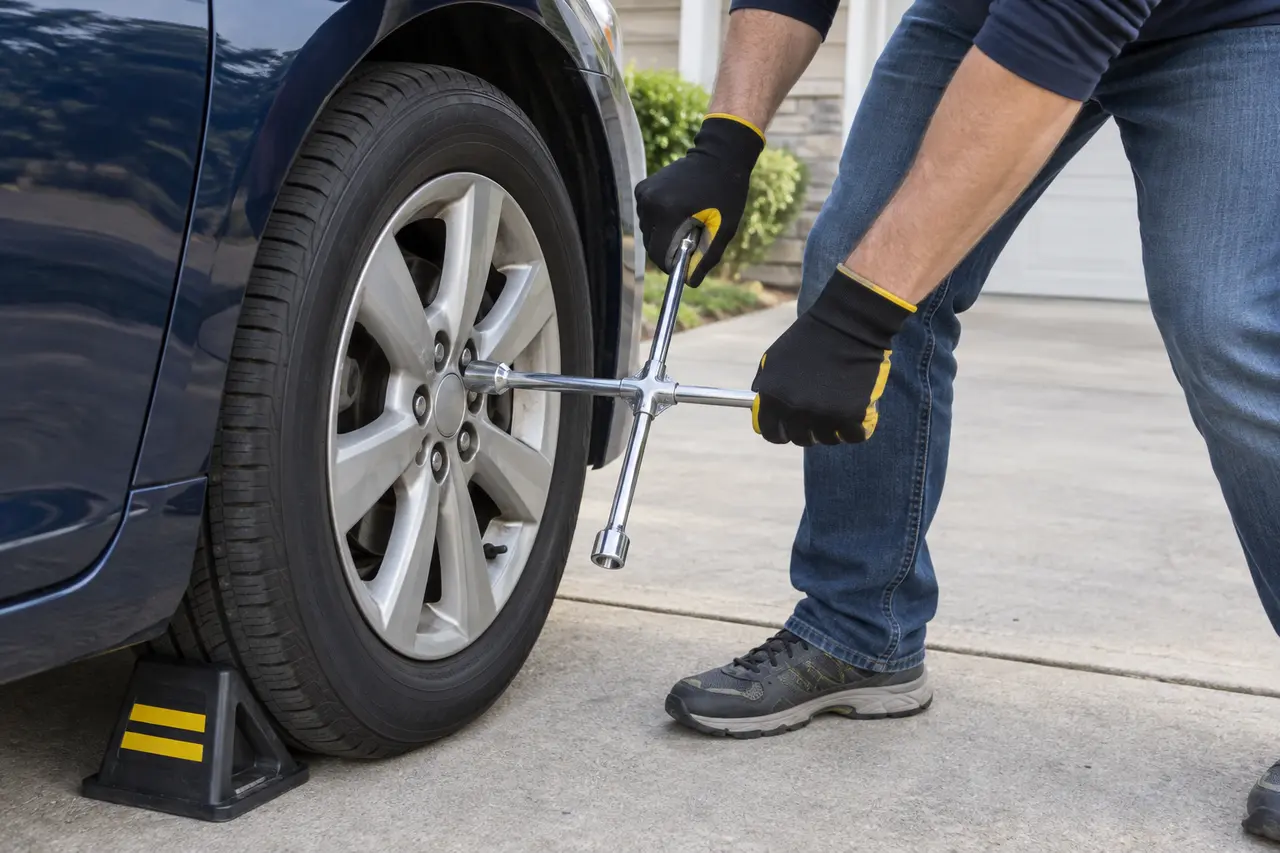
To use a lug wrench, secure the vehicle, select the exact socket size, seat it fully on the wheel fastener, and apply smooth force while the tire remains on the ground. Loosen each fastener slightly before lifting, then use a crossing pattern and specified torque during installation.
A lug wrench provides leverage but does not measure torque. Its correct role is removal and initial installation. Use a calibrated torque wrench for final tightening when the vehicle manufacturer provides a torque specification.
What Type of Wheel Fastener Does the Vehicle Use?
Many vehicles use lug nuts threaded onto studs fixed in the hub. Others use wheel bolts that pass through the wheel and thread into the hub. The wrench action is similar, but wheel bolts can make wheel alignment more difficult during installation.
A locking lug nut or bolt requires a matching key. Decorative caps may cover ordinary fasteners. Some capped lug nuts can deform or swell, changing the apparent socket fit. Inspect the system before an emergency.
Which Lug Wrench Should You Use?
The factory L-shaped wrench is compact and normally matches the original fasteners. A four-way cross wrench provides several socket sizes and two-handed control. A breaker bar with the correct impact-rated or hand-tool socket can provide more leverage.
Select the exact size. Metric and inch sockets that appear close are not interchangeable. A loose fit can damage the corners of the fastener. A socket must also be deep enough and shaped correctly for the nut.
| Tool | Advantage | Limit |
|---|---|---|
| Factory L wrench | Compact and vehicle matched | Limited leverage and hand positions |
| Four-way wrench | Good control and several fixed sockets | Bulkier and not every size may fit |
| Telescoping wrench | Compact storage with added leverage | Locking mechanism must be sound |
| Breaker bar | Strong controlled leverage | Requires separate correct socket |
| Torque wrench | Measures final tightening torque | Not intended for routine loosening |
How Do You Prepare the Vehicle?
Park on firm, level ground away from traffic. Apply the parking brake, select Park or the manual-specified gear, and place wheel chocks. Remove passengers and keep them away from the vehicle.
Take out the spare, jack, wrench, wheel-lock key, and pressure gauge before lifting. Check the spare. Remove the wheel cover, center cap, or lug caps only as described by the vehicle instructions.
How Do You Seat the Lug Wrench Correctly?
Clean loose dirt from the fastener face. Push the socket straight on until it reaches full depth. Hold the wrench so force remains in the turning plane rather than pulling the socket sideways.
With a cross wrench, choose the exact arm and use the opposite arm for balanced control. With an L wrench or breaker bar, arrange the handle where steady downward pressure is possible without falling toward the vehicle or roadway.
Which Direction Loosens Lug Nuts?
Most modern passenger vehicles use standard right-hand threads. Viewed directly at the fastener, counterclockwise loosens and clockwise tightens. Do not continue applying force when the fastener has special markings or behaves unexpectedly.
Check the owner’s manual for specialized vehicles, older equipment, or unusual wheel systems. Direction is only one factor. Corrosion, overtorque, damaged threads, and decorative caps can make a normal fastener difficult to turn.
Why Should Fasteners Be Loosened Before Lifting?
The grounded tire resists rotation and keeps the vehicle more stable while initial torque is applied. Turn each fastener only enough to break it loose, commonly a small fraction of a turn. Leave every fastener installed.
Attempting to break a fastener loose after lifting can rotate the wheel and push the vehicle sideways on the jack. If the fastener will not move with controlled force, stop before raising the car and request suitable help.
How Much Force Is Safe?
Use a stable stance and gradual pressure. Keep the socket square. Do not kick, jump, or bounce on the wrench. Avoid pipes or improvised extensions that can bend the tool, break the fastener, or cause a fall.
A purpose-built breaker bar can provide controlled leverage when it and the socket are rated for the work. Roadside space and traffic may still make high-force removal unsafe. A seized or rounded fastener requires professional tools.
How Do You Remove the Fasteners?
After the vehicle is safely raised and the tire clears the ground, turn the loosened fasteners by hand or with the wrench. Support the wheel so it does not bind against the final nut or bolt. Store fasteners in a clean tray or pouch.
Do not place them on dirt where grit can enter the threads. Do not mix hardware from different wheel positions when the vehicle uses unique fasteners or locks.
How Do You Start Lug Nuts or Wheel Bolts?
Align the spare wheel squarely against the hub. Start each fastener by hand when the design permits. It should turn several threads without heavy resistance. Stop if it binds immediately because cross-threading can damage the stud, bolt, or hub.
Wheel bolts may require holding the wheel while aligning a hole with the hub thread. Use an approved guide tool when provided. Never hang the wheel from one partially engaged bolt while forcing the others.
What Tightening Pattern Should You Use?
Snug fasteners in a star or crisscross pattern so the wheel seats evenly. For four fasteners, move to the opposite fastener. For five, follow a star. Six and eight patterns also alternate across the center.
Do not fully tighten one fastener while the others remain loose. Bring them into contact in stages. The wheel mounting face should sit flush against the hub without a gap.
How Is Final Torque Applied?
Lower the vehicle as the manual directs so the tire resists rotation. Set a suitable torque wrench to the manufacturer’s specification and tighten in the same crossing pattern. Apply one smooth pull at the designated handle location and stop at the tool’s signal.
Do not guess torque by body weight or count of wrench turns. Do not lubricate threads unless the manufacturer specifically requires it because lubrication changes the relationship between applied torque and clamping force.
What If a Lug Nut Is Stuck, Rounded, or Missing?
Recheck direction and socket size. A six-point socket can provide better contact than a twelve-point socket for difficult hex fasteners. Stop when the tool slips or metal begins to round. Extraction may require special sockets, heat control, or replacement parts.
Do not drive normally with missing or damaged wheel hardware. Install the spare only when all required fasteners can be secured correctly. Arrange towing or professional roadside service when the wheel cannot be clamped as designed.
How Should a Lug Wrench Be Stored?
Clean and dry the tool after use. Inspect the socket and drive areas for cracks, spreading, bends, or corrosion. Secure it with the factory kit or in a tool bag so it cannot become a projectile.
Keep the wheel-lock key and any adapter with the wrench. Add both to the emergency tire change kit. Learn how to apply final torque and follow the complete wheel-change sequence for safe use.
Quick answers
Frequently Asked Questions
Which way do lug nuts loosen?
Most passenger-vehicle wheel fasteners loosen counterclockwise and tighten clockwise when viewed from the fastener. Some specialized vehicles can differ, so stop and check the manual if markings or resistance are unusual.
Should you loosen lug nuts before jacking up the car?
Yes. Break each fastener loose slightly while the tire remains on the ground. This lets the tire resist turning and avoids applying large side force to a raised vehicle. Do not remove the fasteners before lifting.
Can you stand or jump on a lug wrench?
No. Jumping can cause a fall, make the socket slip, round the fastener, or destabilize the vehicle. Use a correctly fitted tool, stable stance, and controlled pressure. Request professional help for seized hardware.
Is a lug wrench the same as a torque wrench?
No. A lug wrench loosens and installs fasteners. A torque wrench measures final tightening torque. Do not use a torque wrench as a breaker bar unless its manufacturer specifically allows that use.
What should you do if a lug nut is stuck?
Confirm the direction and socket fit, then apply smooth controlled force with an appropriate lug wrench or breaker bar. Stop if the socket slips, the nut rounds, or excessive force is required. Roadside assistance may need specialized removal tools.