
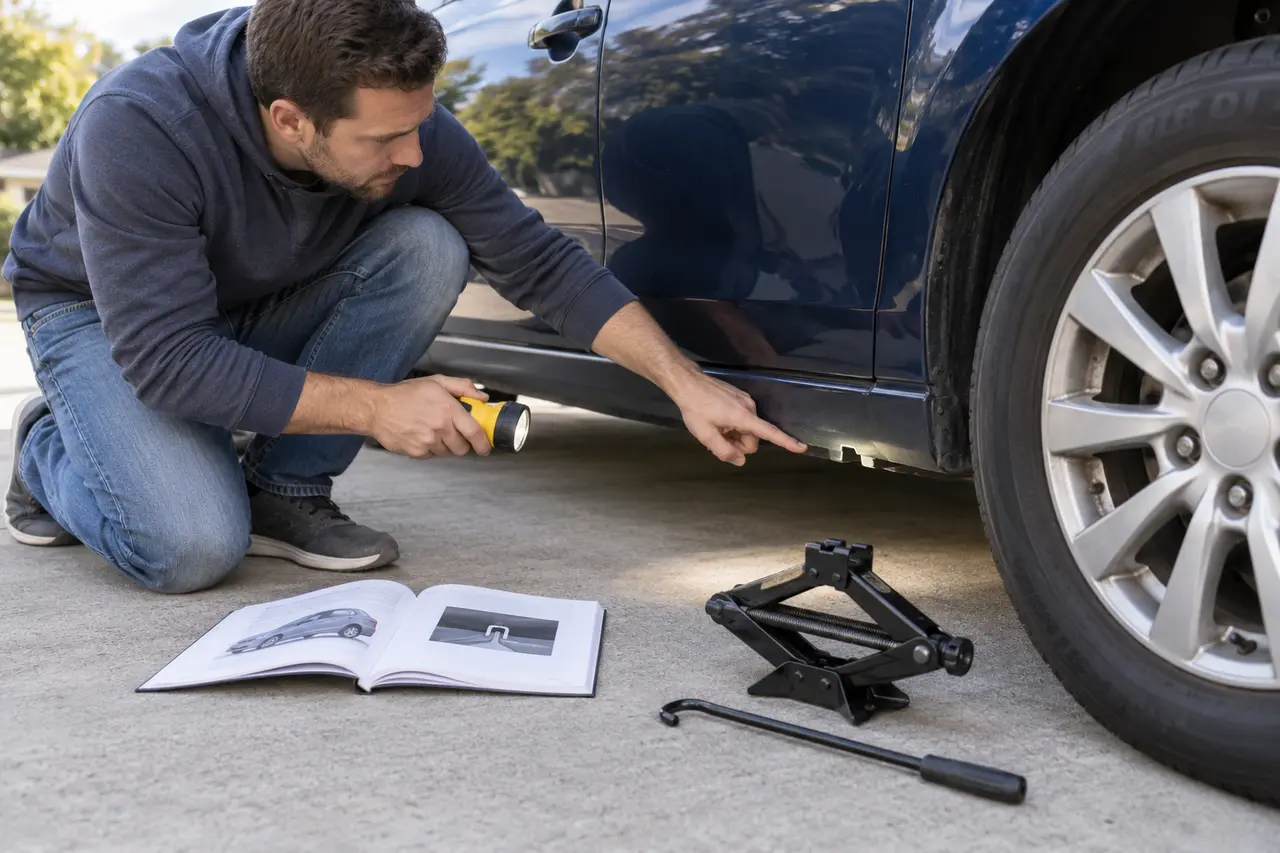
Find your car’s jack points in the owner’s manual before looking beneath the vehicle. Many passenger cars use reinforced pinch-weld areas near each wheel, marked by notches or arrows, while trucks and other vehicles may specify frame, axle, subframe, or dedicated lifting pads.
Never select a point only because the metal looks strong. Body panels, battery enclosures, exhaust parts, suspension links, and floor sections can be damaged or unstable under concentrated jack load.
Why Is the Owner’s Manual the First Step?
The lifting diagram shows the approved emergency points, jack orientation, and vehicle preparation. It may also identify points that are only for a service lift or floor jack. These locations are not interchangeable unless the manufacturer says they are.
Look under “changing a wheel,” “flat tire,” “lifting,” “jacking,” or “emergency equipment.” Save an offline digital copy if the printed manual is absent. Confirm the model year, body style, and drivetrain because locations can change between versions.
What Does a Pinch-Weld Jack Point Look Like?
A pinch weld is a vertical seam where body panels join beneath the rocker area. The approved point is a reinforced section, often near the front or rear wheel. It may be identified by two small notches, stamped marks, an arrow on trim, thicker metal, or a shaped contact area.
The factory scissor-jack saddle may have a slot that fits around the seam while its load surfaces contact the reinforced area. Do not lift from any random part of the seam. Unreinforced metal can fold.
Where Are Frame or Axle Jack Points Found?
Body-on-frame trucks and some sport utility vehicles may use frame rails or specified axle locations. The diagram determines whether a point is for lifting or supporting. Brake lines, fuel lines, wiring, differentials, steering parts, and thin brackets are not lift points unless explicitly identified.
A floor jack may use a central service point that raises more than one wheel, while jack stands are placed at separate support points. This is workshop work and differs from a roadside scissor-jack procedure.
How Do Emergency and Service Lift Points Differ?
| Point type | Typical equipment | Main purpose |
|---|---|---|
| Side emergency point | Factory scissor jack | Raise one corner for a wheel change |
| Central floor-jack point | Compatible hydraulic floor jack | Controlled garage lifting |
| Support point | Rated jack stand | Support the vehicle after lifting |
| Two-post lift point | Workshop lift arm and pad | Raise the vehicle for professional service |
A diagram may show several symbols. Read the legend. A point approved for a two-post lift pad may require different contact geometry from the roadside jack.
How Do You Inspect the Area Safely?
Park on firm, level ground, apply the parking brake, select the proper transmission position, and place wheel chocks. Use a flashlight from beside the vehicle. Kneel where you remain outside traffic and outside the space beneath the car.
Do not slide your head, arm, or torso under an unsupported vehicle. Do not rely on a phone camera positioned where your hand would be trapped if the vehicle moved. If trim hides the point, follow the removal or access instruction in the manual.
How Do You Match the Jack Saddle to the Point?
Compare the saddle shape with the illustration. A scissor-jack slot may straddle a reinforced seam. A floor-jack pad may contact a flat reinforced surface or use an approved adapter. Incorrect contact can bend the seam, crack trim, or let the saddle slide.
Place the unloaded jack directly beneath the point with its base flat. Raise only until the saddle touches, then pause. Confirm full, centered contact before lifting the tire.
Which Areas Should Never Be Assumed Safe?
- Plastic rocker covers: trim cannot carry vehicle weight unless a designed access point is specified.
- Flat floor sheet metal: broad-looking panels can be thin and unsupported.
- Battery enclosures: electric-vehicle packs and covers require strict avoidance or approved contact points.
- Exhaust components: pipes, shields, and catalytic converters are hot and not structural lift points.
- Suspension links: control arms and other parts require explicit manufacturer approval before contact.
- Fuel or brake lines: crushing or bending them can create serious hazards.
- Rust-damaged metal: corrosion can reduce the strength of an otherwise approved location.
How Do Jack Points Differ on Electric Vehicles?
Electric vehicles often place a large battery enclosure beneath the floor. Approved lift points are arranged to keep loads away from the battery and high-voltage components. Some models require removable plugs, shaped pads, or dedicated adapters.
Never contact the battery case, cover, cooling lines, or high-voltage areas. Follow the exact model instructions. If a point or adapter is missing or damaged, request qualified service.
What Changes with SUVs and Trucks?
Greater ride height does not mean every visible frame area is suitable. A truck may specify the frame for one task and an axle housing for another. Independent suspension, solid axles, running boards, and skid plates affect access.
Confirm jack capacity and lift range. A passenger-car scissor jack may not reach or support the vehicle. Large wheels also require additional ground clearance before removal.
What If the Car Has Air Suspension?
Some air-suspension vehicles require a jack, tire-change, or service mode before lifting. The system can otherwise attempt to correct ride height while a wheel is off the ground. Follow the shutdown and reactivation procedure in the manual.
Do not depend on the air suspension to hold the vehicle up. It is not a lifting or support device.
Do Aftermarket Parts Change the Jack Point?
Side skirts, running boards, body kits, underbody panels, lift kits, lowering springs, and battery guards can block access or change required lift range. They do not automatically relocate an approved structural point.
Use documented instructions from the vehicle and component manufacturers. An approved adapter may be needed. Do not stack random pads to reach around trim.
What If the Jack Point Is Rusted or Damaged?
Do not lift from metal that is deeply rusted, torn, bent, crushed, or previously repaired without confirmation that it is structurally sound. Surface dirt is different from structural corrosion, but roadside inspection cannot always determine the difference.
Arrange professional lifting at another approved point only when official instructions permit it. A technician may need to inspect and repair the structure before normal lifting resumes.
How Do You Confirm the Point During Initial Contact?
Raise the saddle until it just contacts the vehicle. Check that the base remains flat, the jack is aligned, and the saddle engages the intended surfaces. Watch for trim deflection, seam folding, slipping, or jack lean.
Lower immediately if contact is incorrect. Reposition only while the jack is unloaded. Do not push the loaded jack sideways.
When Should You Stop Looking and Call for Help?
Stop when the manual is unavailable, markings are unclear, the point is hidden or damaged, the available jack does not match, or the surface is unsafe. Also stop for collision damage, leaking fluid, smoke, or battery damage.
Once the correct point is confirmed, follow safe scissor-jack instructions. Compare scissor and floor jacks before choosing equipment, and use the full tire-change guide for the complete sequence.
Quick answers
Frequently Asked Questions
Where are jack points usually located on a car?
Many unibody passenger cars have reinforced pinch-weld points near each wheel, often indicated by notches or arrows. Other vehicles use frame, subframe, axle, or dedicated pads. The owner’s manual identifies the exact locations.
Can you jack a car from the pinch weld?
Only at the reinforced pinch-weld section specified by the vehicle manufacturer and with a compatible jack saddle or approved adapter. An unreinforced seam can bend and may not support the load safely.
Is the rocker panel a jack point?
Not automatically. The visible rocker cover can be plastic or thin body material. The actual lift point may sit behind or beneath it. Use the manual and manufacturer markings instead of choosing by appearance.
Are emergency jack points and floor-jack points the same?
Not always. A vehicle may specify side points for the factory emergency jack and separate central or service lift points for workshop equipment. Follow the instructions for the exact jack and task.
Where are jack points on an electric vehicle?
They are model-specific and must avoid the battery enclosure and other protected structures. Use the EV owner’s manual or official service lifting information. Approved pads or adapters may be required.