
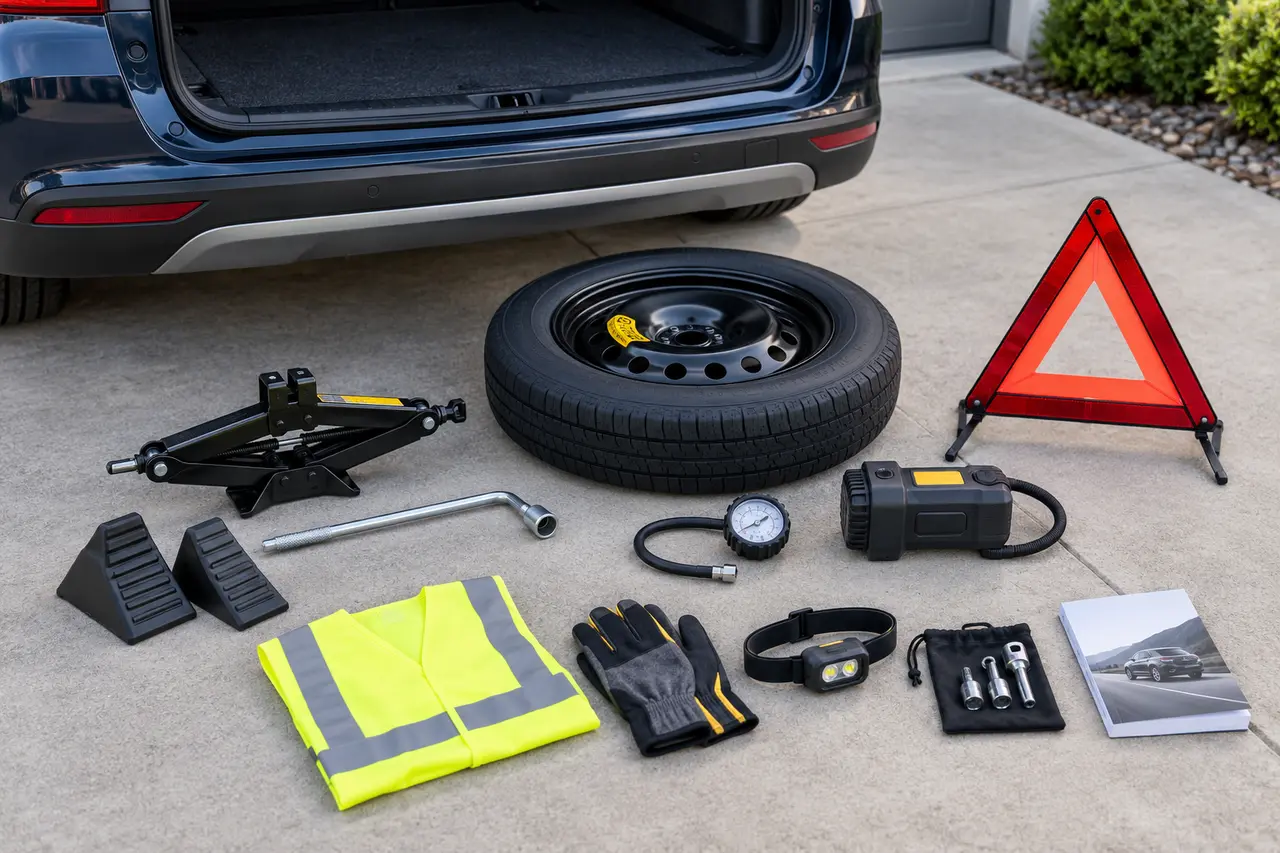
An emergency tire change kit should contain a usable spare wheel and tire, the correct jack, a matching lug wrench, the owner’s manual, a wheel-lock key, and wheel chocks. Add a pressure gauge, portable inflator, gloves, headlamp, reflective vest, warning device, charged phone, and weather supplies.
The best kit is specific to one vehicle. A generic jack may not fit the lift point. A socket may not fit the wheel fasteners. A spare from another model may have the wrong dimensions or mounting pattern. Confirm compatibility before the kit is needed.
What Are the Essential Tire-Change Items?
The essential group allows the complete wheel assembly to be removed and replaced. If one item is missing, the change may not be possible. Keep these parts together rather than distributing them between the garage and vehicle.
| Item | Main purpose | Pre-trip check |
|---|---|---|
| Spare wheel and tire | Replaces the damaged wheel assembly | Correct fit, safe condition, specified pressure |
| Approved jack | Raises the affected corner | Capacity, lift-point fit, complete handle |
| Lug wrench | Turns lug nuts or wheel bolts | Correct socket size and sound condition |
| Wheel-lock key | Releases locking wheel hardware | Matching pattern and undamaged engagement |
| Wheel chocks | Reduce unintended vehicle movement | Two purpose-made chocks with good grip |
| Owner’s manual | Provides vehicle-specific instructions | Printed or offline copy is accessible |
Some vehicles use wheel bolts instead of lug nuts. Some store a temporary spare under the cargo floor or beneath the vehicle. Others have no spare. Inspect the actual system rather than relying on a standard checklist alone.
What Type of Spare or Mobility System Do You Have?
A full-size spare may resemble the road wheels, but it still requires correct pressure and inspection. A compact spare is a temporary mobility device with speed, distance, load, and sometimes wheel-position limits. The sidewall and owner’s manual provide the controlling restrictions.
A tire mobility kit usually combines sealant and an inflator. It may address only a limited tread puncture. It cannot safely repair a sidewall cut, a tire separated from the rim, a damaged wheel, or some large punctures. Sealant also has an expiration date and temperature limits.
Run-flat tires may permit limited travel after pressure loss under specified conditions. They are not immune to damage and do not permit unlimited driving. Know the vehicle and tire limits before a warning appears.
Which Pressure Tools Belong in the Kit?
Carry a reliable tire pressure gauge that covers the spare’s required range. Temporary spares often use a different pressure than the road tires. Check the pressure while the spare is cold and follow the specified value.
A compact 12-volt or battery inflator can restore pressure to an otherwise serviceable spare. Match the connector and output to the vehicle. Test it at home. Store the power cable, hose, adapters, and instructions together.
An inflator does not confirm structural safety. Do not inflate a tire with visible separation, severe cracking, bead damage, or wheel damage. Request professional help when the source of failure is uncertain.
Which Visibility and Personal-Safety Items Help?
- Reflective vest: improves the driver’s visibility when leaving the vehicle is safe.
- Headlamp: illuminates the lift point and leaves both hands available.
- Warning triangle: provides advance notice where local rules and safe placement allow it.
- Work gloves: improve grip and reduce contact with dirt, heat, and sharp wheel damage.
- Kneeling pad: supports a stable position on wet, hot, or rough pavement.
- Rain layer: keeps clothing controlled and reduces exposure without creating loose material near tools.
- Eye protection: helps when corrosion, grit, or road debris may fall from the wheel area.
Visibility equipment does not make a narrow highway shoulder safe. Do not walk into traffic to place a warning device. Review roadside tire-change safety before choosing to work beside the vehicle.
What Communication and Emergency Supplies Are Useful?
Keep a charging cable and power bank with the kit. A phone supports emergency calls, roadside-service contact, location sharing, and access to a digital manual. Save roadside provider details and important phone numbers offline.
Carry drinking water, a compact first-aid kit, and seasonal protection appropriate for the route. Cold-weather supplies may include an insulated layer and blanket. Hot-weather planning may require additional water and shade while waiting in a safe area.
A paper card with vehicle details, insurance information, roadside membership, and emergency contacts remains useful when a phone battery fails. Do not include sensitive information that would create unnecessary risk if the vehicle is entered.
How Should the Kit Be Organized?
Use a durable case or divided bag for loose equipment. Keep the factory jack and spare in their designed mounts. Place the wheel-lock key in a labeled pouch beside the wrench. Store flashlight batteries separately only when the device instructions recommend it.
Arrange the kit in order of use. Visibility items and gloves should be reachable first. Chocks, manual, wrench, jack, and spare release tools should follow. The inflator and gauge should be available before lifting so the spare can be checked.
Secure every heavy object. A jack, breaker bar, or inflator can become hazardous in a sudden stop. Do not let tools roll freely under seats where they can interfere with pedals.
How Often Should You Inspect the Kit?
Check road-tire and spare pressure during routine pressure checks and before long trips. Complete a deeper kit inspection when seasons change. Vehicle service visits also provide a useful reminder.
Operate the jack through part of its range without lifting the vehicle, when the tool instructions permit. Confirm that the handle is complete. Test the wrench fit, wheel-lock key fit, inflator, gauge, headlamp, phone cable, and power bank. Check sealant and battery dates.
Look for corrosion, bent parts, cracked plastic, damaged cords, stripped threads, leaking inflators, and missing adapters. Replace questionable equipment with compatible parts. Do not wait for a roadside emergency to test a used or unfamiliar jack.
How Does the Kit Change for an EV, SUV, or Truck?
Electric vehicles can be heavy and have restricted lift areas near battery structures. Some have no spare. Sport utility vehicles and trucks may require greater jack capacity, more lift range, and tools that fit larger wheels. Dual-wheel and commercial-style systems can require trained service.
Use the load, lift, wheel, and spare information for the exact model. Do not add a generic jack because it looks stronger. Capacity, lift range, saddle shape, and approved contact location must all be suitable.
What Should You Leave Out of the Kit?
Do not carry improvised jack extensions, damaged sockets, loose blocks, unapproved tire chemicals, or a spare of uncertain fit. Avoid long pipes intended to multiply wrench force. Excess leverage can damage fasteners or cause loss of control.
A torque wrench is useful for final tightening, but it should be stored according to its instructions and protected from impacts. It should not replace a breaker bar or lug wrench for loosening fasteners. Learn how to use a torque wrench before adding one.
What Is the Final Emergency Kit Checklist?
Confirm the spare or mobility system, approved jack, jack handle, lug wrench, correct socket, wheel-lock key, chocks, pressure gauge, inflator, manual, gloves, headlamp, reflective vest, warning device, charging equipment, water, and weather supplies. Add only equipment that fits the vehicle and that you know how to use.
Review the main tools needed to change a tire, learn how to use a scissor jack, and follow the complete tire-changing procedure. The kit supports a safe decision. It does not require you to complete a change when the location or conditions are unsafe.
Quick answers
Frequently Asked Questions
What should be in an emergency tire change kit?
Include a usable spare, compatible jack, correctly sized lug wrench, owner’s manual, wheel-lock key, wheel chocks, pressure gauge, inflator, gloves, headlamp, reflective vest, warning device, charged phone, and basic weather supplies..
How often should you check a tire emergency kit?
Inspect the kit at least when seasons change and before long trips. Check spare pressure more frequently with the road tires. Confirm that batteries work, sealant has not expired, tools fit, and metal parts are not damaged or corroded.
Does every vehicle need a spare tire kit?
Every vehicle needs a model-appropriate tire emergency plan, but not every vehicle carries a spare. Some use run-flat tires or a mobility kit. Read the owner’s manual and prepare for the limits of the exact system.
Can tire sealant replace a spare tire?
No. Sealant works only on certain small tread-area punctures and cannot make sidewall cuts, large punctures, separated tires, or damaged wheels safe. Follow the sealant and vehicle instructions and arrange a full inspection.
Where should the emergency tire kit be stored?
Store it in the designated cargo area or another secure, dry location that remains accessible when the vehicle is loaded. Restrain heavy tools so they cannot move during sudden braking or a collision.