
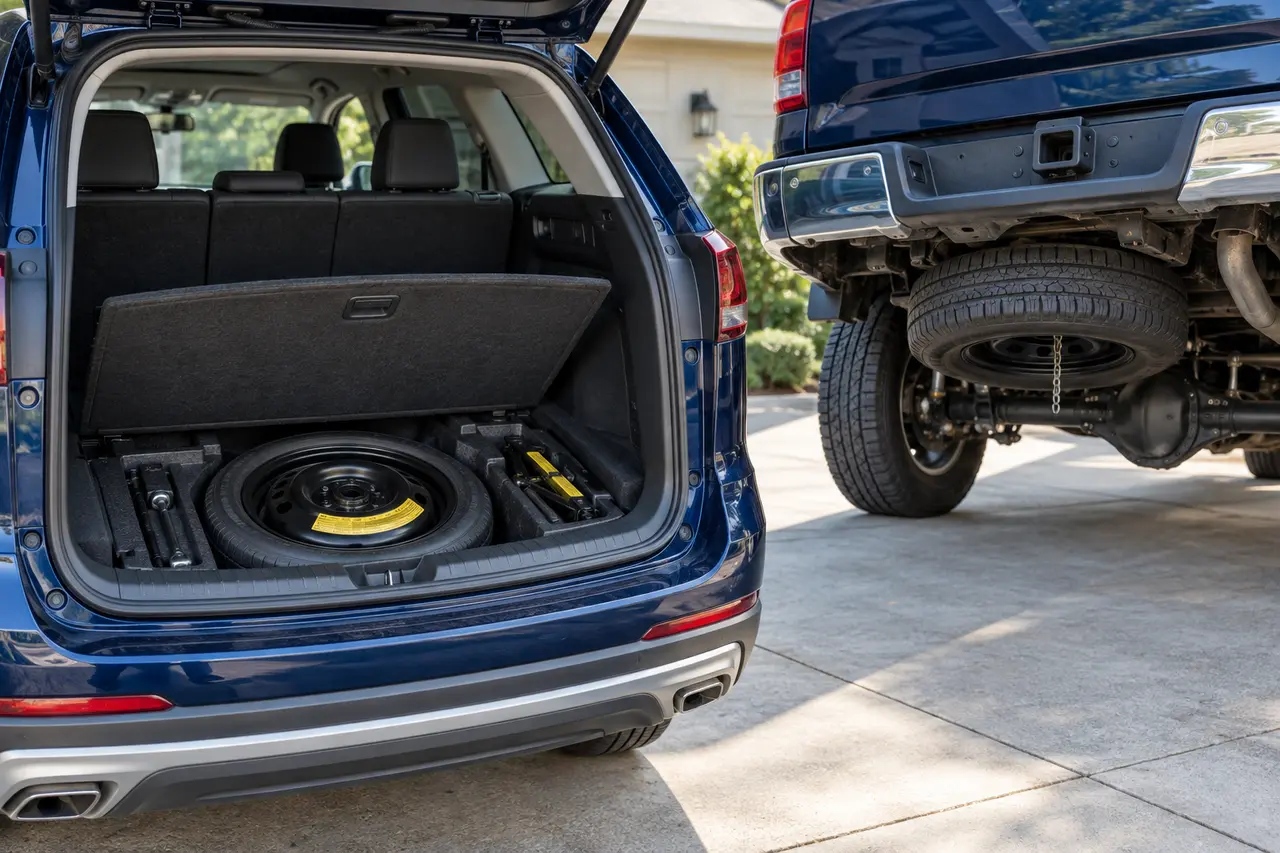
Common spare-tire locations include beneath the trunk or cargo floor, under the rear of the vehicle, on a rear door, beneath a pickup bed, or inside a side compartment. Some vehicles have no spare and provide run-flat tires or a sealant-and-inflator kit instead.
Storage varies by model, trim, drivetrain, seating layout, and market. A used vehicle may also be missing equipment that was originally supplied.
What Does the Owner’s Manual Control?
The equipment diagram shows the spare, release mechanism, jack, handle, towing eye, and wheel-lock key. Use the correct model-year manual because storage can differ between trims.
The manual identifies compatible spare types, storage and release instructions, approved jack points, fastener torque, and temporary-use limits. The markings on the spare provide additional pressure, speed, load, and service information. Use the more restrictive instruction when required and seek manufacturer guidance when information appears inconsistent.
Which Spare-Tire Type Is Involved?
A compact spare usually fits in a shallow cargo well. A full-size spare may hang below a truck or SUV. Exterior rear-door mounts are common on some utility vehicles. Collapsible spares use less space.
| Factor | What to check | Why it matters |
|---|---|---|
| Cargo-floor well | Lift the trunk or cargo panel | Common for cars and crossovers |
| Underbody carrier | Look beneath the rear bumper area | Requires a crank or winch release |
| Rear door or tailgate | Exterior wheel cover or mount | Check lock and carrier hardware |
| Pickup-bed underside | Below the bed near the rear axle | Release through a bumper access point |
| Interior side panel | Behind removable cargo trim | Often paired with separate tools |
| No spare system | Inflator, sealant, or run-flat marking | Changes the roadside response |
How Do You Check Compatibility?
If a spare is found loose or added later, confirm it belongs to the vehicle. Storage location does not prove fit. Check wheel and tire specifications, fasteners, pressure, and axle limits.
A spare supplied for another vehicle may have the wrong bolt pattern, center bore, offset, overall diameter, load capacity, brake clearance, or tire construction. Do not force a wheel onto the hub or substitute wheel hardware. Use only a spare and fasteners approved for the vehicle and required position.
How Do You Inspect the Spare Before Use?
Once accessible, check pressure, tire age, cracking, tread, valve, wheel, carrier, cable, and retention hardware. Underbody spares need extra attention for dirt and corrosion.
Check pressure when the tire is cold, meaning it has not recently been driven and heated. Inspect both sidewalls, the tread, valve, bead area, and wheel. Do not install a spare with severe cracking, a bulge, exposed reinforcement, separation, a damaged wheel, or pressure that cannot be maintained.
What Is the Correct Procedure?
Park safely and unload cargo only away from traffic. Follow the panel, winch, latch, or lock instructions. Support an underbody spare as it lowers so it does not fall or trap hands.
Prepare the spare and tools before raising the vehicle. Keep the parking brake applied and wheel chocks positioned as directed. Lift only at the approved point. Start fasteners carefully, snug them in a crossing pattern, lower as specified, and apply final torque with the correct specification.
What Driving Limits Apply?
Do not drive on the spare until its temporary limits are known. Storage labels may be dirty or hidden, so read the sidewall and manual before installation.
Compact spares commonly carry reduced limits, but the exact number is vehicle and tire specific. Many are marked for no more than 50 mph or 80 km/h, while permitted distance can vary. Drive smoothly, avoid hard acceleration and braking, and travel directly to professional service. Stop for vibration, pulling, noise, pressure loss, or unstable handling.
How Do Weather, Load, and Road Conditions Matter?
Mud, ice, salt, and corrosion can seize an underbody mechanism. Heavy cargo can block a well. Night or roadside access may be unsafe even when the spare is present.
A temporary spare changes the vehicle’s available traction and may affect ground clearance. Reduce load when the instructions require it. Avoid towing, snow chains, rough roads, deep water, high-speed travel, and long detours unless the manufacturer specifically permits them with the installed spare.
What Mistakes Should You Avoid?
- Do not crawl under an unsupported vehicle: use the designed release from a safe position.
- Do not force cargo panels: hidden latches and wiring may be damaged.
- Do not cut a carrier cable casually: the spare can fall and the system will need repair.
- Do not assume a mobility kit is a spare: it has limited puncture coverage.
- Do not leave tools buried: keep the release handle accessible.
- Do not reinstall a loose spare: retention hardware must be secure.
A spare is part of a vehicle system, not a universal wheel. Guessing pressure, fit, placement, or travel limits can damage the tire, wheel, drivetrain, brakes, or body. Stop when the specified setup cannot be confirmed.
When Is Professional Help Required?
Request service when the carrier is seized, the spare is too heavy to control, cargo cannot be moved safely, a security lock is missing, or no spare or mobility system is present.
Roadside assistance can install a usable spare when the location permits. Towing is appropriate when there is no compatible spare, the mobility kit cannot address the damage, multiple tires are affected, the wheel or suspension is damaged, or the vehicle cannot be lifted safely.
What Should Happen After the Spare Is Used?
Clean and inspect the compartment or carrier. Rewind cables according to instructions and secure the wheel tightly. Return tools in their molded locations so rattles do not hide a loose assembly.
Have the normal tire removed and inspected internally when repair is considered. Restore a compatible road wheel as soon as practical. Then check the spare, correct its pressure, replace it if damaged or aged out, and return every tool to secure storage.
How Do You Keep the Spare Ready?
Practice finding and releasing the spare at home. Lubricate or maintain the carrier only as specified. Check underbody systems after winter and include spare access in pre-trip cargo planning.
Include the spare in routine tire checks. NHTSA advises checking all tires, including the spare, at least monthly when cold. Inspect before long trips and when seasons change. Confirm that the jack, lug wrench, wheel-lock key, pressure gauge, and inflator remain present and functional.
Which Spare-Tire Guides Are Related?
These pages explain the connected decisions around storage, installation, pressure, placement, age, and limited travel:
Use the complete tools checklist and roadside safety guide before beginning. A serviceable spare helps only when the vehicle, equipment, driver, and location are ready.
Quick answers
Frequently Asked Questions
Where is the spare tire in most cars?
It is commonly beneath the trunk or cargo floor under a removable panel..
Where is an SUV spare tire stored?
It may be in the cargo floor, under the rear body, or on an exterior rear-door carrier..
Why can I not find a spare tire?
The vehicle may use run-flat tires or a mobility kit, or the spare may be missing from a used vehicle..
How do you lower an underbody spare?
Use the manufacturer’s crank or winch tool through the designated access point while supporting the wheel..
Are the jack and spare stored together?
Often, but some vehicles place the jack and tools in a separate side panel or under a seat..