
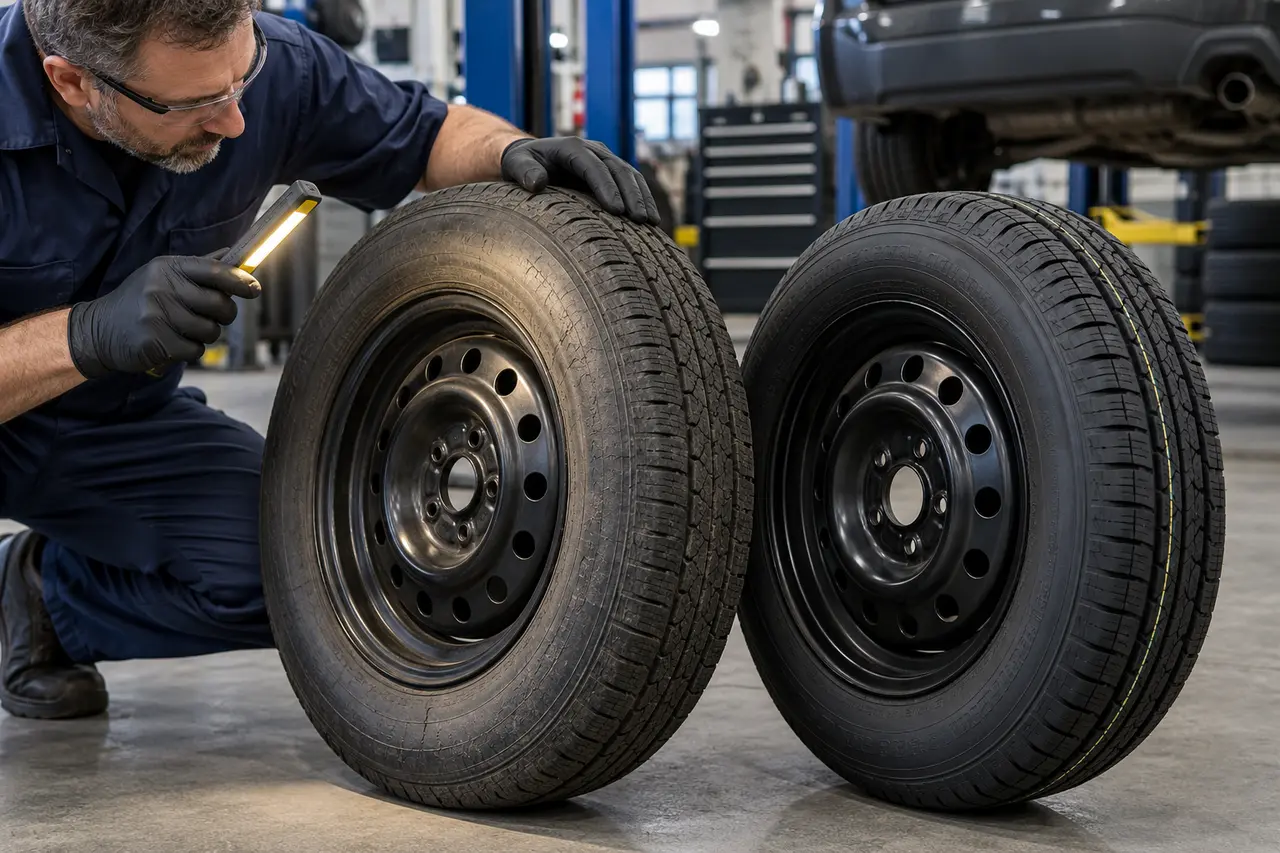
Spare-tire replacement age varies by vehicle and tire manufacturer, but many manufacturers call for inspection or replacement around six to ten years. Follow the exact guidance for the tire and vehicle, and replace earlier for cracking, bulges, separation, pressure loss, wheel damage, or excessive temporary-spare wear.
Rubber changes with oxygen, heat, sunlight, moisture, and time. Storage in a trunk protects a spare from some exposure but can add heat. Low mileage does not stop aging.
What Does the Owner’s Manual Control?
Check the maintenance and tire sections for age guidance. Tire manufacturers may provide separate recommendations. The production date supports the decision but does not replace physical inspection.
The manual identifies compatible spare types, storage and release instructions, approved jack points, fastener torque, and temporary-use limits. The markings on the spare provide additional pressure, speed, load, and service information. Use the more restrictive instruction when required and seek manufacturer guidance when information appears inconsistent.
Which Spare-Tire Type Is Involved?
A compact spare can have very little tread and still be aged out. A full-size spare may be rotated with road tires when it truly matches, or it may remain stored for years. Collapsible designs have special inspection needs.
| Factor | What to check | Why it matters |
|---|---|---|
| Production date | Last four date-code digits show week and year | Establishes tire age |
| Sidewall condition | Cracks, bulges, cuts, or discoloration | Can reveal deterioration or damage |
| Pressure retention | Monthly cold readings | Repeated loss suggests a leak |
| Prior use | Distance, speed, and road conditions | Temporary tread and structure have limits |
| Storage environment | Heat, moisture, chemicals, and sunlight | Affects aging and wheel corrosion |
| Manufacturer guidance | Vehicle and tire replacement interval | Controls the final age decision |
How Do You Check Compatibility?
When replacing an aged spare, match the approved tire size, construction, load capacity, wheel, and temporary-use marking. A tire shop should confirm availability and mounting requirements.
A spare supplied for another vehicle may have the wrong bolt pattern, center bore, offset, overall diameter, load capacity, brake clearance, or tire construction. Do not force a wheel onto the hub or substitute wheel hardware. Use only a spare and fasteners approved for the vehicle and required position.
How Do You Inspect the Spare Before Use?
Find the Tire Identification Number and read the final four digits as week and year when using that format. Inspect both sidewalls because the full code may face inward. Check tread, bead, valve, wheel, and pressure.
Check pressure when the tire is cold, meaning it has not recently been driven and heated. Inspect both sidewalls, the tread, valve, bead area, and wheel. Do not install a spare with severe cracking, a bulge, exposed reinforcement, separation, a damaged wheel, or pressure that cannot be maintained.
What Is the Correct Procedure?
Remove the spare from storage safely for a complete inspection. Do not mount a questionable tire merely to test it. Have an older or damaged spare evaluated by a tire professional and replaced on the correct wheel.
Prepare the spare and tools before raising the vehicle. Keep the parking brake applied and wheel chocks positioned as directed. Lift only at the approved point. Start fasteners carefully, snug them in a crossing pattern, lower as specified, and apply final torque with the correct specification.
What Driving Limits Apply?
Age guidance applies even when the spare is used only briefly. A temporary spare that has accumulated its wear limit or was driven underinflated may need earlier replacement.
Compact spares commonly carry reduced limits, but the exact number is vehicle and tire specific. Many are marked for no more than 50 mph or 80 km/h, while permitted distance can vary. Drive smoothly, avoid hard acceleration and braking, and travel directly to professional service. Stop for vibration, pulling, noise, pressure loss, or unstable handling.
How Do Weather, Load, and Road Conditions Matter?
High trunk temperatures, outdoor underbody storage, salt, moisture, petroleum products, and chemical contact can accelerate deterioration or corrode the wheel and carrier.
A temporary spare changes the vehicle’s available traction and may affect ground clearance. Reduce load when the instructions require it. Avoid towing, snow chains, rough roads, deep water, high-speed travel, and long detours unless the manufacturer specifically permits them with the installed spare.
What Mistakes Should You Avoid?
- Do not judge by tread alone: unused rubber can age and crack.
- Do not ignore the valve and wheel: either can cause pressure loss.
- Do not buy an old replacement: check the production date before installation.
- Do not mix age rules: follow the exact manufacturer guidance.
- Do not use a cracked spare: temporary need does not make damage acceptable.
- Do not forget underbody carriers: corrosion can affect both release and wheel condition.
A spare is part of a vehicle system, not a universal wheel. Guessing pressure, fit, placement, or travel limits can damage the tire, wheel, drivetrain, brakes, or body. Stop when the specified setup cannot be confirmed.
When Is Professional Help Required?
Ask a tire professional when the date code is unreadable, the sidewall cannot be fully inspected, the tire is near or beyond guidance, or storage damage is visible. A replacement compact spare may require special ordering.
Roadside assistance can install a usable spare when the location permits. Towing is appropriate when there is no compatible spare, the mobility kit cannot address the damage, multiple tires are affected, the wheel or suspension is damaged, or the vehicle cannot be lifted safely.
What Should Happen After the Spare Is Used?
Record the replacement date and pressure. Inspect the carrier and retention bolt, then store the spare securely. Replace damaged tools or labels so the new spare remains usable.
Have the normal tire removed and inspected internally when repair is considered. Restore a compatible road wheel as soon as practical. Then check the spare, correct its pressure, replace it if damaged or aged out, and return every tool to secure storage.
How Do You Keep the Spare Ready?
Check pressure monthly and inspect age at least annually and before long trips. Keep the spare clean, dry, secured, and away from oils or chemicals. Rotate a matching full-size spare only under an approved plan.
Include the spare in routine tire checks. NHTSA advises checking all tires, including the spare, at least monthly when cold. Inspect before long trips and when seasons change. Confirm that the jack, lug wrench, wheel-lock key, pressure gauge, and inflator remain present and functional.
Which Spare-Tire Guides Are Related?
These pages explain the connected decisions around storage, installation, pressure, placement, age, and limited travel:
Use the complete tools checklist and roadside safety guide before beginning. A serviceable spare helps only when the vehicle, equipment, driver, and location are ready.
Quick answers
Frequently Asked Questions
Do spare tires expire if never used?
Yes. Rubber ages in storage, so unused spares still need inspection and eventual replacement.
How do you read a spare tire date code?
The final four digits commonly show the production week and year, such as week 22 of a given year..
Should a ten-year-old spare be used?
Follow manufacturer guidance, but a tire of that age commonly requires replacement even if unused..
Does a donut last longer than a full-size spare?
Not automatically. Both age, while donuts also have limited tread and temporary-use design.
Can heat in the trunk age a spare tire?
Yes. Repeated heat exposure contributes to rubber aging, although the exact rate varies.