
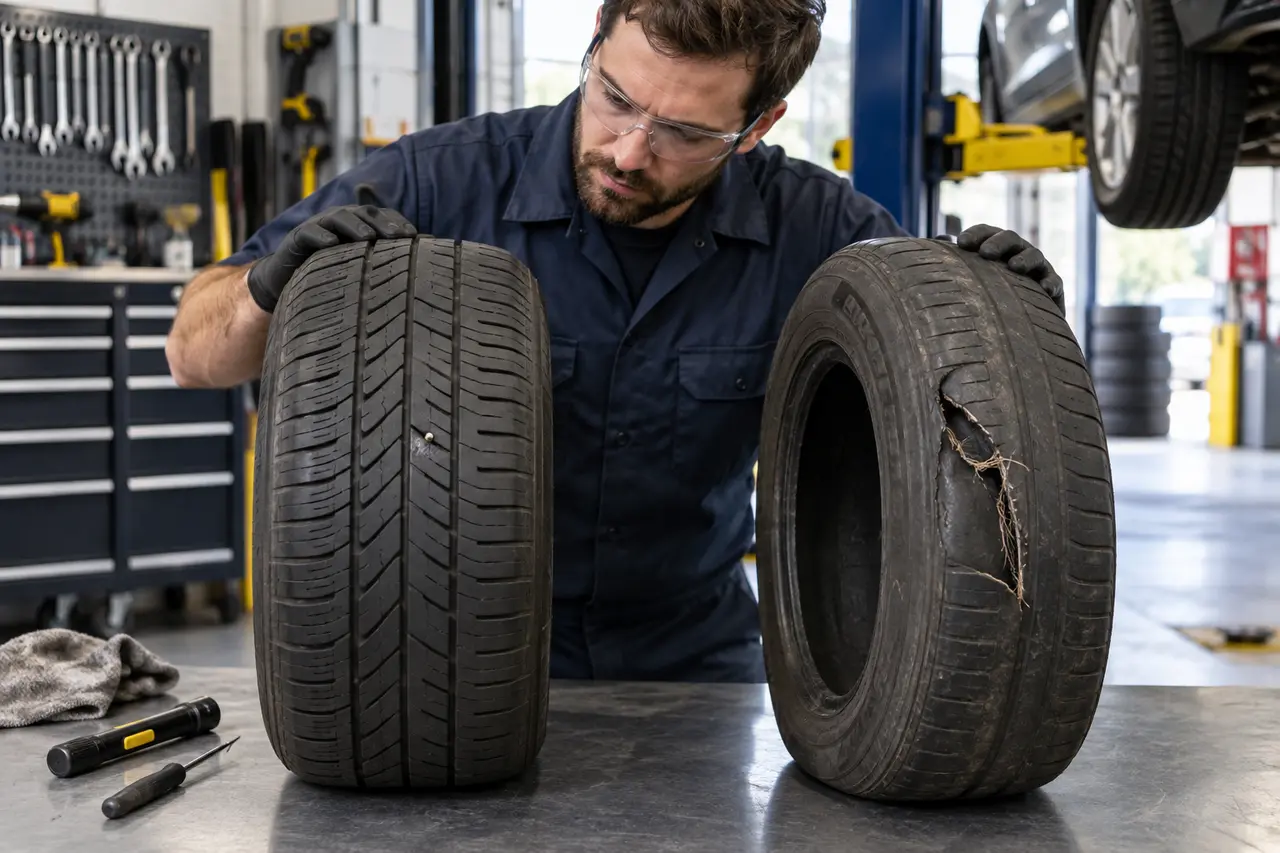
Repair a flat tire only when the puncture is small, confined to the repairable tread area, and the tire passes a complete internal inspection. Replace it when damage reaches the shoulder or sidewall, the tire was driven flat, cords are exposed, the injury is too large, repairs overlap, or the tire is otherwise worn, aged, or structurally damaged.
Flat Tire Repair vs Replacement at a Glance
| Finding | Likely decision | Why |
|---|---|---|
| Small puncture in the central tread area | May be repairable | The injury can sometimes be filled and the inner liner sealed |
| Shoulder or sidewall injury | Replace | These flexible structural areas are outside the normal repair zone |
| Cut, bulge, exposed cord, or separation | Replace | The casing has structural damage |
| Driven while flat | Inspect, often replace | Heat and crushing can damage the liner and cords invisibly |
| Overlapping or improper prior repair | Replace | The remaining material may not support another safe repair |
| Very low tread or advanced cracking | Replace | Repairing the puncture does not restore the rest of the tire |
When Is a Flat Tire Usually Repairable?
The first condition is location. The injury must be within the repairable crown or tread area defined by the tire maker and repair standard. Damage near the outer tread edge, shoulder, or sidewall is normally excluded because those areas flex differently and contain critical structural components.
The second condition is size. USTMA guidance for passenger and light-truck tires generally limits repair to punctures no larger than 1/4 inch, or 6 mm, and only within the permitted tread area. A technician must also consider the angle and shape of the injury, not just the visible hole.
The third condition is the tire's full condition. The inner liner must be sound. There should be no evidence of underinflation damage, separation, exposed cords, bead damage, or an unsafe prior repair. The tire maker's policy can be more restrictive, especially for some run-flat, high-performance, speed-rated, or specialty tires.
When Should the Tire Be Replaced?
- Sidewall or shoulder damage: cuts, punctures, bulges, bubbles, and exposed cords require replacement.
- Run-flat damage: abrasion, creasing, heat rings, or travel beyond the stated limit can make the tire unsafe.
- Large or irregular injury: a gash, long cut, or hole above the manufacturer's repair limit is not a patch candidate.
- Multiple close injuries: repair areas cannot overlap or weaken the same part of the casing.
- Bead damage: torn rubber, distorted bead wire, or damage from driving or mounting can prevent a safe seal.
- End-of-life condition: worn tread, cracking, separation, or other age-related deterioration still matters after the air leak is fixed.
Why Must the Tire Be Removed From the Wheel?
The outside does not reveal the entire injury. Removing the tire lets the technician examine the inner liner, sidewall, bead, and impact area. A dark abrasion ring, loose material, powdered rubber, wrinkles, or exposed cords can show that the tire was damaged while underinflated.
Removal is also required for a complete repair. According to USTMA Tire Repair Basics, the puncture channel must be filled and the inner liner must be sealed. A one-piece combination repair or a compatible plug-and-patch system performs both jobs.
Does Tire Age or Tread Depth Change the Decision?
Yes. A technically repairable hole may not make economic or safety sense in a tire that is nearly worn out, has widespread weather cracking, shows irregular wear, or is near a manufacturer age limit. Check the tire identification code, tread depth across several grooves, and the tire maker's service recommendations.
Uneven wear can point to misalignment, suspension wear, incorrect pressure, or an unsuitable tire match. Replacing the tire without correcting the cause may damage the new tire quickly.
What If Only One Tire Needs Replacement?
The new tire must match the vehicle's required size, load capacity, type, and other specifications. The best axle position and the need to replace a pair depend on tread differences, vehicle design, weather needs, and manufacturer instructions.
All-wheel-drive systems may limit the acceptable difference in tire circumference. Too much difference can keep the driveline working as if the vehicle is constantly turning. Measure tread depth on all four tires and follow the owner manual before ordering one replacement.
Questions to Ask the Tire Shop
- Will the tire be removed for a complete internal inspection?
- Is the injury fully inside the manufacturer's repairable area?
- Will the repair fill the puncture channel and seal the inner liner?
- Is there evidence the tire was driven while underinflated?
- Do tread depth, age, prior repairs, or vehicle requirements favor replacement?
- Should the wheel, valve, and TPMS sensor also be checked?
Related Flat-Tire Guides
Quick answers
Frequently Asked Questions
Can every nail hole in a tire be repaired?
No. The injury must be in the repairable tread area, within the permitted size, and free from structural or run-flat damage.
Can a sidewall puncture be repaired?
A normal passenger-tire sidewall puncture is not considered repairable because the sidewall flexes and carries high structural loads.
Does the tire need to come off the wheel?
Yes. Removal is needed to inspect the inner liner, locate hidden damage, prepare the injury, and complete a proper repair.
Can a tire be repaired after driving on it flat?
Often it must be replaced. Driving without enough pressure can crease the liner and break internal cords.
Should one tire or two tires be replaced?
It depends on tread-depth differences, axle position, vehicle requirements, and all-wheel-drive limits. Follow the owner manual and tire professional's measurements.