
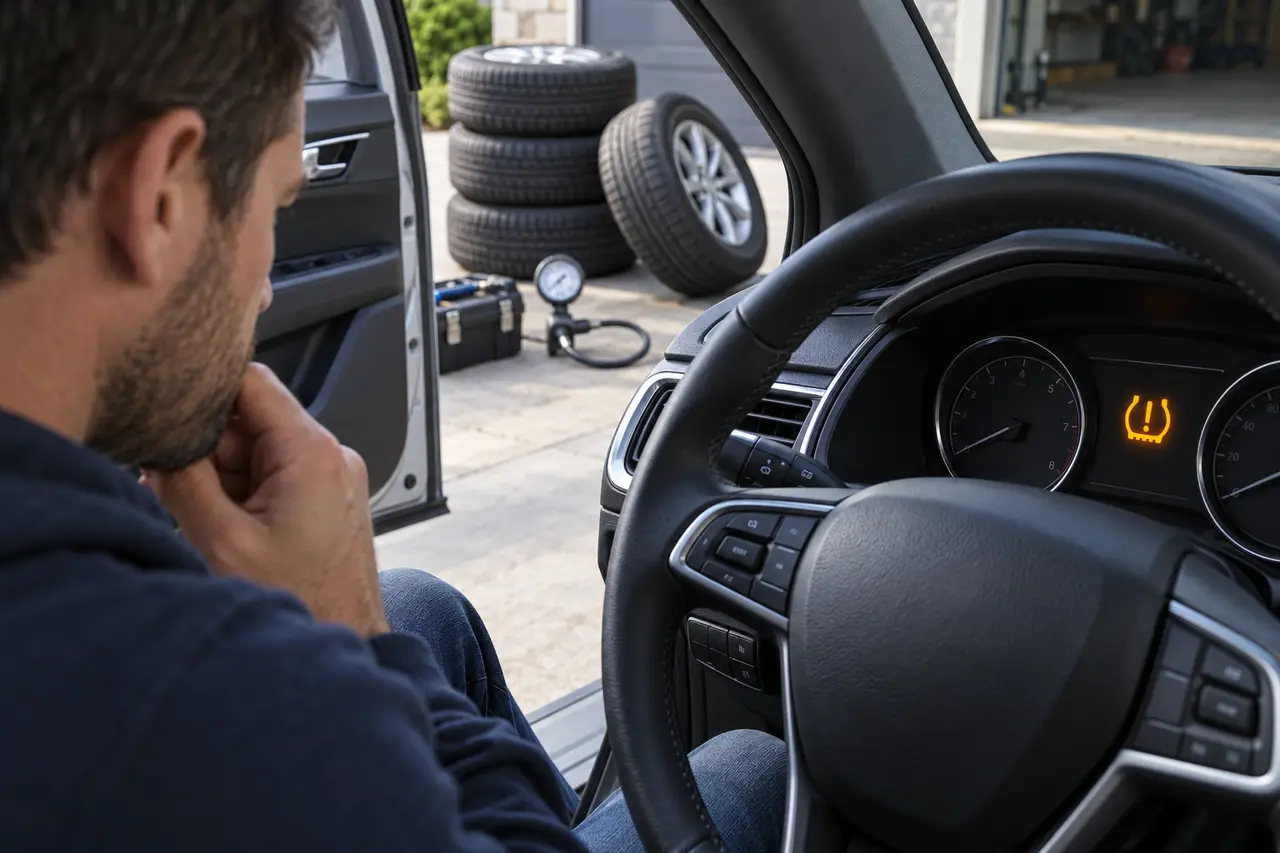
A TPMS light after changing a tire usually means the new or repaired tire is still underinflated, the temporary spare is not monitored, or the system has not recognized the sensor or wheel position. Check every road tire with a gauge when cold, use the pressure on the vehicle placard, and follow the owner manual for any relearn or reset.
First Identify What the TPMS Light Is Doing
| Warning pattern | Likely meaning | First action |
|---|---|---|
| Stays on steadily | At least one tire is significantly underinflated | Inspect and measure all road tires |
| Turns on during a cold morning, then off | Pressure may be near the warning threshold | Check cold pressure and correct it |
| Flashes for 60 to 90 seconds, then stays on | TPMS malfunction | Arrange system diagnosis |
| Appears after fitting a temporary spare | The flat road wheel is still low or the spare lacks a compatible sensor | Follow the spare instructions and restore the road wheel promptly |
NHTSA TireWise explains that a steady TPMS symbol indicates significant underinflation. For model year 2008 and newer vehicles, a malfunction can be shown by a 60-to-90-second flashing sequence followed by continuous illumination.
Why Can the Light Stay On After Tire Service?
- Pressure was set incorrectly: the technician may have used a general value, a warm-tire reading, or the tire sidewall maximum instead of the vehicle placard.
- Pressure changed with temperature: a tire set near the threshold can trigger the warning after the air cools.
- The temporary spare is installed: many compact spares are not monitored, while the flat road wheel continues to report low pressure or is absent.
- A direct sensor was damaged: the valve, seal, sensor body, or battery may have failed during impact, demounting, or service.
- The sensor ID is not registered: a replacement sensor or seasonal wheel set may need programming and relearning.
- An indirect system was not initialized: a wheel change, rotation, or pressure correction may require the vehicle's reset process.
- The tire still leaks: a puncture, valve, bead, wheel, or repair leak can reduce pressure again.
How to Check the System Safely
- 1Park and inspect
Use firm, level ground. Look for a low tire, sidewall damage, loose fastener, or wheel that does not sit correctly.
- 2Find the correct pressure
Read the Tire and Loading Information Label on the driver's door area or the owner manual.
- 3Measure all road tires cold
Use an accurate gauge. Front and rear specifications may differ.
- 4Correct pressure
Add or release air to match the vehicle specification. Reinstall every valve cap.
- 5Follow the relearn instructions
Drive, reset, or program only as the owner manual directs. The process varies by vehicle.
- 6Recheck the warning
If it flashes, returns, or one tire loses pressure, request TPMS and leak diagnosis.
Direct TPMS vs Indirect TPMS
A direct system uses pressure sensors mounted in the wheels and identifies low pressure from their readings. A replacement sensor may need the correct frequency, protocol, ID registration, and position relearn. A dead battery or damaged valve can create a malfunction warning.
An indirect system estimates pressure loss from wheel-speed and other vehicle data. It normally needs the tires set correctly before initialization. Resetting an indirect system while a tire is low can teach the system the wrong baseline.
Does Driving Turn the Light Off?
On some vehicles, the warning clears after pressure is corrected and the car is driven for a specified time or speed. Other vehicles require a button sequence, menu command, scan tool, or stationary relearn. There is no universal drive cycle.
Do not keep driving solely to force a reset. First measure pressure and inspect the tires. If the vehicle pulls, vibrates, has a visibly low tire, or loses pressure quickly, stop and arrange service.
What If a Spare Tire Is Installed?
Follow the temporary spare's pressure, speed, distance, load, and axle restrictions. The warning may remain until the normal road wheel is repaired and reinstalled. Some vehicles monitor a full-size spare, while many do not monitor a compact spare.
A TPMS warning does not confirm that a spare is safe. Check the spare directly with a gauge before driving and restore the normal wheel and tire as soon as practical.
When Does the Vehicle Need Professional TPMS Service?
Arrange diagnosis when the light flashes and then remains on, a new sensor is not recognized, the display shows the wrong wheel positions, a valve leaks, or correct pressures do not clear the warning after the specified procedure. A technician can test sensor signals and IDs, battery condition, valve components, receiver operation, and diagnostic trouble codes.
Related Flat-Tire Guides
Quick answers
Frequently Asked Questions
Why is the TPMS light on after changing a tire?
The installed tire may be underinflated, the temporary spare may not be monitored, or the system may need a vehicle-specific relearn or sensor repair.
Will the TPMS light reset itself?
Some vehicles recognize corrected pressure after driving, while others require a relearn or reset procedure. Follow the owner manual.
What does a flashing TPMS light mean?
A light that flashes for about 60 to 90 seconds and then stays on usually indicates a TPMS malfunction, not only low pressure.
Does the spare tire have a TPMS sensor?
Some full-size spares do, but many compact spares do not. Check the vehicle manual.
Can you drive with the TPMS light on?
Check all tire pressures immediately. Do not continue if a tire is visibly damaged, rapidly losing air, or causing poor handling.