
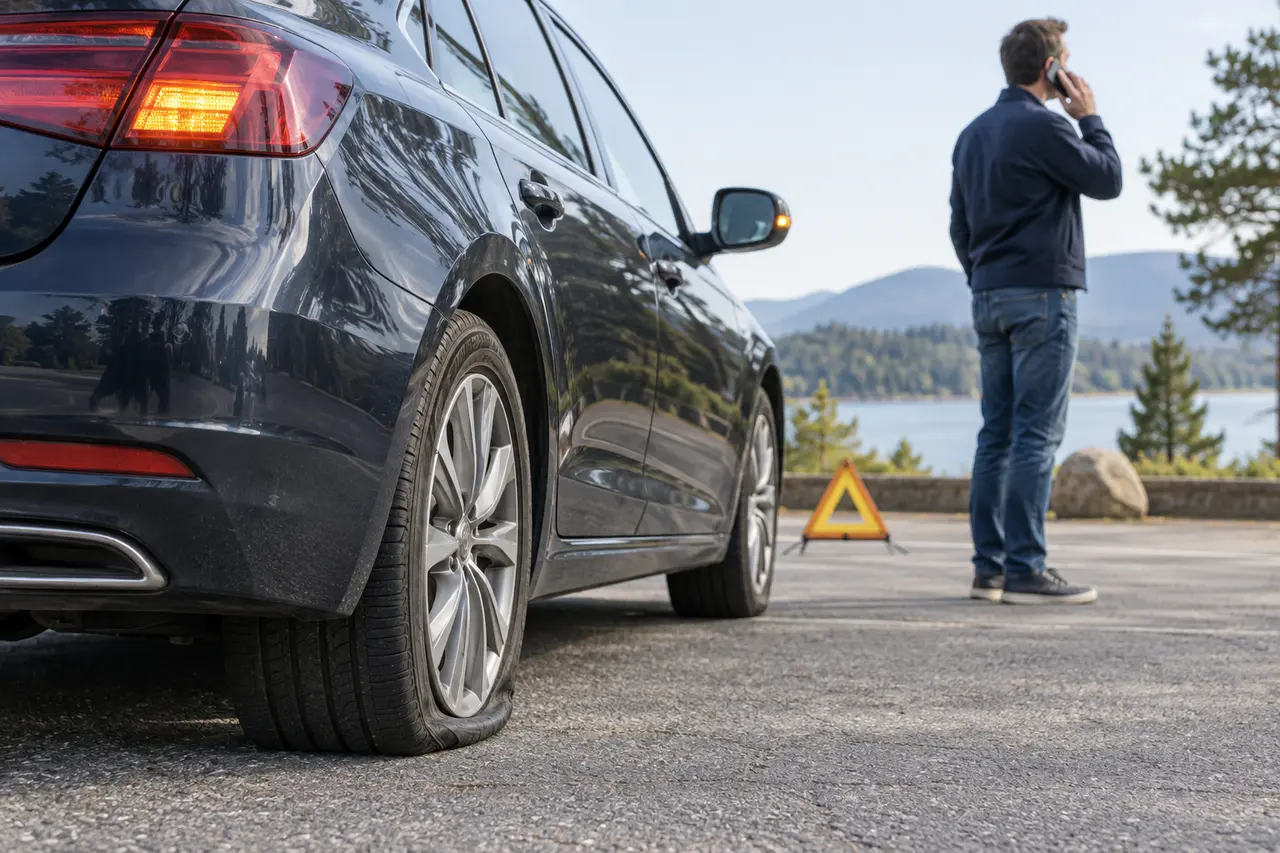
No, you should not continue driving on a standard flat tire. If the vehicle is exposed to moving traffic, use slow and controlled movement only to reach the nearest protected stopping place. Then install an approved spare, use the vehicle's permitted mobility system, or call roadside assistance.
A tire carries the vehicle through pressurized air and a flexible structure. When most or all pressure is lost, the sidewall folds under the wheel. Even a short trip can turn a repairable puncture into a destroyed tire, damaged wheel, or loss-of-control problem.
What Happens If You Drive on a Flat Tire?
The unsupported sidewall flexes far beyond its normal range. That repeated bending creates heat and can break internal cords. The inner liner may crease, the bead can shift away from the rim, and the wheel can strike the pavement. The tire may look less damaged after it is reinflated, but hidden structural damage can remain.
Vehicle control can also change. A flat front tire may make the steering pull or respond slowly. A flat rear tire can reduce stability, especially during a turn or lane change. Braking distance and anti-lock brake operation may be affected because one wheel no longer has a normal contact patch.
How Far Can You Move the Car?
There is no safe general mileage allowance for a standard flat tire. The useful rule is distance to safety, not distance to a repair shop. If you are stopped in a live lane, on a blind curve, or beside another immediate hazard, move at walking speed only as far as needed to reach a shoulder, turnout, parking lot, or other protected area.
Stop sooner if the wheel grinds, the tire separates, the steering pulls sharply, the vehicle shakes, or you smell hot rubber. If controlled movement is not possible, stay in the safest available place, turn on the hazard lights, and contact emergency or roadside services.
Standard Tires and Run-Flat Tires Are Different
| Tire condition | What it permits | What to do |
|---|---|---|
| Standard tire with no pressure | No normal travel allowance | Move only to escape immediate danger |
| Run-flat tire after pressure loss | Limited mobility when the exact product and vehicle conditions are met | Follow the lowest stated speed and distance limit |
| Temporary spare installed | Limited travel under the spare and vehicle instructions | Drive directly to service |
| Sealant and inflator used | Temporary mobility for eligible punctures only | Observe kit limits and tell the technician sealant was used |
Do not assume a tire is run-flat because it still holds its shape. Confirm the sidewall marking and check the owner manual. Run-flat capability can be lost after impact, sidewall damage, overload, or travel outside the approved limit.
What Should You Do When a Tire Goes Flat?
- 1Keep the vehicle stable
Hold the wheel firmly, ease off the accelerator, and avoid a hard brake application.
- 2Reach the nearest safe place
Signal and use smooth inputs. Do not cross several lanes just to reach a preferred location.
- 3Secure the car
Choose firm, level ground, apply the parking brake, and keep passengers away from traffic.
- 4Check the tire and equipment
Look for separation, smoke, a bent wheel, a usable spare, the correct jack, and the wheel-lock key.
- 5Select the safe recovery method
Use the approved spare or mobility kit only as instructed. Call for a tow when the location or damage is unsafe.
When Is Towing the Better Choice?
- The tire is off the rim: further movement can damage the wheel and suspension.
- The sidewall is cut or shredded: an inflator or sealant cannot restore the tire's structure.
- The wheel is bent or cracked: a spare may not seat or clamp correctly.
- The vehicle has no compatible spare: do not borrow a wheel based only on bolt count.
- The shoulder is narrow, soft, sloped, or exposed: the location is not suitable for lifting a vehicle.
- There is collision damage, smoke, leaking fluid, or fire risk: contact emergency services and keep away.
Can the Flat Tire Still Be Repaired?
Possibly. A small puncture in the repairable tread area may qualify, but the tire must come off the wheel so a technician can inspect the inner liner and sidewall. A tire that was driven with very low or zero pressure may have hidden damage even when the nail hole itself is small.
USTMA tire-repair guidance explains that an eligible puncture requires an internal inspection and a repair that fills the injury and seals the inner liner. A plug inserted from the outside is not a complete permanent repair.
How Can You Reduce the Risk of Another Flat?
Check all tire pressures when cold at least monthly and before long trips. Use the pressure on the vehicle placard or in the owner manual, not the maximum pressure molded on a regular road tire. Inspect tread, sidewalls, valve stems, and wheels for nails, cracks, bulges, or impact damage.
Respond to the tire-pressure warning promptly. NHTSA TireWise guidance notes that an illuminated TPMS symbol means at least one tire is significantly underinflated and should be checked as soon as possible.
Related Flat-Tire Guides
Quick answers
Frequently Asked Questions
How far can you drive on a flat tire?
A standard flat tire is not meant to be driven on. Move only the shortest controlled distance needed to leave immediate danger, then stop.
Can you drive slowly to a tire shop on a flat?
No. Low speed does not prevent the unsupported sidewall from flexing, heating, and being crushed between the wheel and road.
Can driving on a flat tire damage the rim?
Yes. Once the tire can no longer support the vehicle, the rim may contact the road and can bend, crack, or lose its sealing surface.
Is it safe to drive on a run-flat tire?
Only within the exact speed, distance, load, and damage limits stated by the vehicle and tire manufacturers.
Can a tire be repaired after it was driven flat?
Sometimes, but only after the tire is removed and inspected internally. Creasing, heat damage, exposed cords, or liner damage usually means replacement.