
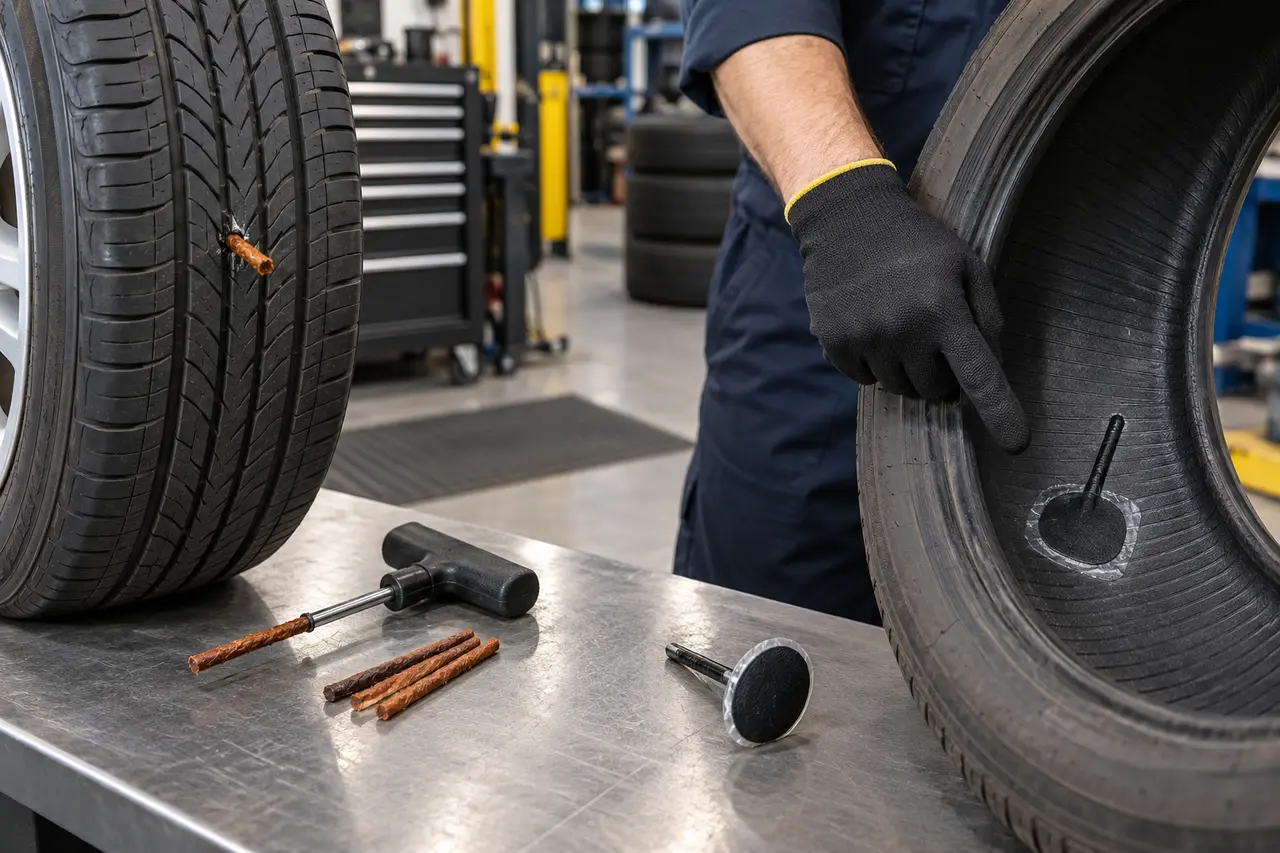
A tire plug fills the puncture channel, while a patch seals the inner liner. Neither job is complete by itself. For an eligible tread puncture, accepted industry guidance calls for removing the tire, inspecting it internally, filling the injury with a rubber stem, and sealing the inner liner with a patch.
Tire Plug vs Patch Comparison
| Method | What it does | Main limitation |
|---|---|---|
| Outside plug only | Pushes repair material into the puncture from outside | Does not permit full internal inspection or reliably seal the inner liner |
| Inside patch only | Covers the injury on the inner liner | Leaves the puncture channel open to moisture and contamination |
| Plug and patch | Fills the channel and seals the liner | Works only for eligible injuries in a sound tire |
| Sealant kit | May slow an eligible leak temporarily | It is mobility equipment, not a full structural repair |
Why Is a Plug Alone Not a Complete Repair?
An outside plug can stop or slow air loss, but it does not show whether the tire was damaged internally. It may also leave part of the inner liner unsealed. Air or moisture can move through the injury path and contribute to corrosion of steel components or separation around the puncture.
A roadside plug may be marketed as an emergency measure, but product instructions vary. If it is used to leave a dangerous location, treat it as temporary and have the tire removed and inspected as soon as possible. Do not assume that the absence of bubbles means the tire is structurally sound.
Why Is a Patch Alone Incomplete?
A patch bonds to the prepared inner liner and restores the air seal at that surface. However, a simple patch does not fill the puncture channel through the tread. The open path can collect water, dirt, and road chemicals. It can also make it harder to confirm that the full injury was prepared correctly.
The safest recognized approach for a repairable puncture is to perform both functions. USTMA repair guidance states that the injury must be filled with a plug or stem and the inner liner must be sealed with a patch. A molded combination unit can do both in one component.
Which Punctures Can Be Repaired?
A repair starts with eligibility, not with the repair material. For a passenger or light-truck tire, the injury generally must be a small puncture in the repairable tread area. USTMA materials use a maximum diameter of 1/4 inch, or 6 mm, for this category, but the tire maker may set tighter restrictions.
- Repairable area: the injury is fully within the permitted tread crown.
- Permitted size: the hole does not exceed the applicable limit.
- Sound casing: the liner, cords, bead, and sidewalls show no structural damage.
- No damaging run-flat history: the tire was not crushed or overheated by driving without pressure.
- No overlapping repair: the new repair will not interfere with an existing repair.
- Manufacturer approval: the tire type and service category allow repair.
How Is a Professional Combination Repair Done?
- 1Remove the tire
The wheel assembly is taken off the vehicle and the tire is demounted.
- 2Inspect inside and outside
The technician checks the injury, liner, cords, sidewalls, bead, prior repairs, and run-flat damage.
- 3Prepare the puncture
The injury channel and liner are cleaned and prepared with compatible tools and materials.
- 4Fill and seal
A stem fills the channel and a patch seals the inner liner.
- 5Finish and verify
The tire is remounted, inflated, leak-checked, balanced when needed, and installed to vehicle specifications.
This is trained service work. Incorrect reaming, contamination, patch placement, bead handling, inflation, or wheel installation can create a new failure.
When Should You Replace Instead?
Replace the tire for a shoulder or sidewall puncture, long cut, impact break, bulge, exposed cord, bead damage, separation, unsafe prior repair, or evidence of being driven flat. Replacement is also appropriate when the tire has inadequate tread, serious cracking, or another condition that makes continued service unreasonable.
Run-flat and high-performance tires may have product-specific repair policies. Give the shop the tire brand, model, size, speed rating, and pressure-loss history so it can apply the correct policy.
What Should You Do at the Roadside?
Do not pull out a nail or screw while the tire is still holding useful pressure. It may be slowing the leak. Move to a safe place, check pressure with a gauge, and use the approved spare or mobility kit. Call for service when the tire is losing air quickly, visibly damaged, or exposed to traffic.
Related Flat-Tire Guides
Quick answers
Frequently Asked Questions
Is a tire plug a permanent repair?
A plug inserted from the outside by itself is not considered a complete permanent repair under USTMA guidance.
Is a patch alone enough?
A patch seals the inner liner but does not fill the puncture channel, so it is not a complete repair by itself.
What is a plug-patch combination repair?
It is a repair that fills the puncture path with a rubber stem and seals the inner liner with a patch.
Can a tire plug be used on a sidewall?
No. Sidewall and shoulder injuries are outside the normal repairable tread area.
Must a tire be removed before repair?
Yes. The tire must be removed so its interior and the full injury can be inspected before a permanent repair decision.