
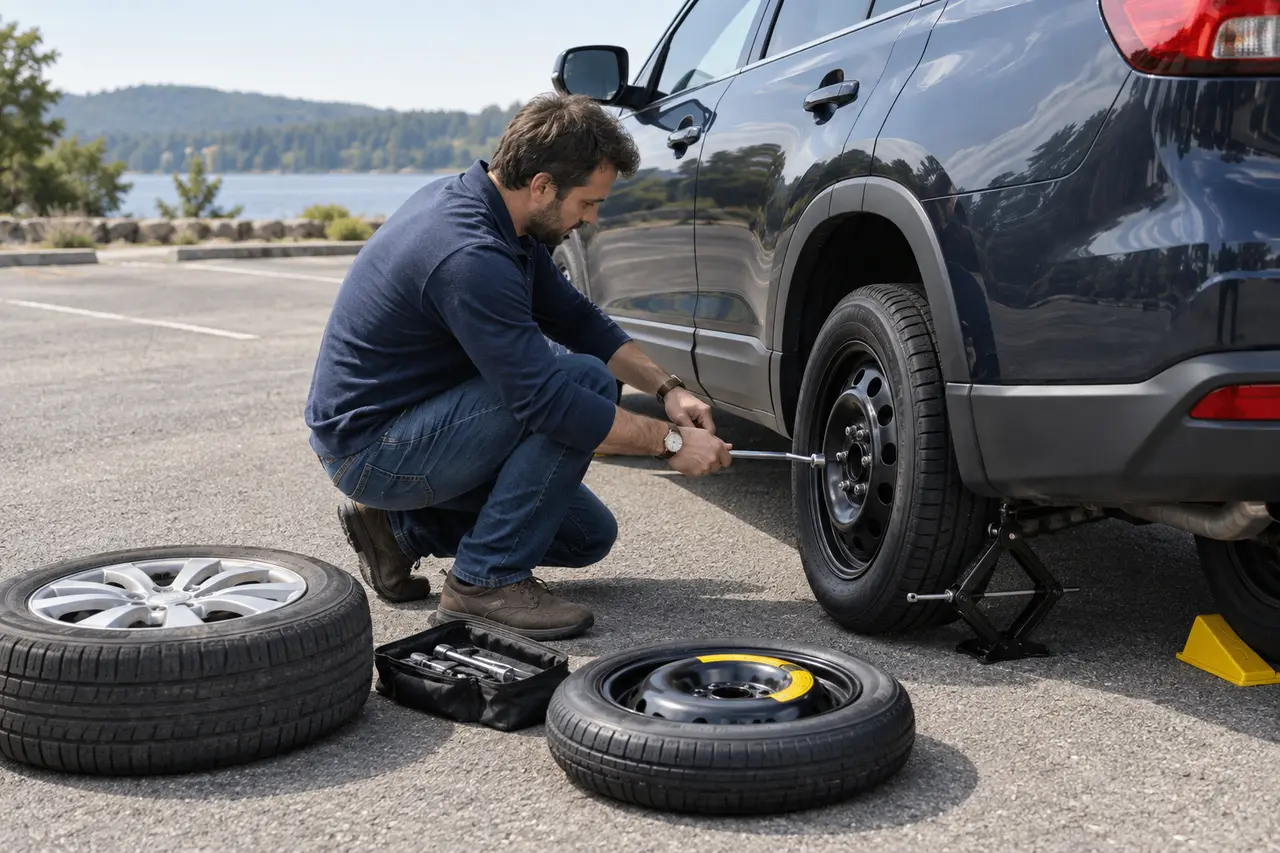
Changing a tire commonly takes 15 to 30 minutes for a prepared driver in safe conditions. A first attempt may take 30 to 60 minutes. The complete roadside event can take longer because finding a safe location, unloading tools, handling stuck parts, and checking the spare are part of the job.
The shortest time is not the safest target. A stable surface, correct jack placement, controlled wheel fastening, and final pressure checks matter more than speed. Leave the vehicle in a protected location and request roadside assistance when traffic, weather, terrain, or equipment makes the task unsafe.
What Is a Realistic Tire-Change Timeline?
A prepared driver can use the following ranges for planning. They are estimates, not deadlines. Vehicle design and site conditions can change every stage.
| Stage | Typical time | Main task |
|---|---|---|
| Location assessment | 2–10 minutes | Move away from traffic and confirm firm, level ground |
| Vehicle setup | 3–6 minutes | Apply brake, place chocks, unload spare and tools |
| Loosen and lift | 3–8 minutes | Break fasteners loose and raise at the approved point |
| Swap wheels | 4–8 minutes | Remove the flat, mount the spare, install fasteners |
| Lower and check | 3–8 minutes | Tighten in sequence, check pressure, store equipment |
These stages can overlap for an experienced technician, but they should not be skipped. The time needed to wait for traffic conditions, move occupants to safety, or call emergency support is more important than the mechanical estimate.
Why Can a First Tire Change Take 30 to 60 Minutes?
A first-time driver spends more time locating the spare, jack, wheel-lock key, and reinforced lift points. Reading the manual is part of the process. The driver may also need to learn how the jack handle connects and how the spare is released from its storage location.
Practice on a level driveway or private parking area removes many of these unknowns. A supervised practice session should focus on tool identification and vehicle preparation. There is no need to rush or work near moving traffic. If lifting the vehicle during practice is not appropriate, inspect the manual and equipment without performing the full change.
Physical ability also affects timing. Wheels can be heavy, and loosening fasteners requires controlled force. A person who cannot maintain a stable working position or safely handle the wheel should use roadside assistance.
Which Conditions Add the Most Time?
An unsafe stopping place can add the most time because the vehicle may need to be moved or towed before any wheel work begins. A narrow shoulder, curve, steep grade, soft ground, ice, darkness, heavy rain, or poor visibility is a safety problem, not a reason to work faster.
Vehicle storage design is another factor. Some spares sit beneath the cargo floor, under the vehicle, or behind interior panels. Luggage may need to be moved. Underbody spare carriers can corrode or collect road debris. Learn the release procedure before a trip.
Low spare pressure creates a delay and may prevent the change entirely. Check the spare before lifting. A compatible portable inflator can help when the spare is otherwise undamaged, but inflation time depends on tire size and inflator output.
How Do Stuck Lug Nuts and Wheels Affect the Schedule?
Overtightened, corroded, or damaged fasteners can turn a short task into an unsuccessful one. Use the correct wrench and apply steady, controlled force while the flat tire remains on the ground. Do not jump on the wrench or use an unstable extension. Stop if the tool slips or the fastener begins to round.
A wheel can remain attached after the fasteners are removed because corrosion binds it to the hub. Follow the vehicle manufacturer’s guidance. Do not crawl beneath the raised vehicle, strike the wheel in a way that can destabilize the jack, or place hands under the vehicle.
A missing wheel-lock key causes a complete stop when a locking nut or bolt is present. Professional removal may require special equipment. Keep the matching key in a fixed, labeled location with the tire-change tools.
Does Vehicle Type Change the Time?
Yes. A small passenger-car wheel is often easier to handle than a large sport utility vehicle or truck wheel. Larger vehicles may require more jack travel and higher-capacity tools. Electric vehicles can have specific lift restrictions, and some vehicles require suspension settings or other steps before lifting.
Vehicles with spare tires mounted underneath or externally may need additional release steps. Cars with run-flat tires or mobility kits use a different response. Read the model-specific procedure instead of assuming that the same timing applies to every vehicle.
How Long Does Roadside Assistance Need?
A technician may complete a straightforward wheel swap in approximately 10 to 20 minutes after arriving. The total service time includes dispatch and travel, so it depends on traffic, weather, location accuracy, call volume, and provider availability. A tow is required when the car has no usable spare, has multiple damaged tires, has wheel or suspension damage, or cannot be serviced safely where it stopped.
Provide a precise location, vehicle description, damaged-tire position, spare status, and any access restrictions during the call. Mention a highway lane, bridge, tunnel, or other immediate hazard first. Follow emergency-service instructions if the vehicle is exposed to traffic.
How Can You Reduce Tire-Change Time Safely?
- Inspect the kit: verify the spare, jack, wrench, wheel-lock key, gauge, and chocks before travel.
- Read the manual: mark the lift-point and spare-limit pages or save an offline copy.
- Organize the cargo area: keep emergency tools accessible rather than beneath loose luggage.
- Check spare pressure: include it in monthly checks and pre-trip inspections.
- Practice calmly: learn the equipment on private, firm, level ground in daylight.
- Carry lighting: a charged headlamp is faster and safer than holding a phone as a light.
Preparation removes searching and uncertainty. It does not justify changing a tire in an exposed location. Review the full list of tools needed to change a tire and the separate roadside safety guide.
What Happens After the Spare Is Installed?
The job is not complete when the vehicle reaches the ground. Tighten the fasteners in the sequence and to the torque specified by the manufacturer. Confirm spare pressure, store every tool securely, and check that no object remains near the vehicle.
Read the compact spare’s speed, distance, and position restrictions. Drive smoothly to professional service. Have the damaged tire assessed and the wheel fastener torque confirmed. A temporary spare is a short-term mobility device, not a substitute for a normal tire.
Is Speed Ever a Good Reason to Skip a Step?
No. Do not omit wheel chocks, use an unapproved lift point, raise the vehicle before loosening fasteners, or leave tightening incomplete to save minutes. Do not change the tire beside fast traffic because help may take longer.
Use the complete tire-changing sequence for the mechanical procedure. If you are deciding whether to proceed, read can you change a tire yourself. The right time estimate begins only after the location, vehicle, tools, and driver are ready.
Quick answers
Frequently Asked Questions
Can a tire be changed in 10 minutes?
Yes, an experienced person with ready tools may complete a straightforward wheel change in about 10 minutes on a safe, level surface. Roadside assessment, stuck fasteners, spare access, and final checks often make the total time longer.
How long does a first tire change take?
A first tire change may take 30 to 60 minutes in controlled conditions because the driver must identify lift points, arrange tools, and check each step. Stop and request help if the location or procedure becomes unsafe.
How long does roadside assistance take to change a tire?
The physical wheel change may take a trained technician about 10 to 20 minutes when conditions are straightforward. The total wait depends on location, traffic, weather, demand, and whether the vehicle needs towing instead.
What makes a tire change take longer?
Common delays include a buried spare, low spare pressure, locking fasteners, corroded lug nuts, a wheel stuck to the hub, poor lighting, difficult jack access, heavy wheels, and an unsafe roadside location..
Does replacing a tire take longer than changing a spare?
Yes. Replacing the rubber tire requires shop equipment to demount and mount the tire, inspect components, inflate it safely, and balance the assembly. Changing a spare normally swaps the complete wheel and tire assembly.